What the Job Is and What Is Included
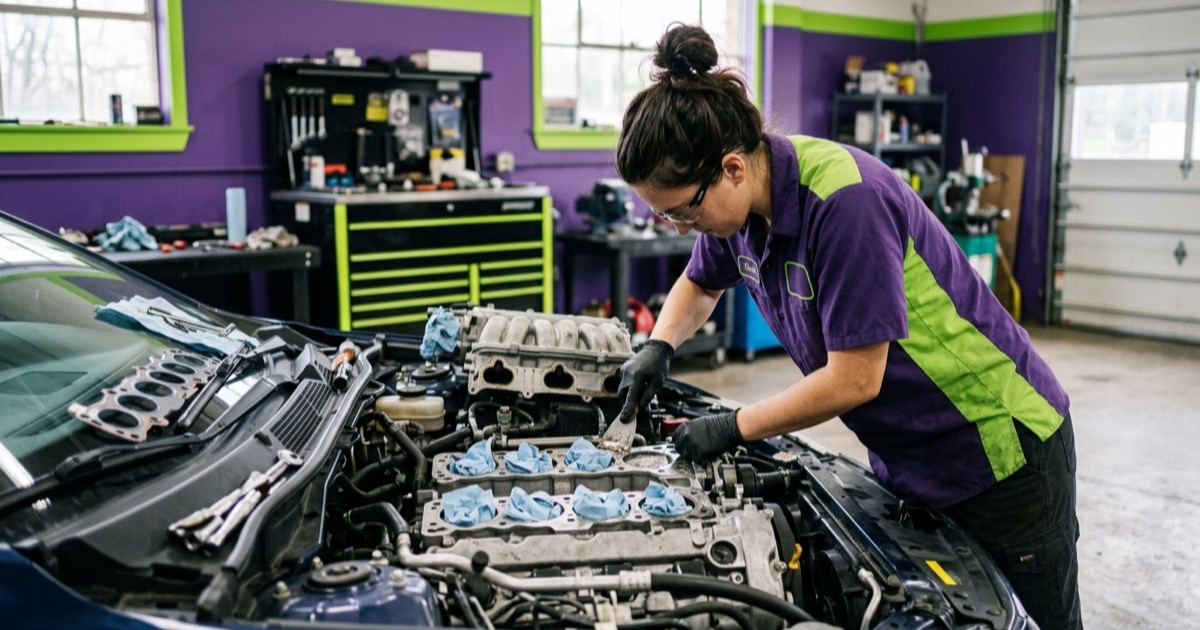
The intake manifold bolts to the side or top of the cylinder heads. Air comes in through the air filter and throttle body, flows into the manifold, and gets split into a runner for each cylinder. The gaskets seal those runners to the heads.
On most four cylinder engines the manifold is plastic and only carries air. On many V6 and V8 engines the lower manifold also carries coolant between the heads. That is why some intake gasket failures leak air and others leak coolant.
A proper job means disconnecting the battery, relieving fuel pressure, and removing the air intake tube, throttle body connections, vacuum hoses, sensors and wiring. On many engines the fuel rail and injectors come off too. If the manifold carries coolant, the cooling system is drained first.
Then the manifold comes off, both sealing surfaces are cleaned, and new gaskets go on. The bolts are torqued in the factory order. Then everything is reconnected, the cooling system is refilled and bled of air if it was opened, and the engine is checked for leaks.
The price should include the gasket set, any coolant, throttle body and injector seals that were disturbed, and all the labor to get there.
Why the Price Varies
The engine layout is the big one. A four cylinder with a plastic air only manifold on the front of the head can be a two hour job. A V6 or V8 with the manifold in the valley between the heads, sensors on top, and coolant passages inside can take five or six.
Some V6 engines have two manifolds. The upper plenum sits on top, and the lower manifold sits under it against the heads. A leak in the upper gasket is cheap. A leak in the lower one costs more because both have to come off.
Coolant adds cost. When the gasket carries coolant, the shop drains and refills the system, uses new coolant, and bleeds the air out. That adds parts and time.
Cracked manifolds change the quote. On some engines the plastic manifold itself cracks or warps, often around a coolant crossover or a mounting point. Then you are buying a manifold, not just a gasket, and the parts cost jumps.
Shop type matters. Dealers charge the most. Independents charge less and use quality gasket sets. Many mobile mechanics handle intake gaskets on common engines in a driveway.
What Usually Gets Done at the Same Time
The top of the engine is open, so some parts are cheap to add. Others are not needed.
Always worth it are the throttle body gasket and any injector O rings or seals that were disturbed. They are cheap, and a reused seal is a common cause of a new vacuum or fuel leak.
Worth it if the cooling system is drained is fresh coolant. Some shops also suggest a thermostat while the coolant is out. That is a fair add on if your thermostat is old or the car runs cool or hot.
Worth it if they are cracked are vacuum hoses and the PCV hose. Rubber that has been near engine heat for years gets hard. A cracked hose can cause the same lean code you were trying to fix.
Worth it if it is buried under the manifold, depending on your engine, is a knock sensor or other sensor that sits in the valley. Ask the shop if anything known to fail lives under your intake.
Usually an upsell is a full fuel system cleaning or a throttle body service with a big price tag. A quick wipe of the throttle body while it is off is fine.
- Throttle body gasket and injector seals: always
- Coolant: yes if the system was drained
- Thermostat: only if old or acting up
- Brittle vacuum and PCV hoses: yes if cracked
- Parts buried under the manifold: ask what lives there on your engine
- Fuel system cleaning package: usually skip
How to Tell If You Really Need It
An intake gasket that leaks air causes a vacuum leak. The engine gets air the computer did not measure, so it runs lean. Common signs are a rough or high idle, a hissing sound, hesitation, and lean codes like P0171 and P0174.
Lots of things cause the same codes. A cracked vacuum hose, a torn intake boot after the airflow sensor, a dirty mass air flow sensor, a bad PCV valve or hose, a weak fuel pump or clogged fuel filter, and leaking injectors can all look the same on a scanner.
The best test is a smoke test. The tech pumps harmless smoke into the intake and looks for where it comes out. If smoke pours from the manifold seam, the gasket is your problem. A smoke test costs far less than guessing.
An intake gasket that leaks coolant shows different signs. Look for coolant crust on the side of the manifold, a sweet smell, a falling coolant level, or milky brown oil on the dipstick or cap.
Milky oil can also mean a head gasket. A cooling system pressure test, a look at where the coolant goes, and sometimes a combustion gas test sort out which one it is. Make sure the shop does those tests before quoting either job.
Questions to Ask Before You Approve the Quote
These questions help you confirm the diagnosis and compare two quotes fairly.
- Did you smoke test the intake, and where did the smoke come out?
- Is my gasket leaking air, coolant, or both?
- If coolant is involved, did you rule out the head gasket?
- Does my engine have an upper and lower manifold, and which gaskets are in the quote?
- Is the manifold itself cracked or warped?
- Does the price include new injector seals, throttle body gasket and coolant?
- If oil has coolant in it, will you change the oil and filter after the repair?
- What is the warranty on parts and labor?
Can a Mobile Mechanic Do It?
Often, yes. Intake gasket work happens on top of the engine, so it does not need a lift. A mobile mechanic with a torque wrench, a smoke machine and a good scan tool can do most four cylinder and many V6 and V8 intake jobs in a driveway.
The harder versions are engines with the intake under the cowl or under turbo plumbing, and jobs where coolant got into the oil. Those may need more time, more fluid handling and a follow up oil change, which a shop can do more easily.
Ask the mechanic if they own a smoke machine. A mechanic who smoke tests before replacing anything is the one you want.
How to Make the Repair Last
Clean surfaces and correct torque are what make a gasket seal. A good tech cleans both faces, checks a plastic manifold for warp, and torques the bolts in the right order.
Use the right coolant. Mixing coolant types or running old coolant can attack gaskets and form deposits. Use the type your owner manual lists and change it on schedule.
Keep the engine from overheating. Heat is hard on plastic manifolds and gaskets. Fix cooling problems early.
If coolant got into the oil, change the oil again after a few hundred miles. That flushes out what is left and gives the bearings clean oil.
Signs you need this repair
- Check engine light with lean codes such as P0171 or P0174
- Rough idle, high idle or an idle that hunts up and down
- Hissing or whistling sound from the top of the engine
- Coolant level dropping with crust or wet spots around the intake
- Milky or light brown oil on the dipstick or under the oil cap
- Engine running hot or the temperature gauge climbing
- Hesitation or stumbling when you press the gas
Cost by vehicle type
| Vehicle | Typical range | Notes |
|---|---|---|
| Compact / economy car | $225 to $1,095 | Most four cylinder compacts have a plastic manifold on the front or back of the head with no coolant passages. Labor is often two to three hours. |
| Midsize sedan / small SUV | $230 to $1,140 | Four cylinder versions price like compacts. V6 versions often have an upper and lower manifold, and some lower gaskets carry coolant, which adds a coolant drain and refill. |
| Full-size truck / large SUV | $260 to $1,300 | V8 trucks have the manifold in the valley between the cylinder heads. The job is roomy but long, and some engines have a coolant crossover that is a known leak point. Expect the middle to upper part of the range. |
| Luxury / European | $310 to $1,570 | Many European engines pack the intake tight against the firewall with lots of sensors, and some use manifolds with built in flaps that fail and are replaced as a whole part. OEM parts cost more. |
| Hybrid | $255 to $1,255 | Same job as the gas version of the engine. The shop should follow the factory high voltage safety steps if the inverter or orange cables sit near the intake. |
| Electric vehicle | Electric cars do not take in air for combustion, so they have no intake manifold or intake gasket. | |
| Diesel / heavy duty | $305 to $1,540 | Diesel intakes run under boost and often carry soot, and on some trucks the intake sits under the turbo or EGR plumbing. Labor runs toward the top of the range. |
Ranges assume national-average labor rates ($95, $140/hr) and quality aftermarket parts.
Cost by state
State ranges reflect typical independent-shop labor rates for a midsize vehicle.
Common questions
How much does it cost to replace an intake manifold gasket?
Most drivers pay about $230 to $1,150 at an independent shop. Four cylinder engines with an air only manifold sit near the low end. V6 and V8 engines with a lower manifold that carries coolant sit near the top, and a cracked manifold or a dealer adds more.
Can I drive with a bad intake manifold gasket?
If it is a small vacuum leak, yes, for a short time, though the engine will run rough and use more fuel. If it leaks coolant, especially into the oil, stop driving and fix it, because coolant in the oil can destroy the engine bearings and a low coolant level can overheat the engine.
What are the signs of a bad intake manifold gasket?
The most common signs are a rough idle, a hissing sound, lean codes like P0171 or P0174, and poor acceleration. If the gasket carries coolant, you may also see coolant loss, a sweet smell, overheating, or milky oil.
Is an intake manifold gasket the same as a head gasket?
No. The intake gasket seals the air intake to the cylinder heads, while the head gasket seals the cylinder heads to the engine block. Both can leak coolant into the oil, but a head gasket job costs much more. Ask the shop to test for which one it is.
How long does an intake manifold gasket replacement take?
About two to six hours. Four cylinder engines with simple access take two or three. V6 and V8 engines with upper and lower manifolds and coolant passages take most of a day.
Will stop leak fix an intake manifold gasket?
Usually not for long. A cooling system stop leak can slow a small external coolant seep, but it does not fix an air leak, and it can clog the radiator and heater core. Fix the gasket instead.
Is an intake manifold gasket worth fixing on an old car?
Yes, in most cases. It is far cheaper than an engine, and a coolant leak left alone can ruin the engine. On a simple four cylinder the repair is a few hundred dollars, which is often worth it even on an older car.
Related Repair Guides
More Engine Repair Costs
Sources and further reading
Primary sources behind this page. Federal safety, emissions and consumer-protection references, worth reading before you authorize any repair.
- EPA vehicle emissions inspection and maintenance How state emissions programs use the check engine light, which a vacuum leak can trip.
- fueleconomy.gov maintenance guide DOE and EPA advice on how engine problems and a check engine light affect fuel use.
- SAE International The engineering body behind standard diagnostic trouble codes such as lean codes.
Need Work Done? Get a Free Quote.
Tell us what the car is doing. A local mechanic calls you back, most requests get a call back the same day. No fee, no obligation.