
What you're actually paying for
An alignment is unusual among car repairs: there are no parts. The entire price is labor and machine time — your car goes on a calibrated alignment rack, sensors clamp to each wheel, and a technician adjusts the suspension angles until they match the factory specifications for your exact vehicle. Most shops charge a flat rate for this rather than hourly, typically $75 to $200, and the job takes about 45 minutes to an hour and a quarter when nothing is seized or worn.
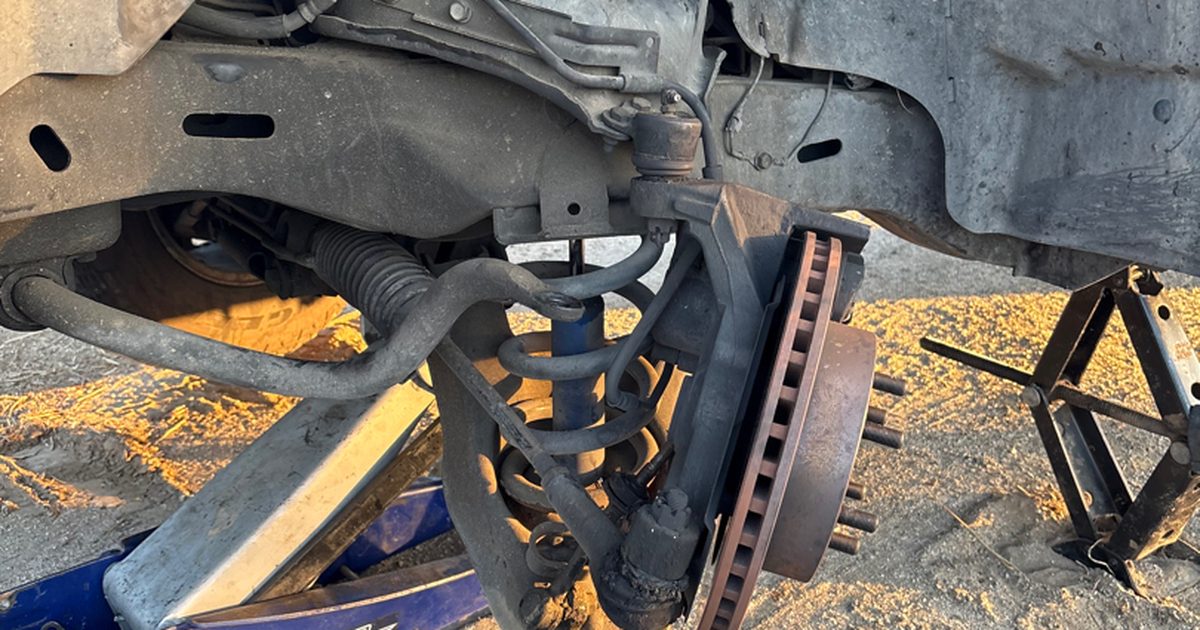
This is also one of the few services that genuinely requires a shop. A mobile mechanic can inspect your suspension, confirm that you need an alignment, and fix the worn parts that caused the problem — but the alignment itself needs a rack that costs tens of thousands of dollars and sits bolted to a shop floor. There is no driveway version of this job.
What alignment actually adjusts: toe, camber, and caster
Three angles get measured, and each one misbehaves differently when it's off.
Toe is whether the tires point slightly toward each other or away from each other when viewed from above, like feet that are pigeon-toed or duck-footed. Toe is the big tire-killer: even a small toe error drags the tread sideways across the pavement with every rotation, sawing off rubber. It's also the most commonly knocked-out angle and, luckily, adjustable on nearly every car.
Camber is the inward or outward tilt of the tire viewed from the front. Too much tilt wears one edge of the tread — inner edge for negative camber, outer edge for positive — and a camber difference side-to-side makes the car pull toward one side.
Caster is the angle of the steering pivot viewed from the side, like the raked front fork on a motorcycle. Caster doesn't wear tires much, but it controls straight-line stability and how the steering wheel returns to center. Uneven caster causes a pull; low caster makes the car feel wandery and nervous at highway speed.
In short: pulls usually mean camber or caster, rapid or uneven tire wear usually means toe, and a crooked steering wheel means the toe is split unevenly between the two sides.
Two-wheel vs. four-wheel alignment
A two-wheel (front-end) alignment adjusts only the front wheels. A four-wheel alignment measures all four and adjusts everything that's adjustable, setting the fronts relative to the actual thrust line of the rear wheels.
Almost every modern car should get a four-wheel alignment. Any vehicle with independent rear suspension — which is most cars, crossovers, and SUVs built in the last two decades — has rear toe that can drift out of spec and rear angles that affect how the whole car tracks. If the rear wheels are steering the car slightly sideways, aligning only the front just centers the steering wheel around a crooked baseline.
The two-wheel alignment still has a legitimate place: trucks and older vehicles with a solid rear axle, where nothing in back is adjustable anyway. Even then, a good shop measures the rear to confirm the axle isn't shifted or bent before setting the front. If a shop quotes you a cheap front-end alignment on a car with independent rear suspension, that's a corner being cut, not a deal.
What knocks a car out of alignment
Alignment doesn't drift much on its own — something moves it. The usual suspects are potholes hit at speed, curb strikes while parking, and railroad tracks or speed bumps taken too hard. One solid hit can bend a tie rod or shift the toe enough to start eating a tire.
Worn parts do it gradually: as ball joints, tie rod ends, and control arm bushings loosen up, the wheel angles wander under load even if they measure fine on the rack. Sagging springs change ride height, which changes camber and toe along with it.
And here's the rule most owners don't know: any suspension or steering repair should be followed by an alignment. New struts, tie rods, control arms, ball joints — replacing any of them disturbs the angles, and on many cars the strut-to-knuckle bolts are the camber adjustment. If a shop replaces your struts and doesn't recommend an alignment afterward, that's a red flag about the shop, not a money-saver.
What a good alignment includes — and what to ask for
A proper alignment starts with a check of tire pressures and a quick inspection of the steering and suspension for play, because worn parts make the numbers meaningless. Then the car goes on the rack, the sensors go on the wheels, and the machine prints the before readings.
Always ask for the before-and-after printout. Every modern alignment machine produces one, showing each angle in red or green against the factory spec range. The before numbers prove what was wrong; the after numbers prove it was fixed. A shop that won't hand you the printout is a shop to be suspicious of — some places sell alignments after doing nothing but a check.
The job should end with the steering wheel locked straight while the toe is set, so the wheel is centered when you drive straight, and a short test drive to confirm the car tracks true. If you get the car back and the steering wheel sits off-center on a straight road, take it back — that's a redo, not a new charge.
Why the price varies
Most alignments are flat-priced between $75 and $200. The spread comes from the shop's market and equipment, and from your car. A basic economy car with front toe as the only adjustment is quick; a luxury or performance car with adjustable camber and caster at both ends takes longer and often carries a higher flat rate. Cars with air suspension or adaptive dampers may need to be set to a specific ride-height mode before measuring, which adds steps.
Newer cars add one more wrinkle: ADAS. If your car has lane-keeping assist or adaptive cruise, the forward camera and radar are aimed relative to the thrust line of the car — and a meaningful alignment change can require a camera or radar calibration afterward. That calibration can add anywhere from $100 to several hundred dollars, and not every alignment shop can do it. Ask up front if your car is a late model with driver-assist features.
Lifetime alignment packages (some chains sell them for roughly $200) can be genuinely good math — but only for certain owners. If you keep the car for years, drive rough roads, or run a lowered or lifted vehicle that needs frequent checks, two visits pay it off. If you trade cars every couple of years or drive smooth highways, a single alignment when needed is cheaper. Check whether the package transfers if you sell the car; most don't.
The worn-parts gotcha
Here's the scenario that makes people feel upsold: you come in for a $100 alignment, and the shop comes back with a quote for tie rods or ball joints first. Nine times out of ten, that's honesty, not a hustle.
An alignment machine measures angles at one moment, with the car sitting still. If a ball joint or tie rod end has play in it, the wheel flops within that play the moment you drive off, and the fresh alignment is gone — you paid for numbers that lasted until the end of the parking lot. Reputable shops refuse to align over worn parts for exactly this reason, and many will refund or credit the alignment check toward the repair.
How to tell honesty from upsell: ask them to show you. Play in a tie rod end or ball joint is physically demonstrable — the tech can put a bar under the tire or grab it at 3 and 9 o'clock and let you watch it move. A legitimate finding survives a second opinion, so if the list of parts feels long, getting one is fair and any good shop will understand. But do get the worn parts fixed and then aligned; the sequence matters, and it's always parts first, alignment second.
Signs you need this repair
- The car pulls or drifts to one side on a flat, straight road
- The steering wheel sits off-center or crooked when driving straight
- Tires wearing on the inner or outer edge instead of evenly across the tread
- The car feels wandery or nervous at highway speed, needing constant small corrections
- Tires squeal in normal-speed turns
- Steering feels or tracks differently right after hitting a pothole or curb
- New tires start showing uneven wear within a few thousand miles
Cost by vehicle type
| Vehicle | Typical range | Notes |
|---|---|---|
| Compact / economy car | $75 to $180 | The cheapest cars to align — simple suspensions, and most only have rear toe or nothing adjustable in back, so a basic alignment covers it. |
| Midsize sedan / small SUV | $75 to $180 | Routine four-wheel alignment territory. Most have adjustable rear toe, so skip the two-wheel option. |
| Full-size truck / large SUV | $85 to $200 | Lifted or leveled trucks can't use factory specs — they need a shop that knows how to set custom angles for the new ride height, and it may take extra time or aftermarket cam bolts. |
| Luxury / European | $100 to $235 | Often the most expensive alignments. Tight tolerances, more adjustable angles, and some air-suspension and adaptive-damper systems must be put in a specific ride-height mode before measuring. |
| Hybrid | $85 to $200 | No different from the gas version of the same car — standard alignment procedure and pricing. |
| Electric vehicle | $85 to $210 | The heavy battery pack and instant torque chew through misaligned tires fast — a toe error that costs a gas car a few thousand miles of tread can ruin an EV tire in months. Don't put this off on an EV. |
| Diesel / heavy duty | $100 to $235 | Heavy-duty front ends (especially solid-axle trucks) use different adjustment methods and bigger equipment; expect the higher end of the price range. |
Ranges assume national-average labor rates ($95, $140/hr) and quality aftermarket parts.
Cost by state
State ranges reflect typical independent-shop labor rates for a midsize vehicle.
Common questions
How often should I get a wheel alignment?
Check it once a year or every 12,000 miles as a baseline, and any time you hit something hard, notice a pull or crooked wheel, or have suspension or steering parts replaced. If your roads are rough, lean toward more often — alignment is cheap insurance compared to tires.
Do I need an alignment with new tires?
It's not mandatory, but it's the smartest time to do it. New tires wear to whatever angles the car has, so a hidden toe error starts eating your fresh rubber on day one. If the old tires came off with even wear and the car drives straight, you can skip it; if they showed edge wear or feathering, align before the new set touches pavement.
Why won't the shop align my car with worn ball joints or tie rods?
Because the alignment wouldn't hold. Worn joints have play in them, so the wheel angles move within that slop as soon as you drive — the machine can set perfect numbers, and they're gone by the end of the block. Refusing to align over worn parts is a sign of an honest shop. Fix the parts first, then align.
What's the difference between a two-wheel and four-wheel alignment?
A two-wheel alignment adjusts only the front; a four-wheel alignment measures and adjusts all four, referencing the fronts to the rear thrust line. Nearly all modern cars with independent rear suspension should get the four-wheel service. Two-wheel is really only appropriate for solid-rear-axle trucks and older cars with nothing adjustable in back.
Are lifetime alignment packages worth it?
Do the math against your habits. At roughly $200 for lifetime versus $75–$150 per visit, the package pays off around the second or third visit — which happens fast if you keep the car for years, drive pothole country, or run a lifted or lowered vehicle. If you trade cars every two or three years, pay per visit. Also check the fine print: most packages don't transfer to a new owner.
Will an alignment fix my steering wheel vibration?
No. Vibration at speed is almost always wheel balance, a bent wheel, a tire defect, or worn parts — alignment angles don't cause shake. If the car vibrates, ask for a road-force balance and an inspection. If it pulls or wears tires unevenly, that's alignment.
Can a mobile mechanic do a wheel alignment?
No — this is one of the few jobs that genuinely requires a shop. The alignment rack is a large, calibrated, floor-mounted machine with no portable equivalent. A mobile mechanic can diagnose the need for an alignment, find the worn or bent part that caused it, and replace it in your driveway — but the final alignment itself has to happen on a rack.
How much does a wheel alignment cost?
The price depends on your car and the shop. A two wheel and a four wheel alignment cost different amounts. Trucks, lifted vehicles, and cars with driver assist sensors can take longer, which raises the price. Ask if the quote covers all four wheels and gives you before and after numbers.
Related Repair Guides
More Suspension Repair Costs
Sources and further reading
Primary sources behind this page. Federal safety, emissions and consumer-protection references, worth reading before you authorize any repair.
- NHTSA TireWise Federal guidance on tire age, load ratings, pressure and tread depth.
- NHTSA recall & complaint lookup Check any symptom against open recalls and technical service bulletins before paying for a repair.
- FTC auto repair basics Your rights on estimates, authorization and disputed repair bills.
- DOE Alternative Fuels Data Center: electric vehicles Federal reference on EV drivetrains, batteries and charging.
Need Work Done? Get a Free Quote.
Tell us what the car is doing. A local mechanic calls you back, most requests get a call back the same day. No fee, no obligation.