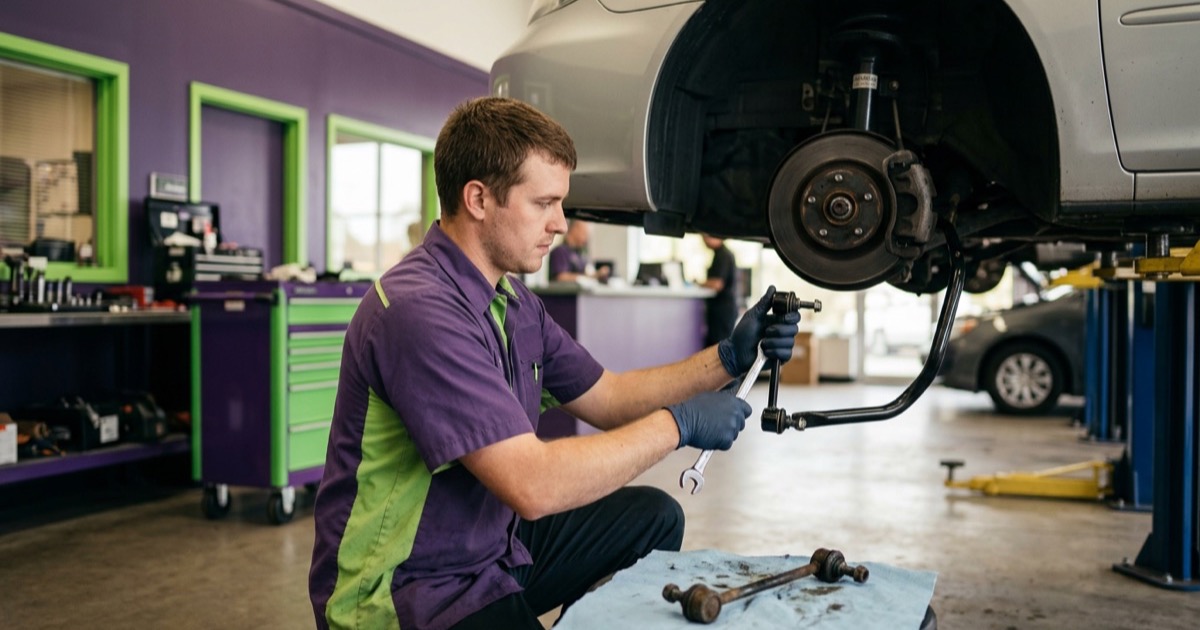
What a Sway Bar Link Does and What the Job Includes
The sway bar, also called a stabilizer or anti-roll bar, is a long steel bar that runs side to side under the car. When you turn, the car wants to lean. The bar twists and pushes back, which keeps the body flatter.
The bar needs a way to reach each wheel. That is the link. It is a short rod with a joint at each end, one end on the bar and the other on the strut or the control arm. Each link moves every time the wheel goes over a bump.
Links wear out because those small joints never stop moving. Once the boot on a ball-type link tears, water and grit get in, the grease washes out and the joint gets loose. Loose joints knock.
The job price should cover the new links, removing the old ones, installing the new ones and a short road test to make sure the noise is gone.
- Raise the car and remove the wheel
- Hold the ball stud and remove the nut at each end of the old link
- Fit the new link and torque the nuts to spec, at ride height if required
- Check the sway bar bushings and other front-end joints while it is up
- Road test over bumps to confirm the clunk is gone
Is It Really the Sway Bar Link?
Clunks in the front end come from many parts. The sway bar link is the cheapest and most common, so it is the right place to start. But a shop should prove it before they swap it.
The classic sway bar link sound is a light clunk or rattle over small bumps at slow speeds. It is often worse when one wheel hits a bump and the other does not, like going over a driveway at an angle. It usually does not change with braking or steering.
A tech can test the link in a few minutes. With the car on the ground or the suspension loaded, they grab the link and try to shake it. A good one has no play. A bad one moves or clicks. Another test is to disconnect one end of each link. If the clunk goes away on the road test, you found it.
Other parts make similar noises. Worn sway bar bushings squeak or thump. Worn strut mounts clunk when you turn the wheel while parked. Bad ball joints and tie rod ends knock and can make the steering feel loose. A shop that checks all of them in one pass saves you a second visit.
- Clunk over small bumps at low speed: likely sway bar links
- Squeak or thump over bumps, worse in the cold: sway bar bushings
- Clunk or pop when turning the wheel while parked: strut mounts
- Knock plus loose or wandering steering: ball joints or tie rod ends
- Clunk when braking: control arm bushings or loose brake parts
Why the Price Varies
Most shops charge about $120 to $300 to replace a pair of front links. A single link costs less but most people do both on one axle.
Parts are the first swing. Basic links on a common car cost under $30 each. Heavy-duty links with greasable joints cost more. Dealer links on European cars can cost several times as much.
Rust is the second swing. On a car from a dry state, the nuts come off in seconds. On a car from a snowy state, the ball stud can spin in its socket or the nut can seize. Then the tech has to cut it off. That can double the labor.
The mounting design is the third swing. Links that bolt to the strut are often easy. Links that tie into the lower control arm can need a pry bar to line up. A few designs need other parts moved first.
This is a good job for a mobile mechanic. Most cars need only a jack, stands and hand tools. Badly rusted trucks are where a shop with a torch and a lift makes more sense.
What Happens If You Wait Too Long
A worn link does not fail all at once. First the boot tears. Then the joint gets a little play and starts to tick over bumps. Over a few months, the play grows and the tick turns into a clunk you can hear with the radio on.
At the end, the ball pulls out of its socket or the rod snaps. The sway bar is now loose on that side. It can bang against the control arm, the strut or the brake line bracket, and the car leans hard in turns.
A broken link will not usually cause a crash on its own. But the car is less stable in a sudden swerve, and a flopping bar can damage nearby parts. A $150 repair can turn into a strut or brake line job if a loose bar keeps hitting things.
There is also a cost to living with the noise. A clunk from a link can hide a newer noise from a ball joint or tie rod that really is a safety problem. Fix the cheap noise so you can hear the next one.
What Usually Gets Done at the Same Time
Replace links in pairs on the same axle. They wore the same miles and the other one is usually close behind. Many parts stores sell them as a pair for that reason. It is not a must, but it often saves a second trip.
Sway bar bushings are the most sensible add-on. They hold the bar to the frame, they are cheap, and they wear on the same schedule. If they are cracked or the bar rattles in them, replace them now.
An alignment is not needed for sway bar links. Links do not change the camber, caster or toe of the wheel. If a shop says you need one just for links, ask why.
If the inspection finds worn struts, ball joints or tie rod ends, those are worth hearing about, but get proof. Ask to see the play in the joint or a photo of the leak before you add hundreds to the bill.
Questions to Ask Before You Approve the Quote
A short list of questions will keep a $150 job from turning into a $1,000 one.
- How did you confirm it is the links and not the bushings, strut mounts or ball joints?
- Is the quote for one link or a pair on the same axle?
- What brand are the links, and are they greasable or sealed?
- Will you torque the links at ride height if my car calls for it?
- If the nuts are rusted and need cutting, what does that add?
- Did you see play in any other suspension part, and can you show me?
How to Make New Links Last
Torque matters more than people think. Many links need to be tightened with the suspension at normal ride height, either on the ground or with the control arm jacked up. Tightening them with the wheel hanging can preload the joint and shorten its life.
Use a hex or Torx key to hold the stud, not an impact gun. Hammering the nut on with an impact spins the ball inside the socket and can ruin a brand-new link in seconds.
Choose decent parts. The cheapest links on the shelf often come with thin boots that crack in a year. A link with a solid boot, or a greasable joint, usually outlasts it by a long way.
If you lifted or lowered your vehicle, use links that fit the new height. Wrong-length links leave the bar at a bad angle and wear out fast.
Signs you need this repair
- Clunk or rattle from the front over small bumps at low speed
- Knocking when one wheel hits a bump, like a driveway at an angle
- Car leans more than usual in turns
- Steering feels a little loose or vague in quick lane changes
- Torn rubber boot on a link during an inspection
- Visible play when a tech shakes the link by hand
- A broken link hanging loose from the bar
Cost by vehicle type
| Vehicle | Typical range | Notes |
|---|---|---|
| Compact / economy car | $100 to $290 | Front links on most compacts bolt to the strut and come off with basic hand tools. Parts are cheap, so this is the low end of the range. |
| Midsize sedan / small SUV | $105 to $310 | Standard job with the wheel off. Some sedans mount the link to the lower control arm instead of the strut, which is just as easy. |
| Full-size truck / large SUV | $125 to $365 | Trucks use longer, heavier links, often with bushings in place of ball joints. Rust on older trucks is the main reason labor climbs. Lifted trucks need longer links to keep the bar level. |
| Luxury / European | $150 to $445 | Many European cars go through front links often, and some models use links with plastic bodies. Parts cost more and some links tie into ride height sensors. |
| Hybrid | $115 to $345 | Same job as the gas version. The extra battery weight can wear links a bit faster on high-mileage hybrids. |
| Electric vehicle | $120 to $360 | Heavy EVs load the links hard in corners. Expect links on the stronger side and parts toward the top of the range. |
| Diesel / heavy duty | $145 to $430 | Heavy-duty links are thick and cheap, but rust and seized hardware on work trucks can add real time. Plow and tow trucks wear them faster. |
Ranges assume national-average labor rates ($95, $140/hr) and quality aftermarket parts.
Cost by state
State ranges reflect typical independent-shop labor rates for a midsize vehicle.
Common questions
How much does it cost to replace sway bar links?
Most shops charge about $120 to $300 for a pair of front sway bar links. A single link costs less. Rusted hardware, heavy truck links and European parts push the price up.
Can I drive with a bad sway bar link?
Yes, for a short time you usually can. A worn link mostly makes noise. If it breaks, the car leans more in turns and can feel loose in a quick swerve, so do not put it off for months.
Should sway bar links be replaced in pairs?
It is a good idea but not required. Both links on an axle wore the same miles, and the second one is often close behind. Doing both at once usually saves you a second trip.
Do I need an alignment after replacing sway bar links?
No, sway bar links do not change your wheel alignment. You only need an alignment if other parts like tie rods, control arms or struts were replaced at the same time.
What does a bad sway bar link sound like?
It sounds like a light clunk or rattle from the front over small bumps at low speed. It is often worse when one side hits a bump. It usually does not change when you brake or turn the steering wheel.
How long do sway bar links last?
Many last 50,000 to 100,000 miles, but rough roads, rust and cheap parts can shorten that a lot. Once the rubber boot tears, the joint usually wears out within months.
Can a mobile mechanic replace sway bar links?
Yes, this is one of the easiest suspension jobs to do in a driveway. Most cars need only a jack, stands and hand tools. Heavily rusted trucks may be better at a shop with a torch.
Related Repair Guides
More Suspension Repair Costs
Sources and further reading
Primary sources behind this page. Federal safety, emissions and consumer-protection references, worth reading before you authorize any repair.
- fueleconomy.gov maintenance tips DOE and EPA guidance on routine maintenance, including keeping tires and suspension in good shape.
- SAE International The engineering body behind vehicle suspension, fastener and torque standards.
- DOE Alternative Fuels Data Center: EV maintenance Federal overview of the suspension and tire maintenance EVs still need.
Need Work Done? Get a Free Quote.
Tell us what the car is doing. A local mechanic calls you back, most requests get a call back the same day. No fee, no obligation.