
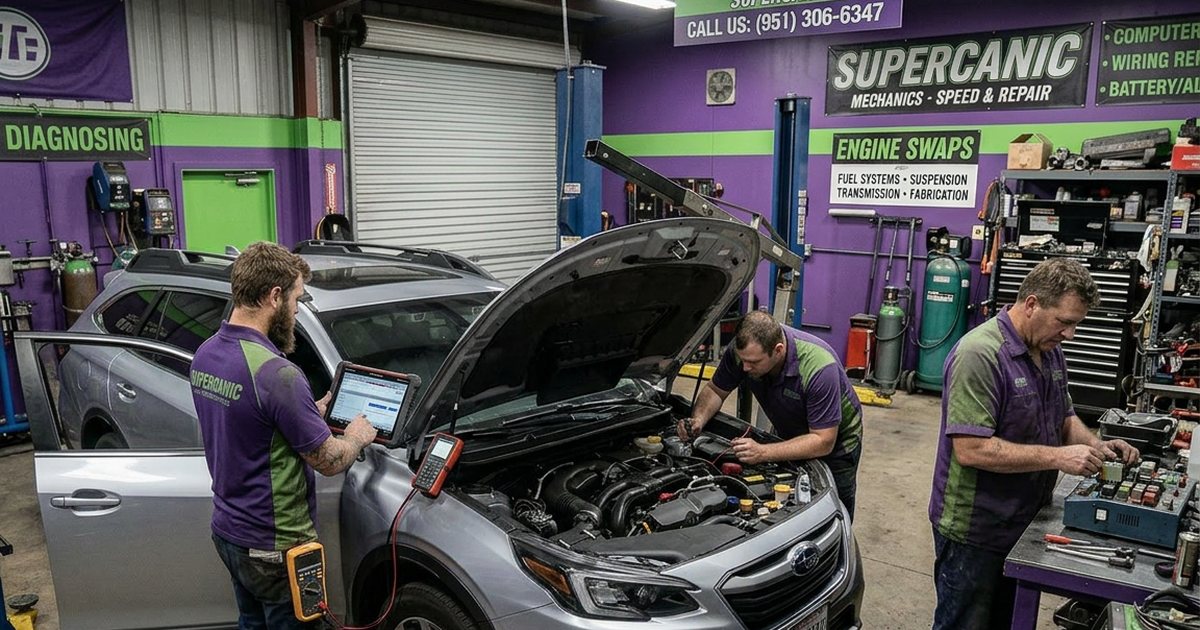
How starters fail
A starter is a simple DC motor with a solenoid bolted on top, and the failures follow from that design. The solenoid's copper contacts burn and pit from arcing every time you start the car — eventually they can't pass enough current, and you get a click with no crank. The motor's carbon brushes wear down until they lose contact with the spinning armature, which causes the classic intermittent starter: works ten times, dead the eleventh. And the drive gear (the small pinion that flings out to engage the engine's flywheel) can wear or fail to extend, producing a grinding noise or a whirring motor that spins without turning the engine.
Heat makes all of this worse. Starters mounted near exhaust components heat-soak after a drive, and marginal internal connections that work fine cold open up when hot. That's why a dying starter so often cranks perfectly in the morning but refuses to start at the gas station after a twenty-minute drive. Heat-soak intermittents are one of the most commonly misdiagnosed problems in this job — the car starts fine by the time it gets to the shop.
Diagnose before you buy a starter
A significant share of replaced starters were never bad. The battery, cables, and connections cause identical symptoms, so a proper diagnosis comes first.
The sound tells you a lot. A single solid click with no crank means the solenoid is engaging but current isn't reaching the motor — that's either a bad starter or a bad power path to it. Rapid machine-gun clicking is almost always a weak battery or corroded connection, not the starter. Total silence points to the ignition switch, neutral safety switch, or a control-circuit problem.
The definitive test is a voltage-drop test on the battery cables while cranking. Corroded or loose cables can read a healthy 12.6 volts at rest but drop most of that voltage across the corrosion under cranking load, starving the starter. Mechanics see this constantly: a $30 cable end fixes what looked like a $500 starter job. The old tap test is still legitimate diagnosis too — if a firm tap on the starter body with a wrench or breaker bar gets the car started, the brushes or solenoid contacts are worn and the starter itself is confirmed bad. Any shop that quotes you a starter without checking battery voltage and cable drops is guessing.
What the job includes
The repair itself is straightforward: disconnect the battery, unbolt the main power cable and the small solenoid trigger wire from the starter, remove the mounting bolts (usually two or three), and pull the old unit out. The new starter goes in the same way, connections get cleaned and tightened, and the car is started several times to confirm a clean, quick crank.
A thorough job also includes the things that killed the last starter or mimic its failure: cleaning the battery terminals and starter cable ends, checking the battery's cranking health, and verifying charging-system output. If the flywheel ring gear teeth are chewed up — often the case when the old drive gear was grinding — the shop should show you, because a new starter grinding against damaged flywheel teeth won't last.
Starters are replaced as a complete assembly. Rebuilding one on the bench with new brushes and contacts is possible, but at today's parts prices almost no shop does it — a replacement unit is faster, warrantied, and often cheaper than the labor to rebuild.
Why the price varies so much
Access is everything on this job. On many trucks and older cars the starter sits low on the engine block, reachable from underneath with two bolts — an hour of work, done. On other engines the starter is buried under the intake manifold in the valley of a V-configuration engine, and the intake, fuel rails, and a stack of gaskets have to come off before you can even see it. Certain Toyota and Lexus V8s are famous for this layout, turning a starter swap into a 4-to-5-hour job with an extra gasket kit on the bill. The labor range on this page covers the typical 1-to-2.5-hour job; if you own one of the buried-starter engines, expect quotes well above it, and know that the high quote isn't the shop padding hours.
Parts price tracks the vehicle: a small four-cylinder starter can be had for near the bottom of the range, while high-torque units for large gas V8s, diesels, and European luxury models push past the top. Regional labor rates move the total too — the same two hours costs meaningfully more in a high-cost metro than in a rural shop.
New vs. remanufactured
Most starters installed today are remanufactured — factory cores rebuilt with new brushes, contacts, bearings, and solenoids, then tested. A quality reman from a reputable brand is a perfectly good part and typically saves 30 to 50 percent over new, usually with a warranty of a year to lifetime.
The trap is the bargain-bin reman. The cheapest units get minimal rebuilding and fail at a much higher rate, and the second failure costs you the labor all over again — which stings badly on a buried-starter engine where labor dwarfs the part. The sensible rule: on an easy-access starter, a mid-grade reman is fine; on a 4-hour-labor starter, pay up for new or a top-tier reman, because you never want to do that job twice.
How to save money on this repair
First, confirm the diagnosis. Insist on a battery test and a cable voltage-drop check before authorizing the starter — it's ten minutes of work that regularly saves people the entire repair. Second, price the part yourself; starter prices vary widely between suppliers for the same application, and some shops will install a customer-supplied part (ask about warranty implications first).
Third, get a mobile mechanic quote. On vehicles with accessible starters this is an excellent driveway repair — hand tools, a jack, and jack stands are all it takes, and mobile labor rates often run under shop rates. It also solves the obvious logistics problem: a car that won't start is a car you can't drive to the shop, and a mobile tech coming to the car beats paying for a tow. Finally, if the tap trick gets you one more start, use that start to drive directly to the repair — not to put the problem off for another month.
Signs you need this repair
- A single solid click when you turn the key, but the engine doesn't crank
- Grinding or ratcheting noise during starting, like metal teeth clashing
- Intermittent no-start that shows up mainly when the engine is hot, then works fine after cooling off
- A freewheeling whir — the starter motor spins loudly but never turns the engine over
- The starter stays engaged after the engine fires, making a whine or grind until you release the key
- Slow, labored cranking even with a known-good, fully charged battery
- Car starts only after tapping the starter with a tool or after several key cycles
Cost by vehicle type
| Vehicle | Typical range | Notes |
|---|---|---|
| Compact / economy car | $220 to $690 | Usually the cheap end of the range — small starters, decent access, and abundant aftermarket and reman options. |
| Midsize sedan / small SUV | $245 to $750 | Typically routine, but some V6 models mount the starter under the intake manifold, which can double the labor time. |
| Full-size truck / large SUV | $290 to $885 | Bigger engines mean bigger, pricier starters, but access from underneath is often generous. Diesel-optioned trucks cost more. |
| Luxury / European | $365 to $1,095 | Higher parts prices and tighter packaging. Some models require removing intake plumbing or accessing the starter from awkward angles, pushing labor toward the high end. |
| Hybrid | $270 to $825 | Most hybrids have no conventional starter — the electric motor-generator spins the engine to start it. If your hybrid won't start, the diagnosis usually points to the hybrid battery or 12-volt system, not a starter motor. |
| Electric vehicle | EVs have no starter motor — the drive motor spins the car directly. | |
| Diesel / heavy duty | $350 to $1,055 | Diesels need high-torque starters to overcome compression, so parts run well above the gas-engine range, and dual-battery systems add diagnostic steps. |
Ranges assume national-average labor rates ($95, $140/hr) and quality aftermarket parts.
Cost by state
State ranges reflect typical independent-shop labor rates for a midsize vehicle.
Common questions
Why does tapping the starter make it work temporarily?
Inside the starter, worn carbon brushes or pitted solenoid contacts are barely making an electrical connection. A sharp tap jars them into contact for one more start. It's a useful roadside trick and a definitive diagnosis — but it's the starter telling you it's on its last legs. Use the start it gives you to drive to the repair, not to postpone it.
How long does a starter last?
Typically 100,000 to 150,000 miles, though it's really measured in start cycles, not miles. A city car making a dozen short trips a day wears its starter far faster than a highway commuter. Heat exposure, oil leaks dripping onto the starter, and long cranking sessions from other engine problems all shorten its life.
How do I know it's the starter and not the battery?
Turn on the headlights and try to start the car. Bright, steady lights plus a single click or silence points to the starter or its wiring. Dim lights, rapid clicking, or lights that die during cranking point to the battery or corroded cables. The tiebreaker is a voltage and load test — any parts store or shop can test the battery free in minutes, and that should always happen before anyone sells you a starter.
If my car starts, can I keep driving it?
Once the engine is running, the starter does nothing — the car drives normally and safely. The risk isn't while driving; it's that the next start may not happen, wherever you happen to be parked. Treat every start as potentially the last one and get it replaced before it decides for you.
Is a remanufactured starter okay, or should I buy new?
A quality reman from a reputable brand is a proven, warrantied part and the standard choice for most repairs, usually 30 to 50 percent cheaper than new. Avoid the very cheapest reman units — their failure rate is high, and a repeat failure means paying the labor twice. On engines where the starter is buried and labor is expensive, spend up for new or a premium reman.
Can a mobile mechanic replace a starter in a parking lot?
Often, yes — and it's one of the best use cases for mobile repair, because a dead starter means the car can't drive itself to a shop. If the starter is accessible from above or from underneath with jack stands, a mobile tech can swap it where the car sits, and the service call usually costs less than a tow plus shop labor. Buried-under-the-intake starters are the exception; those are better handled after a tow to a shop.
Could it be the ignition switch or something else entirely?
Yes. Total silence when you turn the key — no click at all — often means the ignition switch, the neutral safety switch (try starting in Neutral instead of Park), a bad relay, or an anti-theft system issue rather than the starter itself. A dead starter almost always at least clicks. This is exactly why a proper diagnosis beats replacing parts on a guess.
Why does a starter replacement cost so much more at some shops?
The starter is easy to reach on some cars and buried under other parts on others. Labor time swings the bill the most. Part choice matters too, since new, rebuilt, and aftermarket starters all cost different amounts. Ask what brand is quoted, how many labor hours, and what the warranty is.
Related Repair Guides
More Electrical Repair Costs
Sources and further reading
Primary sources behind this page. Federal safety, emissions and consumer-protection references, worth reading before you authorize any repair.
- NHTSA recall & complaint lookup Check any symptom against open recalls and technical service bulletins before paying for a repair.
- FTC auto repair basics Your rights on estimates, authorization and disputed repair bills.
- SAE International The engineering body behind fluid, fastener and diagnostic standards.
Need Work Done? Get a Free Quote.
Tell us what the car is doing. A local mechanic calls you back, most requests get a call back the same day. No fee, no obligation.