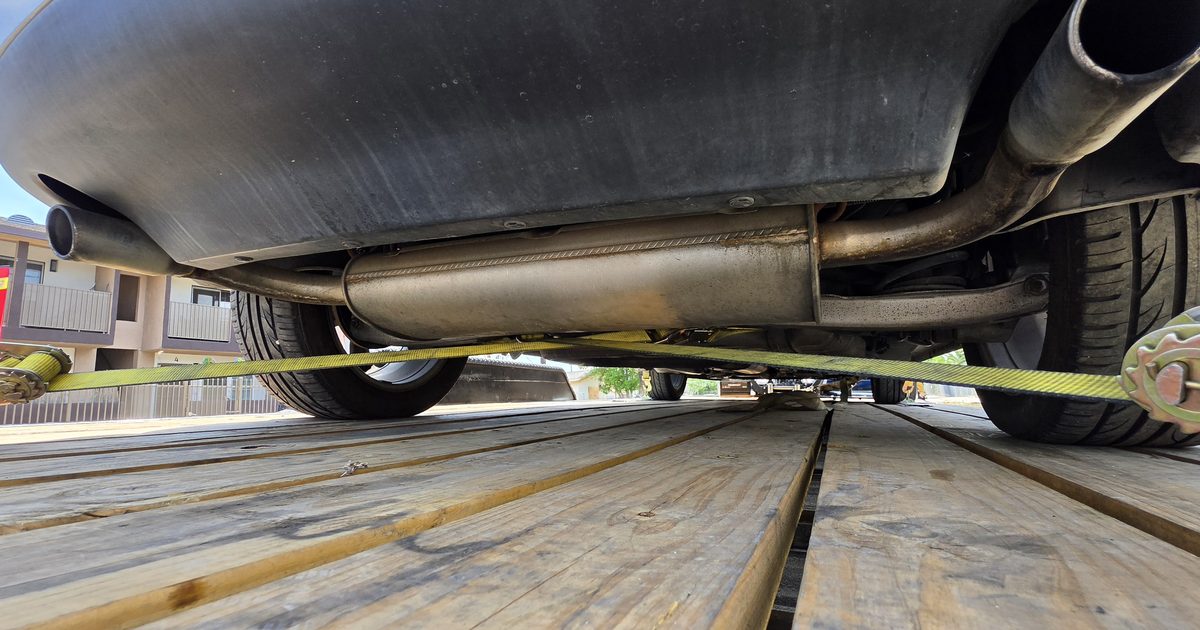
What the converter does, and why it's so expensive
Downstream of the engine, the catalytic converter is a stainless canister holding a ceramic honeycomb washcoated with platinum, palladium, and rhodium. Exhaust flowing through it at temperature triggers reactions that convert carbon monoxide, unburned fuel, and oxides of nitrogen into carbon dioxide, water, and nitrogen. A healthy converter cleans up the vast majority of what the engine sends it, which is why regulators care so much about its health — and why the car watches it constantly with oxygen sensors before and after.
The price is the metals. Converter cost tracks precious-metal markets, and rhodium in particular has traded at multiples of gold — a few grams of it per converter is why OEM units run high, why scrap converters have real cash value, and why converter theft became an epidemic. It's also why the aftermarket exists at a fraction of OEM pricing: aftermarket converters use far lighter metal loading, which is exactly the trade-off to understand before buying one.
Properly, a converter is a lifetime part. The honeycomb doesn't wear out from exhaust flow — it gets poisoned, melted, or broken by problems that start somewhere else. Which leads to the most important thing on this page.
Converters are murdered, not lost to old age
A converter that failed almost always has an upstream killer, and replacing the converter without finding it is how people buy two converters in one year.
The usual suspects: persistent misfires send raw fuel into the converter, where it burns inside the honeycomb and melts it — a slow-motion version happens with any long-ignored flashing check-engine light. Oil burned past worn rings or valve seals coats the catalyst with phosphorus and zinc it can't shed; coolant seeping through a failing head gasket poisons it with silicates. A rich-running engine — bad injector, stuck sensor — overheats it steadily. Even mechanical insult counts: a converter that's rattling has a broken honeycomb, often from thermal shock or a big pothole hit.
So the non-negotiable step before any converter purchase is diagnosing why this one died: compression and leakdown if oil use is suspected, misfire history in the computer, fuel trims, a look at the old converter's face. A good shop treats the dead converter as evidence. If someone quotes you a new converter without any interest in what killed the old one, the warranty on that new part has a countdown timer running.
P0420 doesn't automatically mean a new converter
The code that launches most converter conversations — P0420 (or P0430 for the other bank), "catalyst efficiency below threshold" — is a comparison between the oxygen sensor before the converter and the one after. When the rear sensor's signal starts mimicking the front's, the computer concludes the catalyst isn't storing oxygen like it used to.
But that comparison has several ways to lie. A lazy or contaminated rear oxygen sensor produces the same signature with a healthy catalyst; a small exhaust leak ahead of the rear sensor pulls in outside air and skews the reading; marginal engine running conditions can drag efficiency down without the converter being at fault. Sensors cost a fraction of converters, which is why competent diagnosis — scope the sensor signals, check for leaks, verify fuel trims — comes before parts.
Be equally realistic in the other direction: on a high-mileage car with genuine efficiency decay, swapping oxygen sensors on hope is its own money pit. The difference between hoping and knowing is an hour of diagnostic time, and on a repair with this price tag it's the best-value hour in the whole job.
OEM vs. aftermarket — and the CARB states
The price spread on converters is enormous, and it's mostly about metal loading and legality. An OEM converter matches the original catalyst loading — it will keep the rear-sensor comparison happy for the long haul, at a price that reflects the metals inside. Federal-compliant aftermarket converters (look for EPA compliance) cost a fraction, carry a mandated 25,000-mile emissions warranty, and serve most mainstream vehicles well — though on some models, notoriously including certain Subarus and luxury makes, light-loaded units can leave P0420 glowing within a year or two.
Then there's the CARB layer: California requires CARB-exempted converters (with an EO number specific to your vehicle), and states including New York, Colorado, and Maine have adopted the same requirement for many model years. CARB units cost notably more than federal ones — this is the single biggest reason identical repairs price differently across state lines, and why the per-state table below swings more for this repair than most. Installing a federal-only converter in a CARB state can be illegal and can fail your inspection.
Whoever quotes you should ask where the car is registered before naming a part. If they don't, ask them which certification the converter carries — it's the question that reveals whether the bargain quote is actually a legal repair.
Check the warranty before you spend a dime
Here's the check that occasionally makes this entire repair free: federal law requires manufacturers to warranty the catalytic converter — specifically, along with the engine computer, beyond the ordinary emissions warranty — for 8 years or 80,000 miles on most gasoline vehicles. California's rules extend coverage further for some vehicles sold there.
If your car is inside that window and the converter has genuinely failed, the dealer may owe you a converter at no charge — a fact that's easy to miss because nobody at a general repair shop profits from mentioning it. It's worth a call to a dealer with your VIN before authorizing any converter work on a vehicle under 8 years old.
Two caveats keep it honest. Warranty covers defects and normal-use failures, not a converter murdered by a neglected misfire or an oil-burning engine — the upstream-cause diagnosis matters here too. And the claim runs through a dealer, not your independent shop. Even so: on the short list of thousand-dollar repairs with a plausible free path, this one deserves the phone call.
Theft: the other way you lose a converter
Converter theft is a straightforward crime of metal value: a battery saw, sixty seconds under the car, and the thief walks off with a can of precious metals while you wake up to a car that starts with a roar like an open race pipe. High-clearance trucks and SUVs are targeted for access; hybrids — Priuses above all — for their metal-rich converters; fleet and airport lots for uninterrupted time.
If it happens, it's a comprehensive insurance claim on most policies, and the repair is this page plus whatever the saw took with it — oxygen sensor wiring and flange damage are routine collateral. Repair pricing after theft is the same math as failure, with the aftermarket-vs-OEM and CARB questions unchanged.
Prevention is unglamorous but effective: bolt-on converter shields and cages (a modest cost for popular targets like the Prius), etching the VIN on the shell so scrap buyers must ask questions, parking in lit or busy spots, and — for fleets and frequent targets — anti-theft straps. None of it makes theft impossible; all of it makes your car slower to rob than the next one, which is most of what prevention ever means.
How to save money on this repair
Diagnose before replacing — the two expensive mistakes in this category are buying a converter for a bad oxygen sensor, and buying a second converter because nobody fixed the misfire that ate the first one. An hour of real diagnosis defends against both.
Check the 8-year/80,000-mile federal emissions warranty before paying anyone. If you're outside it, choose the part tier deliberately: quality federal-compliant aftermarket for most mainstream cars outside CARB states, CARB-certified where required, and OEM (or top-tier aftermarket) for makes with a reputation for rejecting light-loaded units — a $500 savings that brings P0420 back in a year isn't savings.
Get the itemized quote: converter jobs hide their variation in gaskets, flanges, oxygen sensors, and whether rusted pipework needs cutting and welding. Independent exhaust shops are often the value play here — converter and pipe work is their daily bread, and a welded-in universal converter done by a good muffler shop can cost dramatically less than a bolt-on direct-fit assembly, where local law allows it. And once the new one's in, fix engine problems promptly — the converter downstream is always the most expensive thing a cheap ignored repair can destroy.
Signs you need this repair
- Check-engine light with code P0420 or P0430 — "catalyst efficiency below threshold"
- A rotten-egg (sulfur) smell from the exhaust, especially under load
- Noticeable loss of power, worst uphill or at highway speed — the sign of a clogging converter
- A rattle from under the car at idle or over bumps — broken honeycomb shaking in the shell
- Failed emissions test despite the engine running normally
- Glowing-red converter shell or paint-burning smell after driving — severe restriction overheating the unit
- A sudden startup roar like a straight pipe — the sound of a converter that was stolen overnight
Cost by vehicle type
| Vehicle | Typical range | Notes |
|---|---|---|
| Compact / economy car | $350, $1,470 | Single small converters with good aftermarket coverage — the cheapest version of the job, provided your state allows standard aftermarket units. |
| Midsize sedan / small SUV | $395, $1,680 | Four-cylinders are routine; V6 models often carry two or three converters (one per bank plus a downstream unit), so make sure the quote specifies which one failed. |
| Full-size truck / large SUV | $480, $2,060 | Dual-bank exhausts mean multiple converters and bigger, pricier units. The high ground clearance that makes the work easier is the same clearance that makes trucks a top theft target. |
| Luxury / European | $605, $2,605 | OEM converters can run several times the aftermarket price, and many luxury models tolerate aftermarket units poorly — marginal catalyst loading can leave the P0420 light on. Budget toward OEM or the highest-tier aftermarket. |
| Hybrid | $435, $1,850 | Hybrid converters carry extra-rich precious-metal loading (the catalyst must work with a cool-running, stop-start engine), which makes them expensive to buy and the single most-stolen converter category — Prius theft is a national statistic. Shields are a worthwhile add-on. |
| Electric vehicle | No combustion, no exhaust, no catalytic converter — and nothing for thieves to saw off, either. | |
| Diesel / heavy duty | $575, $2,465 | Diesel aftertreatment is a different world — DOC, DPF, and SCR systems with their own failure modes, regeneration cycles, and much higher costs. This guide's estimates are for gasoline vehicles; diesel exhaust work needs a diesel-specific quote. |
Ranges assume national-average labor rates ($95, $140/hr) and quality aftermarket parts.
Cost by state
State ranges reflect typical independent-shop labor rates for a midsize vehicle.
Common questions
Can I keep driving with a P0420 code?
Usually yes, for a while — catalyst efficiency codes alone don't harm the engine, and the car drives normally. The costs are downstream: you'll fail emissions testing, and if the true cause is an upstream problem like a slow misfire, it's actively finishing off the converter while you wait. Get it diagnosed soon; drive gently in the meantime, and treat any flashing check-engine light as a stop-driving event.
Why is this part so expensive?
You're buying precious metals. The catalyst honeycomb is coated with platinum, palladium, and rhodium — the last of which has traded at several times the price of gold — and OEM converters carry generous loadings of all three. It's the same reason thieves target converters and scrapyards pay real money for dead ones: the value is in the metal, not the stainless can.
Will a cheap aftermarket converter work on my car?
On most mainstream vehicles, a reputable federal-compliant aftermarket unit works fine and costs a fraction of OEM. The exceptions are real, though: some makes are notorious for turning the P0420 light back on with light-loaded converters, and CARB states legally require certified units with the right EO number for your exact vehicle. Match the part to your car and your state, not just the lowest price.
My converter is only a few years old. Shouldn't this be covered?
Quite possibly — federal law requires converter coverage for 8 years or 80,000 miles on most gasoline cars, separate from the bumper-to-bumper warranty everyone remembers expiring. Call a dealer with your VIN before authorizing paid work. Coverage applies to genuine failures, not converters destroyed by an ignored engine problem, so expect the dealer to look upstream too.
Someone stole my converter. What now?
File a police report and a comprehensive claim with your insurer — theft is a covered loss on comprehensive policies, typically minus your deductible. Have the car towed or driven gently to a shop (it's deafening but usually drivable short distances); expect the repair to include flange or pipe repair and sometimes an oxygen sensor, since saws aren't precise. Consider a shield or cage on the replacement — repeat theft of the same vehicle is common.
Can I just remove the converter or install a "test pipe" instead?
No — removing or gutting a converter on a road-driven car is a federal violation for both you and any shop that does it, on top of state inspection failure, a check-engine light, and the smell. Shops that value their license won't touch it. If cost is the obstacle, a federal-compliant universal converter welded in by an exhaust shop is the legitimate budget path.
Can a mobile mechanic replace a catalytic converter?
For bolt-on converters with cooperative hardware, yes — it's wrenching a mobile tech can do in a driveway. The honest limits are rust and welding: seized exhaust fasteners often need torches or cutting, and universal converters need a welder, both of which favor a shop. Many mobile techs will diagnose the failure and its upstream cause, then refer the pipe work to an exhaust shop they trust.
Related repair guides
Sources and further reading
Primary sources behind this page. Federal safety, emissions and consumer-protection references, worth reading before you authorize any repair.
- EPA vehicle & engine certification Emissions standards that govern what may be replaced or modified.
- NHTSA recall & complaint lookup Check any symptom against open recalls and technical service bulletins before paying for a repair.
- FTC auto repair basics Your rights on estimates, authorization and disputed repair bills.
Need work done? Get a free quote.
Tell us what the car is doing. A local mechanic calls you back, most requests get a call back the same day. No fee, no obligation.