What the Job Is and What You Are Paying For
Each cylinder has an exhaust port on the side of the head. The manifold bolts over those ports and collects the exhaust into one outlet. From there the exhaust goes to the converter, the muffler and out the back.
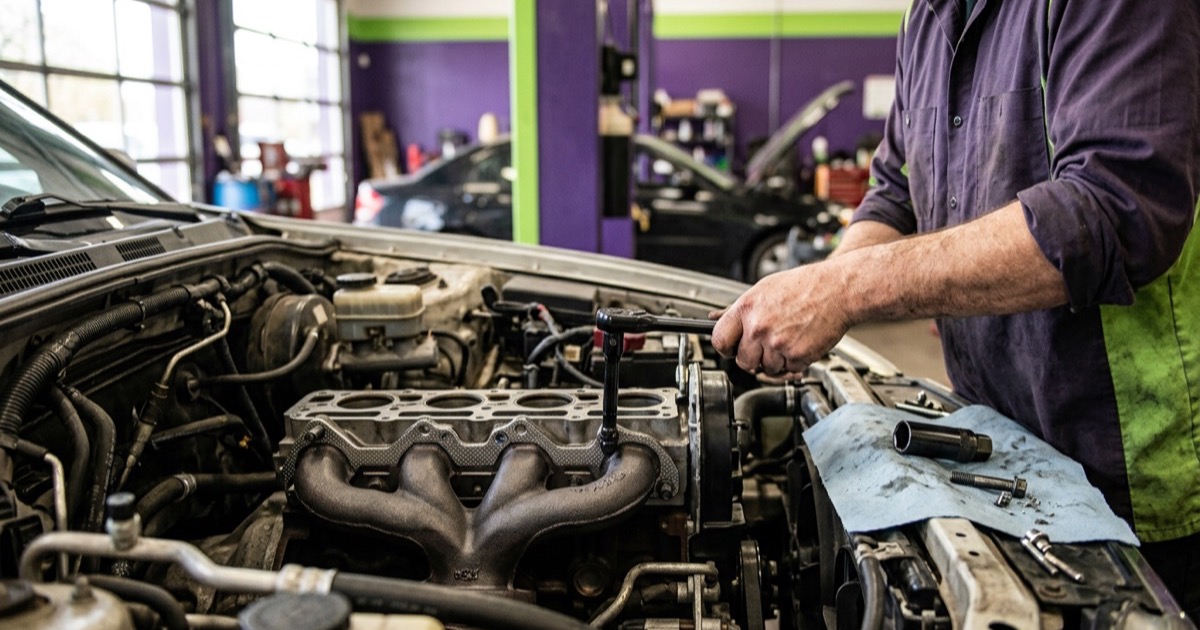
A manifold replacement removes heat shields, oxygen sensors, the downpipe and sometimes other parts in the way. Then the shop unbolts the manifold from the head, cleans the sealing surface, and installs the new manifold with a new gasket and new studs and nuts.
A proper job replaces the studs and nuts, not just the gasket. Old studs are stretched and rusty. Reusing them is a common reason for a leak a few months later.
The price you see depends mostly on the part. A plain cast manifold can cost $150 to $400. A manifold with a built in catalytic converter often costs $500 to $1,200 or more. Labor runs two to five hours on most cars. The national range on this page covers one manifold on a common car, with studs and gasket.
Cracked Manifold or Just a Leaking Gasket?
Not every manifold leak needs a new manifold. Sometimes only the gasket or a stud failed.
If a stud broke or backed out, the gasket can blow out at that spot. The fix is to extract the broken stud and install a new gasket. The manifold itself can be reused if it is flat and not cracked.
If the manifold is cracked, it has to be replaced. Cracks often start near the outlet or between ports, where heat stress is highest.
If the manifold is warped, it will not seal no matter how good the gasket is. Some shops can machine it flat, but on many engines a new one is the better choice.
A good shop checks the manifold on a flat surface and looks for cracks before quoting a new part. Ask which one you have.
Why the Price Varies So Much
The biggest factor is whether your manifold has the catalytic converter built in. Many cars from the 2000s and later do this so the converter heats up fast. That one part can cost three or four times more than a plain manifold.
Broken studs are the second factor. If every stud comes out clean, the job is quick. If two or three snap off in the head, the shop has to drill and extract them. That can add one to three hours. Many shops quote the job with a note that broken studs cost extra.
Access is the third factor. A front manifold on a V6 or one side of a truck V8 can be easy. A rear manifold against the firewall, a manifold under the turbo, or one that needs the engine tilted forward costs more.
The parts tier matters. A quality aftermarket manifold is often fine, but a manifold converter must be legal for your state. In California and other states that follow its rules, converters must be approved, which costs more.
The shop matters too. Dealers charge the most. Independent and exhaust shops are usually cheaper. A mobile mechanic can do some easy front manifolds in a driveway, but stud extraction and rear manifolds are better in a shop with a lift.
Watch out for quotes that skip the stud question. A shop that says nothing about broken studs may come back mid job with a higher price. A shop that explains it up front, and promises to call before going over, is usually the honest one. On trucks known for broken bolts, a good shop may quote a range by side so you know the worst case before you say yes.
What Usually Gets Done at the Same Time
Some add ons make sense because the manifold is already off.
Worth it every time are new studs, nuts and gaskets for the manifold and the downpipe joint. They cost little and prevent a repeat leak.
Worth it if worn are oxygen sensors. They come out anyway, and old sensors often break or seize on removal. If yours are old or have a code, replace them now.
Worth checking are heat shields. Rusted shields rattle and can be replaced or secured while everything is apart.
Worth checking is the flex pipe or downpipe. If it is rusted or leaking, fixing it now saves a second visit.
Usually an upsell is a set of performance headers you did not ask for, or a new converter when your manifold does not include one and there is no code.
- New studs, nuts and gaskets: always
- Oxygen sensors: replace if old, damaged or coded
- Heat shields: fix if rattling or loose
- Flex pipe or downpipe: replace if leaking
- Aftermarket headers: usually skip on a daily driver
- New converter: only if built into the manifold or failed a test
Make Sure It Is Really the Manifold
The classic sign is a ticking or tapping noise that is loud when the engine is cold and quieter once it warms up. As the metal heats, it grows and seals the crack for a while.
That same ticking can come from a lifter, a loose spark plug, or a bad fuel injector. A good shop uses a stethoscope or a smoke test to find the source.
You can sometimes see the leak. Black soot streaks around a stud or along a crack mean exhaust is getting out there.
An exhaust leak in front of the oxygen sensor can let outside air in and cause lean codes or a rough idle. If you have lean codes and a ticking noise, the manifold is a strong suspect.
Ask the shop to show you the soot, the crack, or the broken stud.
Questions to Ask Before You Approve the Quote
Manifold quotes can grow during the job because of broken studs. These questions keep the price clear.
- Is my manifold cracked, warped, or just leaking at the gasket?
- Does my manifold have the catalytic converter built in?
- Is the new part aftermarket or factory, and is it legal in my state?
- Does the price include new studs, nuts and gaskets?
- What do you charge if studs break, and will you call me first?
- Are you replacing the oxygen sensors, and are they needed?
- Do I have one manifold or two, and which one is leaking?
- What is the warranty on parts and labor?
How to Make the New Manifold Last
Make sure the new studs and nuts are torqued in the right order to the factory spec. Uneven torque warps the manifold.
Keep heat shields in place. They protect nearby parts and help the manifold heat evenly.
Fix misfires fast. A misfire sends raw fuel into the exhaust, which burns in the converter and overheats the manifold.
A well installed manifold with new hardware can last the life of the engine.
Signs you need this repair
- Ticking or tapping noise that is loudest on a cold start
- Exhaust smell under the hood or inside the cabin
- Black soot marks around a manifold stud or seam
- Check engine light with lean or oxygen sensor codes
- Loss of power or worse fuel economy
- Burning smell from plastic or wiring near the engine
- Failed emissions test
Cost by vehicle type
| Vehicle | Typical range | Notes |
|---|---|---|
| Compact / economy car | $400 to $1,550 | Many newer compact four cylinders have the catalytic converter built into the manifold, so the part alone can run $500 to $1,200. Older compacts with a plain cast manifold are much cheaper. |
| Midsize sedan / small SUV | $440 to $1,700 | Four cylinder midsize cars often have a manifold converter like compacts. Transverse V6 models have two manifolds, and the rear one sits against the firewall, which adds time. |
| Full-size truck / large SUV | $520 to $2,020 | V8 trucks are known for broken manifold bolts and cracked manifolds that tick when cold. Many shops quote by side, and a side with several broken bolts takes much longer. |
| Luxury / European | $645 to $2,510 | Many German engines put the manifold and turbo or converter together in one assembly. Parts and labor can pass $2,000, and some jobs take the engine down from the top or bottom. |
| Hybrid | $485 to $1,870 | Hybrid gas engines often have a manifold converter, and the job is similar to a regular car. The shop must follow high voltage safety steps if orange cables or the inverter are near the work area. |
| Electric vehicle | Electric cars have no engine exhaust and no exhaust manifold, so this repair does not apply. | |
| Diesel / heavy duty | $620 to $2,410 | Diesel manifolds are heavy and often have the turbo bolted right to them. Cracks and broken studs are common, and labor can run long if the turbo has to come off. |
Ranges assume national-average labor rates ($95, $140/hr) and quality aftermarket parts.
Cost by state
State ranges reflect typical independent-shop labor rates for a midsize vehicle.
Common questions
How much does it cost to replace an exhaust manifold?
Most common cars land around $450 to $1,700 at an independent shop. A plain cast manifold sits at the low end. A manifold with a built in catalytic converter, a rear V6 manifold, or a job with several broken studs costs more.
Can I drive with a cracked exhaust manifold?
You can for a short time if the leak is small and you do not smell exhaust inside the car. Get it fixed soon, because hot exhaust can burn nearby wires and carbon monoxide can get into the cabin.
Can a cracked exhaust manifold be welded?
Cast iron manifolds can sometimes be welded, but the repair often cracks again because of the heat cycles. Most shops recommend replacement for a lasting fix.
Why does my engine tick when cold then go away?
A ticking that fades as the engine warms is a classic sign of an exhaust manifold leak. The metal expands with heat and closes the gap. Have it checked before the crack grows.
Can an exhaust manifold leak cause a check engine light?
Yes. A leak in front of the oxygen sensor can let air in and make the engine computer think it is running lean. That can set lean codes and affect fuel economy.
How long does an exhaust manifold replacement take?
About two to five hours on most cars. Easy front manifolds can take two hours. Rear manifolds on V6 engines or jobs with broken studs can take most of a day.
Is an exhaust manifold covered by the emissions warranty?
If your manifold has the catalytic converter built in, it may be covered under the federal emissions warranty for 8 years or 80,000 miles. Check your warranty booklet and ask the dealer.
Can a mobile mechanic replace an exhaust manifold?
Sometimes. A front manifold on a V6 or an easy four cylinder manifold can be done in a driveway when the studs come out clean. Rear manifolds, broken studs and jobs that need a lift are better done in a shop.
Related Repair Guides
More Exhaust Repair Costs
Sources and further reading
Primary sources behind this page. Federal safety, emissions and consumer-protection references, worth reading before you authorize any repair.
- EPA carbon monoxide Why exhaust leaks are dangerous and how carbon monoxide affects people.
- California Smog Check program How California checks emissions parts like manifold converters during a Smog Check.
- EPA vehicle and engine certification Federal emissions rules that cover catalytic converters and replacement emissions parts.
Need Work Done? Get a Free Quote.
Tell us what the car is doing. A local mechanic calls you back, most requests get a call back the same day. No fee, no obligation.