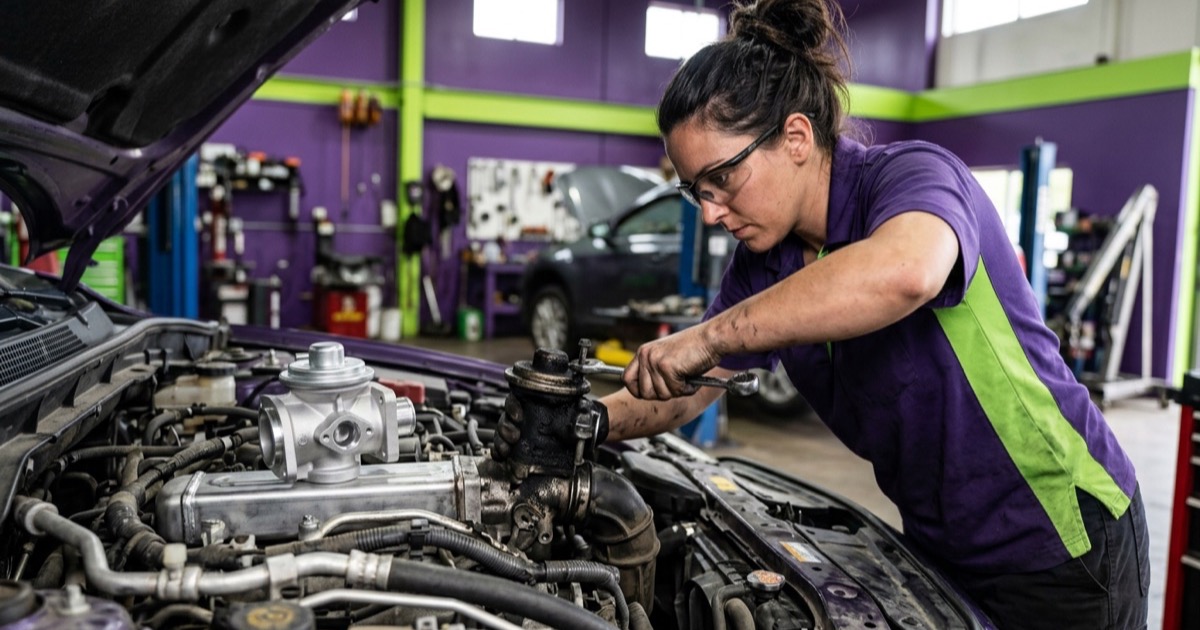
What the Job Is and What the Price Covers
EGR stands for exhaust gas recirculation. At cruise, the valve opens a little and lets some exhaust back into the intake. That inert gas takes up space in the cylinder, so the fire burns a bit cooler. Cooler burning makes less NOx, which is a major part of smog.
A standard replacement covers removing the old valve, cleaning carbon from the port it bolts to, fitting a new gasket and valve, and clearing codes. On electronic valves the shop should run a relearn or a test with a scan tool so the computer knows the new valve's position.
If the passages behind the valve are packed with carbon, a new valve alone will not fix the problem. Cleaning those passages can add an hour or more, and the quote should say so up front.
Some cars use a separate sensor or a vacuum solenoid to control the valve. If that small part failed, the valve may be fine. A good shop tests the control side before selling you the valve itself.
Clean It or Replace It?
Many EGR valves fail from carbon, not from a broken part. If the valve is the vacuum type, or an electronic valve whose motor still tests good, cleaning it and the ports can fix the problem for the price of labor and a gasket.
Replacement makes sense when the electric motor or position sensor inside has failed, the valve is cracked, or it is cheap enough that cleaning time costs more than a new part. On some cars a new valve is under $100. On others it is several hundred.
Ask the shop to tell you which kind of failure you have. A valve that tests bad electrically needs replacing. A valve that is only gummed up is often worth cleaning.
Cleaning is not free. It takes time to scrape and soak hard carbon, and on buried valves the labor can approach the cost of a new part. Ask the shop for both prices so you can choose with real numbers.
Why the Price Varies
Access is first. A valve on top of the engine bills about an hour. A valve at the back of a V6, under the intake plenum, can bill two to three hours.
The type of valve is second. Old vacuum-operated valves are cheap. Electronic valves with built-in position sensors cost more. Some designs combine the valve and the EGR cooler, and the cooler alone can be a big part.
Shop type matters too. Dealers use OEM valves and full book labor. Independent shops offer quality aftermarket choices. A mobile mechanic can do top-mounted valves in a driveway, but buried valves and diesel EGR jobs are better done in a shop.
Some engines skip the EGR valve and use cam timing to do the same job. If your car has no EGR valve and a shop quotes one, ask them to show you where it is.
What Often Gets Done at the Same Time
EGR jobs come with a few smart add-ons and a few that need a reason.
- Worth it: cleaning the EGR port and passages while the valve is out
- Worth it: a new gasket, never reuse the old one
- Worth it if failed: the EGR position sensor or vacuum solenoid that controls the valve
- Worth checking on diesels and some gas engines: the EGR cooler for leaks
- Ask for proof first: intake manifold cleaning or a throttle body service with no symptom
Make Sure It Is Really the EGR Valve
EGR codes are common, and so are wrong guesses. A code that says insufficient flow can mean a clogged passage, not a bad valve. A code that says excessive flow can mean a valve stuck open, or a bad sensor reading.
A good shop commands the valve open with a scan tool and watches the idle. If the idle drops or stumbles, the valve and passages are working. If nothing changes, flow is blocked. They can also check vacuum to the valve on older systems.
Rough idle and stalling also come from vacuum leaks, a dirty throttle body, or a bad idle air control valve. Pinging can come from low octane fuel or carbon in the cylinders. Testing first keeps you from buying a valve you did not need.
Emissions Tests and Why Deleting It Is a Bad Idea
A stuck or disconnected EGR valve will usually set a check engine light, and in most emissions test areas a lit check engine light means a fail. Fixing the valve is often the cheapest way through the test.
Some sellers push EGR delete kits, mostly for diesels. Removing or disabling emissions equipment on a road vehicle breaks federal law and state rules, and it can make the car impossible to pass inspection or register. It also makes the engine run hotter. Fix it, do not delete it.
If you live in a state with a smog program, the program website explains what counts as a pass and where to find a repair station.
Questions to Ask Before You Approve the Quote
These questions tell you whether the shop tested the system or just read the code.
- Did you command the valve open with a scan tool, and what happened?
- Is the valve bad, or are the passages clogged with carbon?
- Can this valve be cleaned instead of replaced?
- Does the price include cleaning the port and a new gasket?
- Is the replacement valve OEM or aftermarket, and what brand?
- Does the new valve need a relearn, and is that included?
- Will this fix pass my state emissions test?
Signs you need this repair
- Check engine light with an EGR flow or EGR position code
- Rough idle or stalling at stop lights
- Pinging or knocking when you accelerate or climb a hill
- Failed emissions test for high NOx
- Hesitation or surging at low speeds
- Lower fuel economy than usual
- Black soot around the valve on a diesel
Cost by vehicle type
| Vehicle | Typical range | Notes |
|---|---|---|
| Compact / economy car | $170 to $690 | Many compacts mount the valve on top of the intake or head where it is easy to reach. Parts are cheap and labor often lands near one hour. |
| Midsize sedan / small SUV | $185 to $750 | Four-cylinder models are usually simple. Some V6 models hide the valve at the back of the engine, which adds time and makes cleaning the passages harder. |
| Full-size truck / large SUV | $215 to $885 | Gas V8 trucks vary a lot. Some have no EGR valve at all, and others bury it under the intake. Rusty or carbon-seized bolts are common on older trucks. |
| Luxury / European | $270 to $1,095 | European engines often pair the valve with an EGR cooler and electronic controls, and OEM parts cost more. Expect the top of the range or above. |
| Hybrid | $205 to $825 | Many hybrids use cooled EGR to boost fuel economy, and short engine run times let carbon build up faster. Parts can cost more than on the gas version of the car. |
| Electric vehicle | Battery electric cars have no exhaust, so they have no EGR valve to replace. | |
| Diesel / heavy duty | $260 to $1,055 | Diesels run much more EGR and build heavy soot, so valves and coolers fail more often. A diesel EGR job, especially with a cooler, can run well over $1,000. |
Ranges assume national-average labor rates ($95, $140/hr) and quality aftermarket parts.
Cost by state
State ranges reflect typical independent-shop labor rates for a midsize vehicle.
Common questions
How much does it cost to replace an EGR valve?
Most gas cars run about $185 to $750 at an independent shop. Top-mounted valves on four-cylinders sit at the low end. Buried valves on V6 engines and electronic valves on newer cars push to the top, and diesels can run far higher.
Can I drive with a bad EGR valve?
You can usually drive with a bad EGR valve for a short time, but it is not a good idea for long. A valve stuck open can make the engine stall in traffic. A valve stuck closed can cause pinging that damages the engine over time.
Can an EGR valve be cleaned instead of replaced?
Yes, often. If the valve is just gummed with carbon and its motor and sensor still test good, cleaning the valve and its passages can fix it. If the electronics inside have failed, it needs replacing.
Will a bad EGR valve fail an emissions test?
Yes, in most cases. It usually turns on the check engine light, which fails most state tests, and a valve stuck shut can push NOx above the limit. Fixing the valve is often the cheapest way to pass.
Is it legal to delete or block off the EGR valve?
No, not on a road vehicle. Removing or disabling emissions equipment breaks federal law and state rules, and the car will likely fail inspection. A proper repair or cleaning is the legal fix.
How long does an EGR valve last?
Many last 100,000 miles or more on gas engines. Short trips, lots of idling and diesel soot make them clog sooner. Regular highway driving helps burn off some deposits.
How much does a dealer charge to replace an EGR valve?
Dealer prices for an EGR valve often run 30 to 60 percent higher than an independent shop. Dealers use OEM parts and bill full book time. For common gas cars, a quality aftermarket valve at an independent shop is usually a solid choice.
Can a mobile mechanic replace an EGR valve?
Yes, when the valve is on top of the engine and easy to reach. A mobile tech can swap it, clean the port and run a relearn with a scan tool in your driveway. Valves under the intake and diesel EGR coolers usually need a shop.
Related Repair Guides
More Exhaust Repair Costs
Sources and further reading
Primary sources behind this page. Federal safety, emissions and consumer-protection references, worth reading before you authorize any repair.
- EPA: Vehicle Emissions Inspection and Maintenance How state emissions test programs work and why the check engine light matters.
- California Bureau of Automotive Repair: Smog Check A state smog program's rules on emissions equipment and repairs.
- EPA: Mobile Source Pollution Federal background on NOx and other pollutants from cars and trucks.
Need Work Done? Get a Free Quote.
Tell us what the car is doing. A local mechanic calls you back, most requests get a call back the same day. No fee, no obligation.