What the Job Is and What You Are Paying For
Your exhaust runs from the engine to the back bumper. After the catalytic converter there is often a resonator, then the muffler, then the tailpipe. The muffler has baffles or chambers inside that cancel out engine noise.
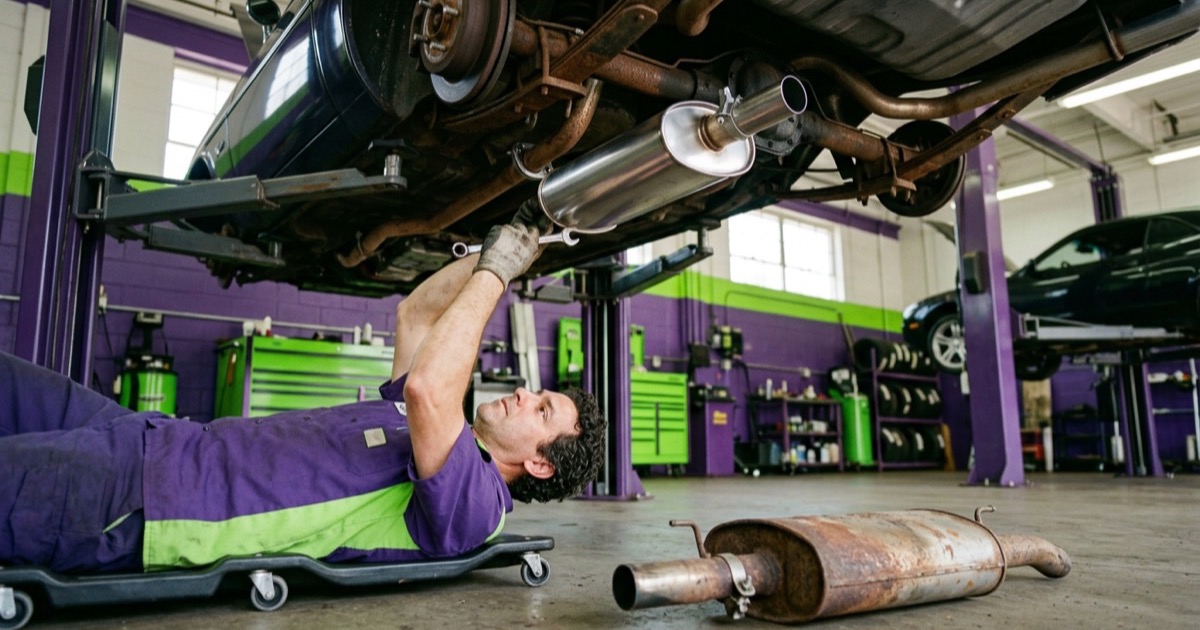
A muffler replacement takes the old muffler off and puts a new one in. On some cars it slides into the pipe and gets clamped. On many factory systems, the muffler is welded to the pipes, so the shop cuts the old one out, fits the new one, and clamps or welds the joints.
A proper job includes new clamps or welds, new rubber hangers if the old ones are cracked, and a check of the pipes in front and behind for rust. If the tailpipe is rotten, it gets replaced too.
Most of the cost is the part. Labor is often an hour or so. The national range on this page covers one muffler with clamps, hangers and basic pipe work on a common car. A full cat back system costs more.
Many mufflers come as part of a rear section that includes the tailpipe. If your car was built that way, the shop can either buy the whole section or cut out just the muffler and clamp in a new one. Cutting in is often cheaper and works fine when the pipe is solid. Buying the full section makes more sense when the tailpipe is also rusty.
Also ask if your car has a resonator. It looks like a small muffler further forward. Some shops call it a muffler, and some quotes mix the two up, so make sure you know which part is being replaced.
Why Mufflers Rust Out
Mufflers die from the inside first. Every time you start a cold engine, water forms in the exhaust. On short trips, the muffler never gets hot enough to boil that water off. It sits inside and rusts the steel.
That is why cars driven mostly on short trips eat mufflers. A car that drives an hour on the highway every day can keep its muffler for many years.
Road salt does the rest from the outside. In salt belt states, mufflers often last only a few years. In dry, warm states, they can last the life of the car.
Aluminized steel mufflers are cheaper and rust sooner. Stainless steel mufflers cost more and last much longer. If you plan to keep the car, stainless is often worth it.
Why the Price Varies So Much
The part type is the biggest factor. A universal aftermarket muffler can cost under $100. A direct fit muffler made for your car costs more but bolts in. A factory rear section from the dealer can cost several hundred dollars to over $1,000.
The pipe condition matters. If the pipes in front of the muffler are still solid, the job is quick. If they are rusted thin, the shop may need to replace them too.
The layout matters. A single muffler is quick. Dual exhaust with two mufflers costs about twice as much. Cars with active exhaust valves add parts and wiring.
The shop matters. Exhaust and muffler shops that bend pipe in house often charge the least and can custom fit a solution. Dealers often only sell the full factory rear section. A mobile mechanic can bolt in a direct fit muffler in a driveway, but jobs that need welding or pipe bending are better at a muffler shop.
What Usually Gets Done at the Same Time
Some add ons save you a second trip. Others are upsells.
Worth it every time are new rubber hangers if the old ones are cracked or stretched. They cost very little and keep the new muffler from hanging low.
Worth it if rusted is the tailpipe. A new muffler bolted to a rotten tailpipe will leak again soon.
Worth checking is the resonator and the pipe from the converter back. If they have holes, fixing them now saves a second visit.
Worth thinking about is a cat back system on some trucks and cars. If the muffler, resonator and pipes are all rusty, a full system can be cheaper than piecing it together.
Usually an upsell is a loud performance muffler you did not ask for, or a new catalytic converter without a code or a test showing it failed.
- Rubber hangers: replace if cracked
- Tailpipe: replace if rusted thin
- Resonator and rear pipes: check and fix if leaking
- Full cat back system: consider if everything is rusty
- Performance muffler: only if you want the sound
- Catalytic converter: only with a code or a failed test
Make Sure It Is Really the Muffler
A loud exhaust does not always mean a bad muffler. The leak can be anywhere from the engine back.
A ticking at the front of the engine, loudest when cold, is often an exhaust manifold leak. That is a different job.
A deep roar from under the middle of the car can be a flex pipe or a joint near the converter.
A rattle under the car is often a loose heat shield, not the muffler. A cheap clamp can fix it.
A rattle from inside the muffler itself means the baffles have broken loose. That muffler needs replacing.
A good shop puts the car on a lift, runs the engine, and finds the leak by sound or by feel. Ask them to show you the hole or the broken part.
Questions to Ask Before You Approve the Quote
Muffler quotes are usually simple. These questions keep them honest.
- Can you show me the hole or the rust on my muffler?
- Is the new muffler direct fit, universal, or factory, and is it aluminized or stainless?
- Does the price include clamps, hangers and any welding?
- Are the pipes in front and behind solid enough to keep?
- Do I have one muffler or two, and are you quoting both?
- What is the warranty on the muffler and the labor?
- Will this pass my state inspection for noise and leaks?
Noise Laws and Inspection
Most states require a working muffler. A car without one, or with a muffler that is too loud, can get a ticket or fail a safety inspection.
Some states also check exhaust leaks during inspection, because a leak in front of the oxygen sensors can affect the emissions test.
Removing a catalytic converter or other emissions parts is against federal law, even if you replace the muffler. Ask for a legal muffler that keeps all emissions parts in place.
Signs you need this repair
- Exhaust much louder than normal, especially on startup
- Rumbling or roaring that gets worse when you speed up
- Rattle from the back of the car at idle or over bumps
- Muffler hanging low or dragging on bumps
- Visible rust holes or flaking on the muffler
- Exhaust smell near the back of the car or inside the cabin
- Water dripping from rust holes in the muffler body
Cost by vehicle type
| Vehicle | Typical range | Notes |
|---|---|---|
| Compact / economy car | $150 to $495 | Compact cars usually have one small muffler and simple hangers, so this is often an hour job with an aftermarket muffler under $150. Many factory systems combine the muffler and tailpipe in one piece. |
| Midsize sedan / small SUV | $165 to $545 | Midsize cars are similar to compacts. Some V6 models have a dual outlet or a muffler welded to the rear pipe, which pushes toward the middle of the range. |
| Full-size truck / large SUV | $195 to $645 | Trucks often have a large muffler mid frame and a long tailpipe. Parts cost more and the tailpipe may need replacing too if it is rusted. |
| Luxury / European | $245 to $805 | Many luxury cars have dual mufflers, stainless parts and exhaust valves that open and close. Factory rear sections can cost $800 to $2,000, so ask about a quality aftermarket or a cut in repair. |
| Hybrid | $185 to $600 | Hybrids have a normal muffler, often smaller. The job is the same as a gas car. On some, the muffler sits near a heat shield over the hybrid battery area, so the shop should be careful. |
| Electric vehicle | Electric cars have no exhaust system and no muffler, so this repair does not apply. | |
| Diesel / heavy duty | $235 to $770 | Many newer diesels have a diesel particulate filter and other emissions parts in place of a classic muffler. Some still use a small muffler after them, but the price is far higher if the emissions parts are involved. |
Ranges assume national-average labor rates ($95, $140/hr) and quality aftermarket parts.
Cost by state
State ranges reflect typical independent-shop labor rates for a midsize vehicle.
Common questions
How much does it cost to replace a muffler?
Most cars land around $170 to $550 at an independent or muffler shop. A simple aftermarket muffler on a compact car can come in under $200. Dual exhaust, stainless parts, or factory rear sections on luxury cars cost more.
Can I drive with a bad muffler?
You can drive short term if it is just loud and nothing is hanging. Get it fixed soon if you smell exhaust inside the car, because carbon monoxide can build up in the cabin. A loud exhaust can also get you a ticket.
How long do mufflers last?
Many last five to ten years or more. Cars that drive short trips or live where roads are salted often need mufflers sooner. Stainless steel mufflers last longer than aluminized steel.
Is it illegal to drive without a muffler?
In most states, yes. State vehicle codes generally require a working muffler that keeps noise down. Driving without one can lead to a ticket or a failed inspection.
Can a bad muffler cause a check engine light?
A muffler leak by itself rarely sets a code because it sits behind the oxygen sensors. A leak closer to the engine can let in air and cause sensor codes. If you have a code, check further up the exhaust.
Should I get a muffler from a muffler shop or a dealer?
A muffler shop is often cheaper and can fit a direct fit or custom part. A dealer usually sells only the factory rear section, which can cost far more. Both are fine if the work is clean and warrantied.
Can I just patch a hole in my muffler?
A muffler patch or wrap can quiet a small hole for a few months. If the muffler is rusted through in several spots, a patch will not last. Replacement is usually cheap enough to just do.
Will a new muffler make my car quieter than before?
A direct fit muffler should bring the sound back to about where it was when the car was new. If the car is still loud after the new muffler goes in, there is another leak further up the exhaust, often at the flex pipe, a joint near the converter, or the manifold.
Related Repair Guides
More Exhaust Repair Costs
Sources and further reading
Primary sources behind this page. Federal safety, emissions and consumer-protection references, worth reading before you authorize any repair.
- EPA carbon monoxide Why carbon monoxide from exhaust is dangerous and hard to notice.
- EPA vehicle emissions inspection programs Background on state inspection programs that check exhaust and emissions.
- California Smog Check program How California checks emissions parts and exhaust during a Smog Check.
Need Work Done? Get a Free Quote.
Tell us what the car is doing. A local mechanic calls you back, most requests get a call back the same day. No fee, no obligation.