
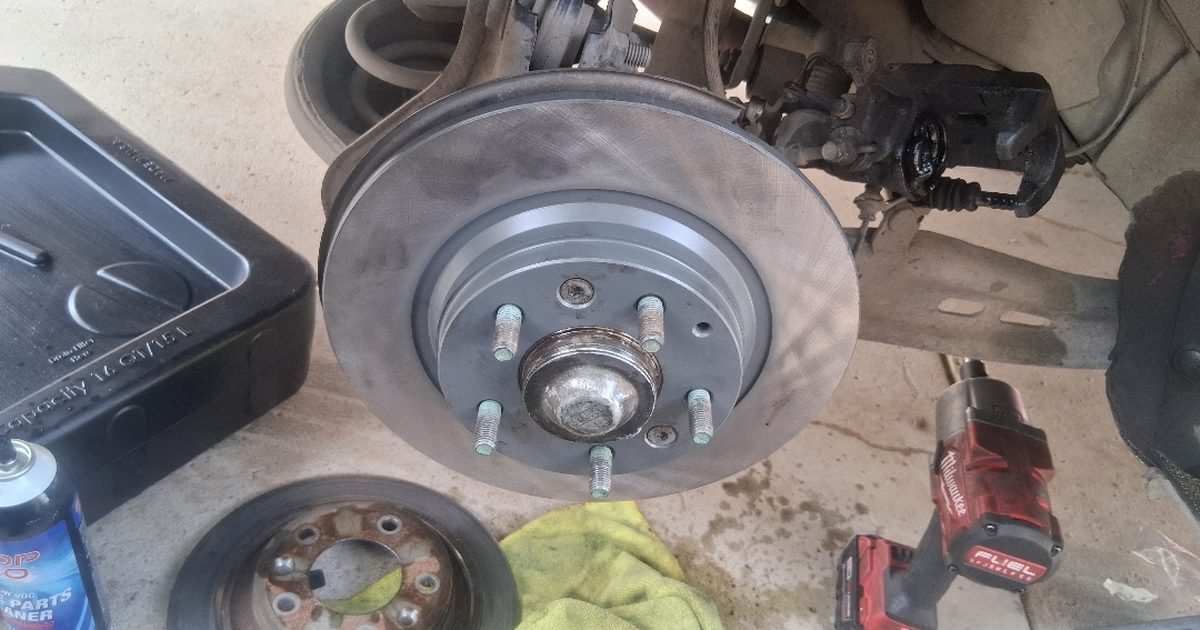
What brake pads are, and how they wear out
Brake pads are blocks of friction material bonded to a steel backing plate. Two of them sit inside each caliper, one on either side of a spinning rotor. Press the pedal, and hydraulic pressure squeezes the caliper's piston, clamping the pads against the rotor face. The friction converts your car's motion into heat, and the car slows down.
That friction material is designed to sacrifice itself. Every stop shaves off a microscopic layer, which is where most of the black dust on your wheels comes from. A new pad starts with roughly 10 to 12 millimeters of material; by 3 millimeters it is due for replacement, and at 2 millimeters or less most shops will tell you not to leave the lot without new ones.
How fast pads wear depends almost entirely on how and where you drive. A highway commuter might see 60,000 miles or more from a set of front pads. A city driver in stop-and-go traffic, a rideshare car, or anyone who lives at the bottom of a long hill might wear through the same pads in 25,000 miles. Front pads wear roughly twice as fast as rears on most vehicles, because weight transfers forward under braking and the front axle does 60 to 80 percent of the stopping work.
Most pads carry a built-in warning: a small steel tab that contacts the rotor when the material gets thin, producing a high-pitched squeal at low speed. That squeal is not a failure — it is the pad telling you it is time. Ignore it long enough and the squeal becomes a grind, which means the friction material is gone and steel is eating your rotor.
What a quality pad replacement includes
A proper pad job is always done in axle pairs — both front wheels or both rear wheels together, never a single corner. Uneven friction side-to-side makes the car pull under braking, so any shop offering to do one wheel is a shop to walk away from.
Beyond the pads themselves, a quality job should include new abutment hardware — the small stainless clips the pads ride on. Old clips lose their spring tension and collect rust, which is a leading cause of squeaks and uneven pad wear after a cheap pad swap. A hardware kit runs $25 to $60 per axle and is the best money in the whole job.
The rotors should be measured, not just eyeballed. Every rotor has a minimum thickness stamped on it, and a tech with a micrometer can tell you in thirty seconds whether yours will safely survive another pad set. The rotor faces should also be checked for scoring, heat spots, and lips at the outer edge.
The caliper slide pins — the pins the caliper floats on — should be pulled, cleaned, and re-greased. A seized or dry slide pin makes the caliper drag one pad constantly, wearing it out in a fraction of its normal life and cooking the rotor.
Finally, the new pads need bedding in: a series of moderate-to-firm stops from around 30 to 40 mph that transfers an even film of friction material onto the rotor face. A shop that hands you the keys without a bed-in drive, or at least instructions to do it yourself, skipped the last step of the job.
Why the price varies so much
Pad material is the first variable. Semi-metallic pads are the budget option — they bite hard and shed heat well but dust heavily and can be noisy. Ceramic pads cost more, run quieter, and keep wheels cleaner, which is why they dominate the mid-range. OEM pads from the dealer parts counter usually cost the most and matter most on vehicles engineered around a specific friction compound — many European makes fall in this camp. The spread between a bargain semi-metallic set and an OEM ceramic set can easily be $60 or more per axle.
The vehicle itself is the second variable. A compact car with small single-piston calipers is at the bottom of the range; a heavy-duty truck or a European sedan with multi-piston calipers and wear sensors sits at the top. Some performance and luxury models also take meaningfully longer to service, which adds labor time.
Labor rates are the third variable, and they swing widely by region and shop type. The same hour of brake work can cost nearly double in a high-cost metro dealer compared to an independent shop in a lower-cost area. Because pad replacement is a driveway-friendly job — hand tools and a jack, no lift required — mobile mechanics are competitive here and often undercut shop quotes on identical parts.
The biggest jump in any brake quote, though, is rotors. If yours are worn under minimum thickness, scored, or warped, adding a pair of rotors can double the total. That is not an upsell when the measurements justify it — but you should always see the measurements.
How a mechanic does the job
The vehicle goes up, the wheels come off, and the tech starts with an inspection: pad thickness on both sides of each rotor, rotor condition and thickness, brake fluid level and color, and a look at the flexible brake hoses.
On each corner, the caliper unbolts from its bracket and gets hung on a hook — never left dangling by its rubber hose. The old pads slide out, the old abutment clips come off, and the bracket gets a wire-brush cleaning where the new clips will seat. The slide pins are pulled, wiped down, inspected for pitting, and re-greased with high-temperature brake grease.
Before the new pads go in, the caliper piston has to be pushed back into its bore to make room for the fresh, thicker friction material. On many modern rear calipers with electronic parking brakes, this step requires a scan tool to retract the piston electronically — one of several reasons rear pad jobs on newer cars are not quite the simple task they used to be.
New clips snap into the bracket, the new pads slide in with a dab of grease on their contact ears, and the caliper bolts back on with the bracket and guide bolts torqued to spec — not guessed at with an impact gun. The tech pumps the brake pedal until it firms up, checks the fluid level, torques the wheels, and takes the car out for a bed-in drive: a series of firm stops that mates the new pads to the rotor surface. Done right, the whole job on one axle takes about an hour.
How to save money on this repair
Start with a free inspection. Most shops and many mobile mechanics will measure your pads at no charge, and pad thickness is an objective number — 8 millimeters means you have plenty of life left no matter what a service advisor's checklist says. Getting the actual measurement stops you from paying for brakes early.
Compare quotes, and include a mobile mechanic in the mix. Pad replacement needs hand tools, a jack, and a torque wrench, not a lift, so it is one of the best repairs to have done in your driveway. Mobile quotes on this job frequently come in 10 to 20 percent under shop pricing for the same parts.
Push back on scare tactics. "Your brakes could fail any moment" attached to pads with half their material left is a sales script, not a diagnosis. Ask for the pad measurements in millimeters and the rotor thickness against the stamped minimum. A trustworthy shop volunteers those numbers; a pressure shop changes the subject.
Do not cheap out on the pads themselves, though. The gap between bargain-bin pads and a quality ceramic set is modest per axle, and the cheap ones dust more, squeal more, stop worse, and wear out sooner — so you pay the labor again that much earlier. Spend on the friction material, save on where the work gets done.
Finally, do not skip the hardware kit to shave a few dollars off the quote. Reused clips are the number one cause of the annoying squeak that shows up two weeks after a budget pad job.
When rotors have to be added
Pads and rotors wear as a pair, and roughly every other pad change the rotors come due too. There are three situations where new rotors are not optional.
First, thickness. Every rotor carries a minimum thickness spec stamped into the hat or the edge. If a rotor measures at or under that number — or will wear under it before the new pads are used up — it must be replaced. A rotor that is too thin cannot absorb and shed heat properly, which leads to fade on long descents and warping under hard use.
Second, damage. Deep grooves from metal-on-metal contact, heat cracks, or hard spots that show up as blue-black patches all condemn a rotor regardless of thickness. New pads clamped onto a scored rotor wear fast, stop poorly, and never bed in evenly.
Third, pulsation. If the pedal or steering wheel shudders under braking, the rotor faces have uneven thickness. Resurfacing can sometimes fix this on a thick enough rotor, but new rotors have become cheap enough that most shops replace rather than machine.
What rotors are not is automatic. Rotors within spec, with smooth faces and no pulsation, can absolutely take a second set of pads — and on gently driven cars, sometimes a third. When a shop adds rotors to the estimate, the only question you need to ask is: what do they measure, and what is the minimum? If the numbers support it, pay for the rotors without guilt, because pads on bad rotors is money thrown away. If nobody can produce the numbers, get a second opinion.
Signs you need this repair
- High-pitched squeal from the wheels at low speed that fades when you press the brakes
- Grinding or growling when braking — the sign that pad material is gone and steel is on the rotor
- Longer stopping distances or a pedal that needs more pressure than it used to
- The car pulls to one side under braking
- A brake warning light or pad-wear message on the dash (common on European makes and newer cars)
- Heavy black brake dust caked on one wheel but not the others
- Visible pad material thinner than about 3 millimeters when you look through the wheel spokes
Cost by vehicle type
| Vehicle | Typical range | Notes |
|---|---|---|
| Compact / economy car | $120 to $340 | The cheapest version of this job — small pads, simple single-piston calipers, and quick labor times keep the total low. |
| Midsize sedan / small SUV | $125 to $360 | Routine work at routine prices. Many run larger front rotors than compacts, which nudges parts cost up slightly if rotors are added. |
| Full-size truck / large SUV | $145 to $420 | Bigger pads and heavier calipers cost more, and towing or hauling can cut pad life in half compared to commuter duty. |
| Luxury / European | $180 to $515 | Expect the high end of the range. Many German makes require OEM-grade pads with wear sensors, and the sensor wire adds a small parts line to every pad job. |
| Hybrid | $140 to $395 | Regenerative braking stretches pad life dramatically — 100,000-mile original pads are common — but pads that barely get used can rust and seize in the caliper, so periodic brake service still matters. |
| Electric vehicle | $145 to $415 | Same story as hybrids, amplified: regen handles most stops, so pads can last the life of the car. The real risk is corrosion and seizure from disuse, which is why EV makers recommend periodic caliper service even with plenty of pad left. |
| Diesel / heavy duty | $175 to $500 | Heavy-duty pads, multi-piston calipers, and longer labor times put these trucks at the top of the price range. |
Ranges assume national-average labor rates ($95, $140/hr) and quality aftermarket parts.
Cost by state
State ranges reflect typical independent-shop labor rates for a midsize vehicle.
Common questions
How long do brake pads last?
Anywhere from 25,000 to 70,000 miles depending on driving. Highway commuting is easy on pads; city stop-and-go, mountain descents, towing, and rideshare duty wear them fast. Front pads typically wear about twice as fast as rears, and hybrid or EV pads can last 100,000 miles or more thanks to regenerative braking.
Ceramic or semi-metallic — which pads should I buy?
For most daily drivers, ceramic: quieter, far less dust, and consistent everyday stopping. Semi-metallic pads cost less and handle extreme heat better, which suits towing, heavy trucks, and hard driving, but they dust heavily and can squeal. If your vehicle came with a specific OEM compound — common on European makes — matching it is usually worth the extra cost.
Why do front pads wear out faster than rear pads?
Weight shifts forward every time you brake, so the front axle does 60 to 80 percent of the stopping work. It is completely normal to replace front pads once or even twice before the rears come due — which is also why this repair is priced per axle rather than for the whole car.
Do I need new rotors every time I get pads?
No. Rotors are replaced when they measure under their stamped minimum thickness, are scored or heat-damaged, or cause pedal pulsation — not on a schedule. Rotors in good shape can take a second set of pads. Ask for the thickness measurements before approving rotors on the estimate; a good shop offers them without being asked.
Can a mobile mechanic replace brake pads at my home?
Yes — pad replacement is one of the best repairs to have done in your driveway. It needs hand tools, a jack, and a torque wrench, not a lift, and mobile quotes often run 10 to 20 percent under shop pricing for the same parts. Just confirm the quote includes new hardware clips and a proper bed-in procedure.
What happens if I keep driving on worn pads?
Once the friction material is gone, the pad's steel backing grinds directly on the rotor. Stopping distances get longer, the noise gets ugly, and within days the rotor face is grooved beyond saving — turning a pad-only job into a pad-and-rotor job at roughly double the cost. In the worst case the backing can dig in far enough to damage the caliper too.
My EV or hybrid barely uses its brakes — do the pads still need service?
Yes, just for a different reason. Regenerative braking means the pads may never wear thin, but pads and calipers that rarely get used collect rust and can seize, causing drag, noise, and uneven braking. Periodic brake service — cleaning and lubricating the calipers and hardware — keeps a lightly used system healthy, and most EV makers recommend it on a time interval rather than a mileage one.
Related Repair Guides
More Brakes Repair Costs
Sources and further reading
Primary sources behind this page. Federal safety, emissions and consumer-protection references, worth reading before you authorize any repair.
- NHTSA recall & complaint lookup Check any symptom against open recalls and technical service bulletins before paying for a repair.
- NHTSA TireWise Federal guidance on tire age, load ratings, pressure and tread depth.
- FTC auto repair basics Your rights on estimates, authorization and disputed repair bills.
- DOE Alternative Fuels Data Center: electric vehicles Federal reference on EV drivetrains, batteries and charging.
Need Work Done? Get a Free Quote.
Tell us what the car is doing. A local mechanic calls you back, most requests get a call back the same day. No fee, no obligation.