What a Brake Fluid Flush Includes
Your brake pedal does not stop the car by itself. It pushes fluid through steel and rubber lines to each wheel, where that fluid squeezes the pads or shoes. The fluid has to be clean, free of air and able to take heat.
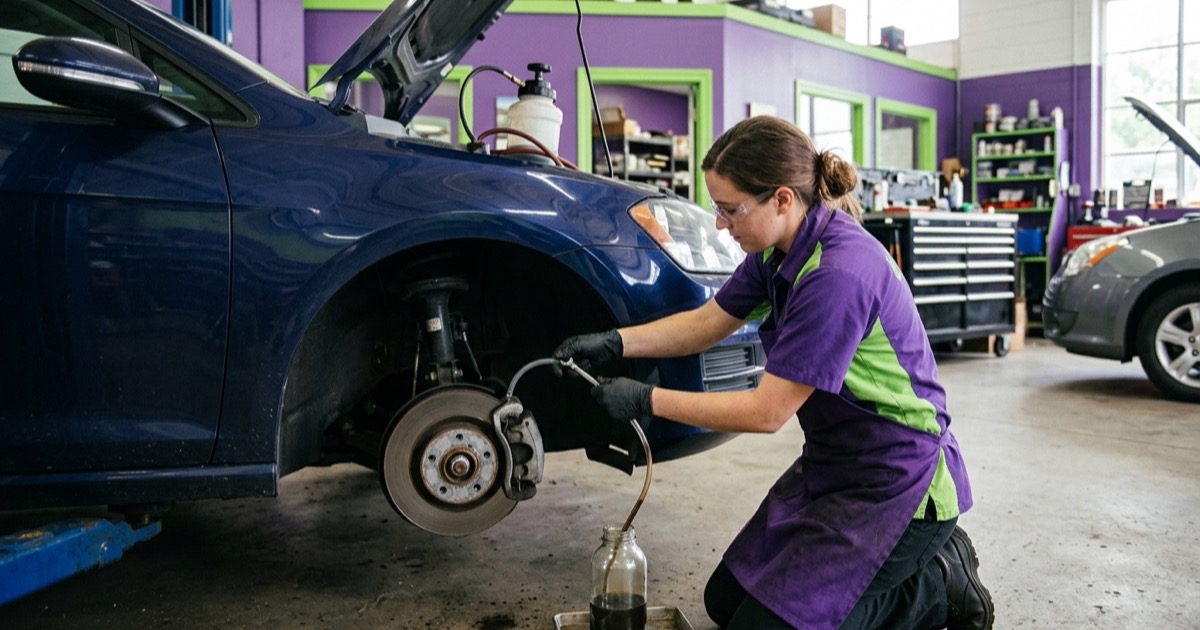
A flush replaces nearly all of it. The tech empties most of the old fluid from the reservoir and refills it with new. Then they open the bleeder screw at each wheel, one at a time, and push fluid through until clean fluid comes out with no bubbles. They start at the wheel farthest from the master cylinder and work toward the closest one, unless the maker calls for a different order.
That is different from a top-off. Adding fluid to the reservoir does nothing about the old, wet fluid sitting in the calipers. It is also different from a bleed, which pushes out air but may leave plenty of old fluid behind.
- Check fluid condition with a test strip or tester before starting
- Remove old fluid from the reservoir and refill with the correct type
- Open each bleeder in order and push fluid through until it runs clean and bubble-free
- Cycle the ABS unit with a scan tool if the car calls for it
- Torque the bleeders, top off to the full line and check for leaks
- Test the pedal feel before the road test
Why Brake Fluid Goes Bad
Most brake fluid is glycol-based, and glycol pulls water out of the air. The water gets in through rubber hoses, seals and the reservoir cap every time it breathes. You cannot stop it. You can only replace the fluid before there is too much.
Water lowers the boiling point. Under the federal standard, fresh DOT 3 fluid must not boil below 401 degrees F. Once it has soaked up water, the minimum drops to 284 degrees F. DOT 4 starts higher, at 446 degrees F dry and 311 degrees F wet.
That gap matters on a mountain grade or in a run of hard stops. Brakes turn speed into heat, and that heat soaks into the fluid in the calipers. If the fluid boils, it makes vapor bubbles. Vapor squishes, and the pedal sinks toward the floor.
Water also causes rust. The inside of your calipers, the steel lines and the tiny valves in the ABS unit can corrode. A sticking caliper costs a few hundred dollars. A failed ABS module can cost far more. A flush every few years is cheap insurance against both.
Why the Price Varies
Most independent shops charge about $80 to $150 for a brake fluid flush. Dealers often run $120 to $200. The fluid itself is cheap, so you are paying almost all labor.
The fluid type changes the bill a little. Basic DOT 3 is the cheapest. DOT 4 and the low-viscosity DOT 4 that many European cars need cost more. DOT 5.1 for some performance cars costs more again. Silicone DOT 5 is a different chemical and must never be mixed with the others.
The ABS step is the big swing. On many cars built in the last 15 years, a full flush needs a scan tool to run the ABS pump and open its valves so old fluid gets pushed out of the module. Shops without a good scan tool may skip it. Ask.
Rusty bleeder screws add time. If one snaps off, the caliper may need to be replaced. On older trucks and cars from snowy states, that risk is real, and an honest shop will warn you before they start.
A mobile mechanic can flush brake fluid in a driveway on most cars. Ask if they carry a pressure bleeder and a scan tool that handles your ABS system.
What Usually Gets Done at the Same Time
The best time for a flush is during a brake job. The wheels are already off, a new caliper or pads may be going on, and the system often needs a bleed anyway. Doing the flush then saves a good chunk of labor.
If a caliper is being replaced, the shop has to bleed at least that wheel. Paying a little more to flush the whole system is usually smart.
A flush is a good time to look at the rubber brake hoses at each wheel. Cracked or swollen hoses should be replaced. The shop should also check the master cylinder for leaks at the back, where it meets the brake booster.
If your car has a hydraulic clutch that shares the brake fluid reservoir, the clutch line should get flushed too. Many shops forget it, and it rusts the same way.
A fuel system cleaning or an engine flush sold alongside a brake flush has nothing to do with your brakes. Treat those as separate decisions.
How to Tell If You Really Need It
Start with your owner's manual. Many makers say every two or three years, with no mileage limit. Some list it under severe service only. If your car is past that time and you have no record of a flush, you likely need one.
Color is a weak test. Fresh fluid is clear to light amber. Dark fluid is often old, but fluid can look fine and still hold a lot of water. A test strip that reads copper levels, or a boiling point tester, gives a real answer. Ask the shop to show you the reading.
A soft or sinking pedal is not always a fluid problem. It can mean air in the lines, a leak, a failing master cylinder or worn rear brakes that need adjusting. A flush will not fix a leaking caliper or a bad master cylinder.
A low fluid level usually means worn pads, not a leak. As pads wear, the caliper pistons move out and more fluid sits in the calipers. If the level is low and the pads are new, look for a leak before you just add fluid.
Questions to Ask Before You Approve the Quote
A brake fluid flush is easy to sell and easy to fake. A few questions sort the honest shops from the rest.
- What fluid type are you using, and does it match what is printed on my reservoir cap?
- Is this a full flush at all four wheels or just a reservoir swap?
- Will you cycle the ABS unit with a scan tool if my car calls for it?
- What did the test strip or boiling point test show on my current fluid?
- If a bleeder screw is seized or snaps, what will you do and what will it cost?
- Will you flush the clutch line too if it shares the reservoir?
- Can I see the old fluid that came out?
How Long a Flush Lasts
Fresh fluid starts soaking up water from day one. In a humid climate it picks up water faster. That is why most makers set a time interval of two to three years rather than a mileage number.
You can help it last. Keep the reservoir cap closed tight. Do not leave an open bottle of brake fluid on the shelf and use it a year later, because it has been pulling water from the air the whole time. Buy small sealed bottles.
If you tow, drive in the mountains or do track days, flush more often. Track drivers often flush before every event with a high-boiling DOT 4 fluid.
After a flush, the pedal should feel firm and high. If it feels softer than before, air got in somewhere. Take it back right away. A good shop will rebleed it free.
Signs you need this repair
- Brake pedal feels soft or spongy, or sinks farther than it used to
- Brakes fade or the pedal goes long on a long downhill or after hard stops
- Fluid in the reservoir looks dark brown or cloudy
- No record of a brake fluid change in the last two or three years
- A test strip or boiling point tester shows the fluid is worn out
- ABS or brake warning light, especially paired with a low fluid level
- Calipers sticking or dragging on an older car
Cost by vehicle type
| Vehicle | Typical range | Notes |
|---|---|---|
| Compact / economy car | $70 to $170 | Most compacts use common DOT 3 or DOT 4 fluid and have easy bleeder access. This is the low end of the range. |
| Midsize sedan / small SUV | $70 to $175 | A standard flush on most sedans takes under an hour. Cars with stability control may need a scan tool step to clear old fluid from the ABS unit. |
| Full-size truck / large SUV | $80 to $200 | Trucks hold more fluid, and the long lines to the rear axle take longer to bleed. Rusty bleeder screws on older trucks are the usual reason a quote climbs. |
| Luxury / European | $100 to $240 | Most European makers call for low-viscosity DOT 4 fluid and a strict two-year interval. Many require a scan tool bleed routine, so expect the top of the range. |
| Hybrid | $80 to $190 | Many hybrids use an electric brake actuator that must be put in a service mode before bleeding. A shop without the right scan tool should not do this one. |
| Electric vehicle | $85 to $200 | Pads may last 100,000 miles on an EV, but the fluid still absorbs water on a time clock. Some EVs use an electric brake booster that needs a scan tool bleed procedure. |
| Diesel / heavy duty | $95 to $235 | Heavy trucks hold more fluid and work their brakes hard when towing, which makes fresh fluid more important. Some use hydraulic boost tied to the power steering, which is a separate system. |
Ranges assume national-average labor rates ($95, $140/hr) and quality aftermarket parts.
Cost by state
State ranges reflect typical independent-shop labor rates for a midsize vehicle.
Common questions
How much does a brake fluid flush cost?
Most independent shops charge about $80 to $150 for a brake fluid flush. Dealers often charge $120 to $200. Cars that need a scan tool ABS bleed or special European fluid land at the top of that range.
How often should brake fluid be changed?
Most makers say every two to three years, no matter how many miles you drive. Brake fluid soaks up water over time, not over miles. Check your owner's manual for your exact interval.
Is a brake fluid flush really necessary or a scam?
It is a real service that your car's maker calls for. It becomes a scam only when a shop pushes it far ahead of schedule or charges for it without doing all four wheels. Ask to see a test result and check your manual's interval.
What happens if you never change your brake fluid?
The fluid fills with water, boils at a lower heat and rusts parts from the inside. You may get a soft pedal in hard braking, and over years you risk sticking calipers and a failed ABS unit. Those cost far more than a flush.
Can I just add brake fluid instead of flushing it?
Adding fluid only tops off the reservoir and does nothing about the old fluid in the lines and calipers. If the level is low, find out why, since worn pads or a leak are the usual causes. A flush is the only way to replace the old fluid.
Can I mix DOT 3 and DOT 4 brake fluid?
Yes, DOT 3, DOT 4 and DOT 5.1 are all glycol-based and can mix, but you should use what is on the reservoir cap. Never mix any of them with DOT 5, which is silicone-based. Mixing those can cause seal and pedal problems.
Can a mobile mechanic do a brake fluid flush?
Yes, on most cars a mobile mechanic can flush brake fluid in your driveway. Ask if they carry a pressure bleeder and a scan tool that can cycle your ABS. Hybrids and some EVs need special scan tool steps, so confirm before booking.
Related Repair Guides
More Brakes Repair Costs
Sources and further reading
Primary sources behind this page. Federal safety, emissions and consumer-protection references, worth reading before you authorize any repair.
- 49 CFR 571.116: Motor Vehicle Brake Fluids The federal standard that sets the dry and wet boiling points for DOT 3, DOT 4 and DOT 5.1 fluid.
- 49 CFR 571.135: Light Vehicle Brake Systems Federal brake performance standard for passenger cars and light trucks.
- DOE Alternative Fuels Data Center: EV maintenance Federal overview of the brake and fluid maintenance EVs still need.
Need Work Done? Get a Free Quote.
Tell us what the car is doing. A local mechanic calls you back, most requests get a call back the same day. No fee, no obligation.