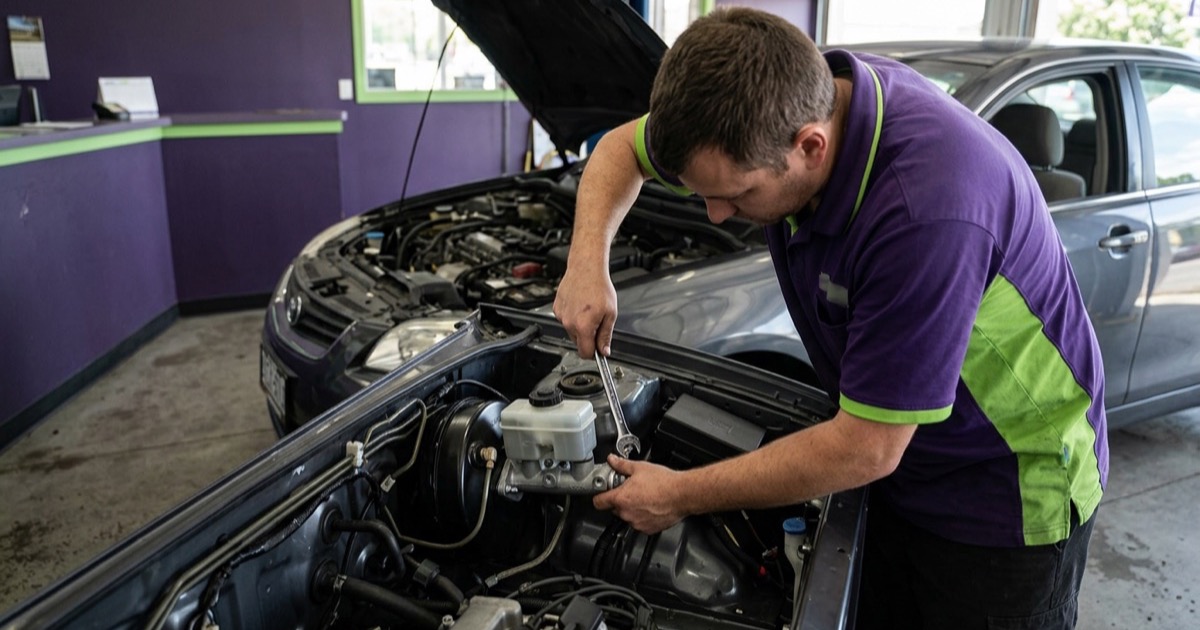
What the Master Cylinder Does and What the Job Includes
When you press the brake pedal, a rod pushes on pistons inside the master cylinder. Those pistons push brake fluid out through the lines to each wheel. The brake booster behind it helps you push, but the master cylinder makes the actual pressure.
Modern cylinders are split into two separate circuits. Most cars pair one front wheel with the opposite rear wheel. If one circuit fails, the other still stops the car, just not as well. That safety split is why a failing cylinder can feel strange instead of just failing all at once.
The job price should include the cylinder, a bench bleed, the install, a full system bleed and a road test. Some quotes also include a new reservoir or new fluid level sensor if the old one is cracked.
- Remove fluid from the reservoir and disconnect the brake lines
- Unbolt the old cylinder from the brake booster
- Bench bleed the new cylinder on a vise so it starts with no air inside
- Install it, connect the lines and torque everything to spec
- Bleed the full system at all four wheels, plus the ABS unit with a scan tool if required
- Check the pedal height and feel, then road test before handing back the keys
How to Tell If It Is Really the Master Cylinder
Diagnosis matters here, because a lot of other problems feel like a bad master cylinder. Shops replace good ones every day.
The classic sign is a pedal that slowly sinks while you hold steady pressure at a stop light. That means fluid is slipping past the seals inside. If the pedal stays firm under steady pressure, the cylinder is probably fine.
A spongy pedal is usually air in the lines, not a bad cylinder. A long pedal that firms up when you pump it often points to rear drum brakes that need adjusting. A hard pedal that takes a lot of force points to the brake booster, not the cylinder.
Low fluid with no wet spot at any wheel can mean the cylinder is leaking out the back into the booster. A tech can pull the cylinder a little away from the booster and look for fluid. A booster full of brake fluid usually needs replacing too.
Also check for leaks at the calipers, wheel cylinders and lines first. A leak anywhere will drop the fluid and soften the pedal, and a new master cylinder will not fix that.
- Pedal sinks slowly under steady pressure: likely master cylinder
- Spongy pedal that stays put: likely air in the lines
- Long pedal that firms when pumped: often rear brakes out of adjustment
- Hard pedal that needs a lot of force: likely the brake booster
- Fluid low with a wet wheel: a leak at that wheel, not the cylinder
Why the Price Varies
Most master cylinder jobs on everyday cars land between about $250 and $650 at an independent shop. Dealers often charge more, mainly for parts.
The cylinder itself is the first swing. A remanufactured unit from a good brand can cost under $100 on a common car. A new aftermarket cylinder costs more. A dealer part can cost two or three times as much. Ask which one is on the quote.
The bleed is the second swing. On an older car with no stability control, a pressure bleed at each wheel is enough. On many newer cars, the ABS unit has to be cycled with a scan tool so trapped air comes out. That takes more time and the right tool.
Access is the third. On most cars the cylinder sits right at the back of the engine bay. On some, cowl panels, battery trays or wiring have to move first.
The last one is hidden damage. If fluid leaked into the brake booster, the booster may need replacing too, which can double the bill. An honest shop will check and tell you before they start.
A mobile mechanic can replace a master cylinder in a driveway on many cars. Ask if they bring a scan tool that can run your ABS bleed. Hybrids and EVs with integrated brake units are dealer or specialist work.
New, Remanufactured or Rebuild Kit?
Remanufactured cylinders are the most common choice at independent shops. A good reman has been cleaned, honed and fitted with new seals. Brand matters. A cheap reman that fails in six months costs you the whole job again.
New aftermarket cylinders cost a bit more but skip the question of how well the old core was rebuilt. On many cars, they are the safest middle ground.
Dealer parts are worth it on cars where aftermarket options have a bad track record or simply do not exist, which is common on some European and newer models.
Rebuild kits with new seals used to be common. Today most shops avoid them. If the bore inside is pitted from water in the fluid, new seals will not hold, and labor to rebuild costs more than a reman unit.
What Usually Gets Done at the Same Time
A full brake fluid flush is part of the job in practice. The system gets bled anyway, so there is no reason to leave old fluid in it. Make sure the quote says flush, not just bleed.
Check the brake booster if there was any sign of fluid leaking out the back of the cylinder. A booster soaked in brake fluid can fail later and give you a hard pedal.
Look at the rubber brake hoses at each wheel. If they are cracked or swollen, now is a good time. Same with calipers that are sticking or bleeders that are seized.
If your car has a clutch that shares the reservoir, the clutch line needs to be bled as well.
Pads and rotors only need replacing if they are worn. A shop that bundles a full brake job with a master cylinder on a car with fresh pads is upselling.
Questions to Ask Before You Approve the Quote
Ask these before you say yes. The answers will tell you if the diagnosis is solid and if the job will be done right.
- What test showed the master cylinder is bad and not a leak, air or the booster?
- Is the part new, remanufactured or dealer, and what brand?
- Will you bench bleed the cylinder before install?
- Does my car need a scan tool ABS bleed, and do you have the tool?
- Did you check for fluid leaking into the brake booster?
- Is a full brake fluid flush included or just a bleed?
- What is the warranty on the part and on the labor?
How to Make It Last
The number one killer of master cylinders is old brake fluid. Water in the fluid rusts the bore. Rough spots in the bore chew up the seals, and the pedal starts to sink. A flush every two to three years keeps the inside clean.
The second killer is a bad bleed. Pushing the pedal all the way to the floor on an old cylinder moves the seals into a part of the bore they never touch in normal driving. Grit and rust there can tear them. Good techs use a pressure bleeder or limit pedal travel during a manual bleed.
Use only the fluid printed on the reservoir cap. The wrong fluid can swell the rubber seals.
A good master cylinder can last the life of the car. Most failures come from neglect, not age. If yours lasted 150,000 miles, the new one can too with fresh fluid on schedule.
Signs you need this repair
- Brake pedal slowly sinks toward the floor while you hold it at a stop
- Brake fluid level drops with no leak at any wheel
- Wet fluid where the master cylinder meets the brake booster
- Brake warning light on the dash, often with a low fluid level
- Pedal feels different from one stop to the next
- Brakes feel weaker or the car takes longer to stop
- Fluid in the reservoir looks dark or has bits in it
Cost by vehicle type
| Vehicle | Typical range | Notes |
|---|---|---|
| Compact / economy car | $210 to $625 | Compact cars have the cheapest cylinders and easy access at the back of the engine bay. Expect the low end of the range. |
| Midsize sedan / small SUV | $225 to $675 | Most sedans follow the standard pattern. If stability control is fitted, the bleed may need a scan tool step to push air out of the ABS unit. |
| Full-size truck / large SUV | $265 to $795 | Truck cylinders cost more and the long brake lines take longer to bleed. Some trucks use hydraulic boost from the power steering pump, which changes the diagnosis. |
| Luxury / European | $325 to $980 | Parts cost more and many makers require a scan tool bleed routine. Some models tuck the cylinder under cowl panels that add labor time. |
| Hybrid | $245 to $745 | Many hybrids use an electric brake actuator in place of a normal master cylinder and booster. Those units cost much more than a standard cylinder and fall outside this range. |
| Electric vehicle | $260 to $775 | Many EVs use an electric booster or a combined brake module. A failure there is usually a dealer-level repair priced well above a standard master cylinder. |
| Diesel / heavy duty | $315 to $945 | Heavy-duty trucks use large-bore cylinders, often with hydraulic boost. Parts land at the top of the range and some setups need extra bleeding steps. |
Ranges assume national-average labor rates ($95, $140/hr) and quality aftermarket parts.
Cost by state
State ranges reflect typical independent-shop labor rates for a midsize vehicle.
Common questions
How much does it cost to replace a brake master cylinder?
Most master cylinder replacements cost about $250 to $650 at an independent shop. Dealers often charge more for the part. Cars that need a scan tool ABS bleed, or that also need a new brake booster, cost more.
Can I drive with a bad master cylinder?
No, you should not. A sinking pedal means the cylinder is losing pressure inside, and it can get worse suddenly. The split circuits usually leave you some braking, but stopping distances get longer. Have it towed or driven a short distance carefully to a shop.
How do I know if it is the master cylinder or the brake booster?
A pedal that sinks slowly under steady pressure points to the master cylinder. A pedal that is very hard and needs a lot of force points to the booster. If fluid leaked out the back of the cylinder, both may need replacing.
Do you have to bleed all four brakes after replacing a master cylinder?
Yes, a full bleed at all four wheels is the normal way to finish the job. Even with a careful bench bleed, air can get into the lines during the swap. Many newer cars also need the ABS unit cycled with a scan tool.
What causes a brake master cylinder to fail?
Old brake fluid is the most common cause, because water in the fluid rusts the bore and wears the seals. A bad bleed that pushes the pedal to the floor on an old cylinder can also tear the seals. The wrong fluid type can swell them.
Is a remanufactured master cylinder good enough?
A good brand reman is fine for most cars and saves money. Cheap rebuilt units from unknown brands are where the comebacks come from. Ask the shop which brand they use and how long the warranty runs.
Can a mobile mechanic replace a master cylinder?
Yes, on many cars a mobile mechanic can do it in your driveway. Ask if they bench bleed and carry a scan tool that runs your car's ABS bleed. Hybrids and EVs with integrated brake units are better left to a specialist or dealer.
Related Repair Guides
More Brakes Repair Costs
Sources and further reading
Primary sources behind this page. Federal safety, emissions and consumer-protection references, worth reading before you authorize any repair.
- 49 CFR 571.135: Light Vehicle Brake Systems The federal brake standard, including the split-circuit failure tests that let a car stop with one circuit down.
- 49 CFR 571.116: Motor Vehicle Brake Fluids The federal standard for brake fluid types and their boiling points.
- fueleconomy.gov: hybrid technology DOE and EPA explanation of regenerative braking in hybrids, which uses a different brake control setup.
Need Work Done? Get a Free Quote.
Tell us what the car is doing. A local mechanic calls you back, most requests get a call back the same day. No fee, no obligation.