
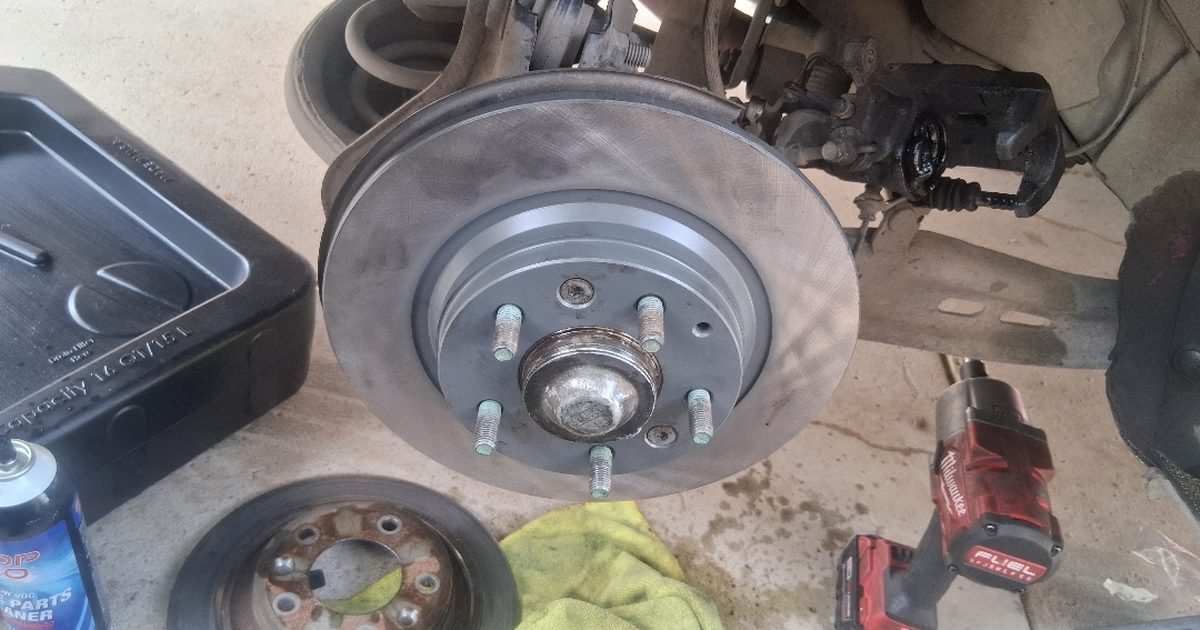
What brake rotors do, and how they fail
A brake rotor is the flat metal disc that spins with each wheel. When you press the pedal, the caliper squeezes the brake pads against both faces of the rotor, and that friction turns your speed into heat — a lot of heat. A single hard stop from highway speed can push rotor surface temperatures past 500 degrees.
Rotors fail in a handful of predictable ways. The most common complaint is a shake or pulse when braking, which mechanics call thickness variation: repeated heat cycles and uneven pad deposits leave the rotor microscopically thicker in some spots than others, so the pads grab and release as it spins. People call this warping, and while the rotor rarely bends like a potato chip, the effect on the pedal is the same. Rotors also get scored with deep grooves when pads wear down to metal, they rust — both on the friction surface and internally between the cooling vanes — and severe heat can leave hard spots or small surface cracks. Any of these means the rotor is done.
What's included in a brake rotor replacement
Like every friction repair, rotors are done in axle pairs — both fronts or both rears, never one corner alone. Mismatched rotors side-to-side cause uneven braking and pulling.
New pads come with the job in almost every case. Old pads wear into the shape of the old rotor's surface, so clamping them onto fresh flat rotors gives poor contact, noise, and glazing. The pads are also cheap relative to the labor you are already paying for, since the caliper comes off either way. Expect a shop to quote rotors and pads together as a single package.
A quality job also includes measuring the old rotors against the minimum-thickness spec stamped or cast into them (which is how the shop justifies replacement in the first place), cleaning the hub face down to bare metal with a wire wheel or abrasive disc so the new rotor sits perfectly flat, lubricating the caliper slide pins, and torquing the wheels properly with a torque wrench. A rusty or dirty hub face is the number one cause of a brand-new rotor pulsing within months — it holds the rotor a few thousandths of an inch off true, and that tiny wobble wears into thickness variation.
Resurfacing vs. replacing — why replacement usually wins now
For decades the standard fix for a pulsing rotor was resurfacing: machining a thin layer off both faces on a brake lathe to restore a flat, true surface. That still works in principle, but it has mostly died out in practice.
Modern rotors are made thinner and lighter to save weight and cost, which leaves very little material between the new thickness and the minimum-thickness spec. Machining off enough metal to clean up the surface often puts the rotor at or below its limit, and a thin rotor holds less heat, warps faster, and fades sooner. Meanwhile, aftermarket rotor prices have dropped to the point where a new rotor often costs about the same as the machine work, with none of the compromise.
So the honest math at most shops today: unless you have expensive performance or heavy-truck rotors with plenty of material left, replacement is the better value. If a shop suggests resurfacing thin economy-car rotors just to save a few dollars, that is a corner being cut.
Why the price varies so much
Rotor prices span a huge range. A plain economy-car rotor can be $30; a large coated rotor for a European SUV or heavy truck can run $150 or more — each, and you need two. Whether pads are included in the quote, and what grade of pads, moves the number further.
Labor is the second variable. On most cars this is a straightforward one-to-two-hour axle job, but rust-belt vehicles can add real time when rotors seize onto the hub, and some trucks and 4x4s require extra disassembly. Shop labor rates themselves vary widely by region — the same job costs noticeably more in a high-cost metro than in a rural area.
Finally, quotes differ in what they include. A bare-bones quote may reuse old pads (a bad idea), skip the hardware, or fit the cheapest uncoated rotors available. A thorough quote includes pads, hub cleaning, and caliper service. When comparing prices, make sure you are comparing the same job.
How a mechanic does the job
The wheel comes off, then the caliper is unbolted and hung on a hook or wire — never left dangling by its rubber brake hose. The caliper bracket comes off next, and then the rotor, which on a clean car slides off the studs and on a rusty car gets hammered, heated, or pressed off with a puller. Some rotors have a small retaining screw that frequently strips and has to be drilled out.
With the rotor off, the tech cleans the hub face to bare, flat metal — this step separates a good brake job from a comeback. The new rotor gets wiped down with brake cleaner to remove its shipping oil, then goes on, followed by the bracket, new pads, lubricated slide pins, and the caliper. The tech pumps the pedal to bring the pads back into contact before moving the car, repeats everything on the other side, torques the wheels, and finishes with a bed-in procedure: a series of moderate stops from about 30 to 40 mph to transfer an even layer of pad material onto the fresh rotor faces. Skipping bed-in is a common cause of early noise and pulsing.
How to save money on this repair
Get the rotors measured before agreeing to replace them. A shake in the wheel does not always mean the rotors are shot — sometimes it is pad deposits, a rusty hub, or even a worn suspension part, and a measurement against the minimum-thickness spec tells the truth. Ask to see the numbers.
Bundle the work: since pads and rotors share the same labor, doing them together costs far less than doing them months apart. Compare a mobile mechanic quote too — rotor and pad work needs hand tools and a jack, not a lift, so it is well suited to driveway service and mobile pricing often comes in under shop pricing for identical parts.
Spend a little more on coated rotors if you live where roads are salted; the coating keeps the hat and edges from rusting and makes the next brake job easier. Skip the false economy of the absolute cheapest white-box rotors — poor castings and uneven metallurgy are the main reason new rotors start pulsing within a year.
Signs you need this repair
- Steering wheel shakes or shimmies when you brake, especially from highway speed
- Brake pedal pulses or throbs underfoot during normal stops
- Deep circular grooves or scoring visible on the rotor face through the wheel
- A raised lip of rust or unworn metal around the rotor's outer edge
- Grinding or scraping noise when braking after the pads wear through
- Blue or dark discolored patches on the rotor surface from overheating
- Longer stopping distances or a brake pedal that feels weaker after repeated hard stops
Cost by vehicle type
| Vehicle | Typical range | Notes |
|---|---|---|
| Compact / economy car | $180 to $535 | Small, light rotors keep parts cost at the low end — this is one of the cheapest cars to do rotors on. |
| Midsize sedan / small SUV | $195 to $580 | Routine job with mid-range parts pricing. Front rotors wear roughly twice as fast as rears. |
| Full-size truck / large SUV | $230 to $685 | Big, heavy rotors cost more, and towing or hauling shortens their life. Some 4x4 hubs add removal labor. |
| Luxury / European | $285 to $845 | Larger performance rotors and stricter wear specs push parts cost up — often past the top of this range. Many European brands treat rotors as a wear item replaced with every second pad set. |
| Hybrid | $215 to $640 | Regenerative braking means rotors see little friction use. Surface rust and corrosion, not wear, is the usual reason they get replaced. |
| Electric vehicle | $225 to $665 | Regen does most of the stopping, so EV rotors commonly rust out from disuse rather than wearing thin. Occasional firm stops help keep the surfaces clean. |
| Diesel / heavy duty | $275 to $815 | Heavy-duty rotors are expensive, and dually or full-floating rear axles can add significant labor time. |
Ranges assume national-average labor rates ($95, $140/hr) and quality aftermarket parts.
Cost by state
State ranges reflect typical independent-shop labor rates for a midsize vehicle.
Common questions
Why do I have to buy new pads with new rotors?
Used pads wear into the contour of the old rotor's surface. Clamped against a fresh flat rotor, they touch only at the high spots — which means weak braking at first, then noise, glazing, and uneven deposits that make the new rotors pulse. Since the caliper is already off for the rotor swap, the pads add little labor and protect the money you just spent.
Can rotors still be resurfaced instead of replaced?
Sometimes, but rarely on modern cars. Today's rotors are made thin to save weight, so machining them flat often takes them at or below the minimum-thickness spec stamped on the rotor. With aftermarket rotors now costing about the same as the machine work, most shops replace rather than resurface. Resurfacing still makes sense for expensive performance or heavy-truck rotors with material to spare.
How long do brake rotors last?
Typically 30,000 to 70,000 miles, or roughly one to two sets of pads. Highway commuters see the high end; city stop-and-go, mountain driving, towing, and salted winter roads push toward the low end. Hybrids and EVs are the exception — regenerative braking uses the rotors so little that rust, not wear, usually ends their life.
Is it safe to drive with warped rotors?
For a short time, yes — the car still stops. But the shake gets worse, the uneven contact accelerates pad wear, and badly worn or below-spec rotors handle heat poorly, which can mean brake fade in a long downhill or an emergency stop. Treat a braking shake as a book-the-appointment symptom, not an ignore-it one.
Are cheap rotors okay, or should I pay for coated ones?
Mid-grade name-brand rotors are the sweet spot. The very cheapest white-box rotors often have inconsistent castings that develop thickness variation quickly — the pulsing comes back within a year. Coated rotors cost $10 to $20 more each and are worth it in rust-prone climates: the coating keeps the non-friction surfaces from corroding and keeps the rotor from seizing to the hub.
Do rotors get replaced in pairs?
Yes — always both rotors on the same axle, along with a full axle set of pads. Replacing one side leaves different friction and heat behavior left-to-right, which causes pulling and uneven wear. Front and rear axles can be done at different times, though, since they wear at different rates.
Can a mobile mechanic replace brake rotors at my home?
Yes. Rotor and pad replacement needs hand tools, a jack and stands, and a torque wrench — no lift required — which makes it one of the most driveway-friendly repairs there is. Mobile quotes often come in 10 to 20 percent under shop quotes for the same parts, and you can watch the old rotors get measured.
What affects the cost of replacing brake rotors?
Rotor quality, front or rear axle, and your vehicle all change the price. Heavy trucks and performance cars use costlier rotors. Most shops also suggest new pads with new rotors, which adds to the total. Ask what is included. Brakes are a safety item, so get the quote in writing and do not delay needed work.
Related Repair Guides
More Brakes Repair Costs
Sources and further reading
Primary sources behind this page. Federal safety, emissions and consumer-protection references, worth reading before you authorize any repair.
- NHTSA recall & complaint lookup Check any symptom against open recalls and technical service bulletins before paying for a repair.
- NHTSA TireWise Federal guidance on tire age, load ratings, pressure and tread depth.
- FTC auto repair basics Your rights on estimates, authorization and disputed repair bills.
- DOE Alternative Fuels Data Center: electric vehicles Federal reference on EV drivetrains, batteries and charging.
Need Work Done? Get a Free Quote.
Tell us what the car is doing. A local mechanic calls you back, most requests get a call back the same day. No fee, no obligation.