
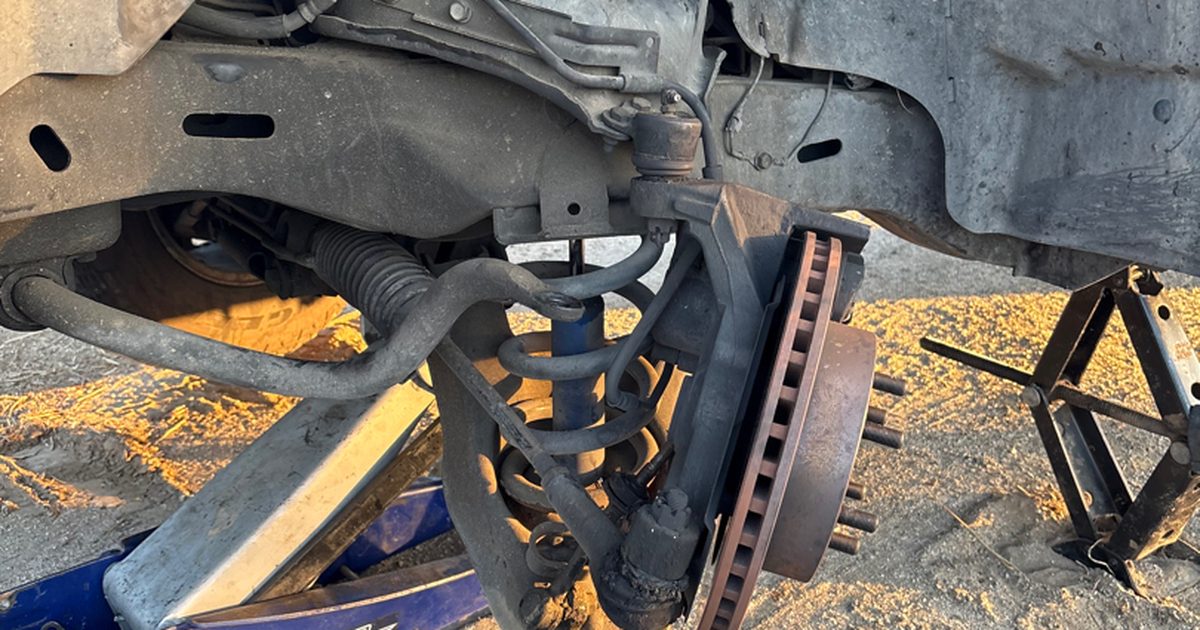
What wheel bearings do, and how they fail
A wheel bearing is a ring of hardened steel balls or rollers, packed in grease and sealed inside a race, that sits between the spinning wheel and the fixed suspension. It carries the entire corner weight of the vehicle — often 800 to 1,200 pounds — while letting the wheel turn thousands of times a mile with almost no friction. Done right, a bearing can last 100,000 to 150,000 miles.
Bearings almost never wear out from spinning. They die when the seal fails. Water and dirt work past the seal, contaminate the grease, and start pitting the polished steel surfaces — from there the damage compounds until the bearing growls. Deep puddles, pressure washers aimed at the wheel, and road salt all accelerate it. The other killer is impact: a hard pothole hit or a curb strike can dent (brinell) the races, and the bearing that was quiet before the hit starts humming a few weeks later. Oversized wheels and worn suspension parts add side-loading that shortens bearing life too.
The lane-change test — how a bad bearing is diagnosed
The classic symptom is a hum or growl that rises and falls with road speed, not engine speed. Coast in neutral and the noise stays; that rules out the engine and transmission. The giveaway is the lane-change test: swerve gently left and the noise changes — gets louder or quieter — then swerve right and it changes the other way. Swerving shifts the vehicle's weight from one side to the other, loading and unloading each bearing. If the noise fades when you weight the left side, the right bearing is usually the culprit, because unloading a bad bearing quiets it.
A shop confirms it three ways. First, chassis ears — clip-on microphones placed at each hub while the car runs on a lift or on a road test — pinpoint which corner is loudest. Second, the spin test: with the car on a lift, the tech spins each wheel by hand and feels the hub for roughness or rumble; a good bearing is dead smooth. Third, the play check: grabbing the tire at 12 and 6 o'clock and rocking it reveals looseness in the bearing (grabbing at 3 and 9 can show tie rod play instead, which is a different repair). Tire noise from choppy or feathered tread is the most common misdiagnosis, so a careful tech checks the tires before condemning a bearing.
Hub assembly vs. pressed bearing — why the design changes the price
There are two basic designs, and which one your car has drives the whole quote.
A hub assembly is a sealed unit — bearing, hub flange, wheel studs, and usually the ABS sensor or tone ring — that bolts to the steering knuckle. The part costs more, often $120 to $300, but the labor is straightforward: unbolt the old unit, bolt on the new one, torque everything to spec. That is the one-to-1.5-hour end of the labor range, and it is what most vehicles built since the early 2000s use.
A pressed-in bearing is just the bearing itself, pressed into the knuckle with tons of force. The part is cheap — sometimes $40 to $80 — but the knuckle usually has to come off the car and go into a hydraulic press to push the old bearing out and the new one in, square and true. That flips the math: low parts cost, high labor cost, and it is not a driveway job. Some shops use an on-car press tool, but either way you are paying for press work and skill, not the part. Common on many Honda, VW, and European designs.
What a proper wheel bearing job includes
The axle nut is the heart of this job. On most front-wheel-drive and all-wheel-drive vehicles, the axle nut clamps the bearing together and sets its preload. It must be torqued to the factory spec — often 150 to 250 lb-ft — with a torque wrench, not an impact gun guessing. Undertorqued, the bearing runs loose and hammers itself apart in months; overtorqued, it runs hot and fails early. Most axle nuts are single-use: they are staked or use a deforming lock, so a proper job includes a new axle nut, not the old one reinstalled.
ABS care matters just as much. On most modern vehicles the ABS tone ring — the toothed or magnetic ring the wheel-speed sensor reads — is built into the bearing or hub assembly itself. The tech should unplug and protect the sensor before pulling parts, clean the sensor tip, and confirm the new part has the correct tone ring for your vehicle (magnetic encoder rings even have a correct side that must face the sensor). A quality job ends with the fasteners torqued to spec, the wheel torqued in a star pattern, and a road test confirming the noise is gone and no ABS or traction lights are on.
Why the price varies so much
Design is the biggest lever: a bolt-on hub on a common sedan is a quick job with a mid-priced part, while a pressed bearing on a European car means knuckle removal, press time, and often an alignment check afterward. Parts quality is the second lever — a bargain-bin bearing can be $50 while a quality name-brand or OEM unit for the same car is $250, and bearings are one place cheap parts genuinely come back to bite you, because a bad one fails in 20,000 miles instead of 120,000.
Rust is the wildcard. In salt-belt states, hub assemblies corrosion-weld themselves into the knuckle, and what books at one hour becomes two-plus hours of penetrating oil, heat, and a slide hammer. Four-wheel-drive front hubs, integrated sensors, and vehicles where the brake caliper, rotor, and axle all have to come apart also add time. Location matters too — this is a labor-driven repair, so the same job costs more where shop rates are higher.
How long can you wait?
A humming bearing is not an emergency on day one — bearings often growl for months before they get dangerous, and plenty of people drive on a noisy one longer than they should. But the failure curve is not linear. As the bearing loosens, three things happen: the noise turns into a grind, play develops that lets the wheel wobble and wear the tire unevenly, and the gap between the ABS tone ring and its sensor starts drifting. That last one is why a worn bearing so often turns on the ABS or traction-control light — the sensor loses a clean signal, and on many cars that also disables stability control.
The end stage is genuinely dangerous. A collapsed bearing can seize and lock the wheel while you are moving, or let the wheel tilt enough to destroy the brake components and, in rare cases, separate. If the noise has become a grind, the steering wanders, or you can feel vibration in the wheel, stop treating it as background noise and get it done this week.
How to save money on this repair
Get the diagnosis confirmed before you approve the work — insist the shop identifies which corner is bad rather than quoting an axle pair, because bearings do not need to be replaced in pairs the way brakes do. One failed bearing does not mean the other side is going.
On parts, pay for quality: a name-brand bearing (SKF, Timken, Moog, NTN, or OEM) costs $50 to $100 more than a no-name unit and routinely lasts three to five times longer. If your vehicle uses bolt-on hub assemblies, get a mobile mechanic quote — it is a driveway-friendly job and mobile labor often runs 10 to 20 percent under shop rates. And while the corner is apart, ask the tech to look at the brakes and ball joint; combining work that shares the same teardown saves you paying for the same disassembly twice.
Signs you need this repair
- A hum, growl, or rumble that gets louder as speed increases and stays when you coast in neutral
- The noise changes — louder or quieter — when you swerve gently or change lanes
- ABS or traction-control warning light, often with no braking problem you can feel
- Play or looseness when the wheel is rocked at 12 and 6 o'clock
- Uneven or scalloped tire wear on one corner
- Steering feels vague or wanders, especially at highway speed
- Vibration in the steering wheel or floor that grows with speed
Cost by vehicle type
| Vehicle | Typical range | Notes |
|---|---|---|
| Compact / economy car | $165 to $605 | Most use bolt-on hub assemblies — the cheapest and fastest version of this repair. |
| Midsize sedan / small SUV | $175 to $650 | Usually hub assemblies front and rear; parts sit in the middle of the range. |
| Full-size truck / large SUV | $205 to $760 | Heavier vehicles eat bearings faster, and 4x4 front hubs with integrated ABS sensors push parts toward the top of the range. |
| Luxury / European | $250 to $935 | Many use pressed-in bearings that need a press, and OEM-quality parts cost more. Expect the high end of both parts and labor. |
| Hybrid | $190 to $715 | Same designs as the gas version of the car, but extra battery weight adds load — bearings can wear a bit sooner than the badge suggests. |
| Electric vehicle | $200 to $750 | Instant torque and a heavy battery pack work bearings harder than in a comparable gas car. ABS and traction sensors are integrated into the bearing, so a failing bearing often takes the sensor reading with it. |
| Diesel / heavy duty | $245 to $905 | Heavy-duty tapered bearing setups and big axle nuts mean more labor time; some solid-axle designs are serviceable rather than replaceable as a unit. |
Ranges assume national-average labor rates ($95, $140/hr) and quality aftermarket parts.
Cost by state
State ranges reflect typical independent-shop labor rates for a midsize vehicle.
Common questions
Do front and rear wheel bearings cost different amounts?
Often, yes. Front bearings on driven wheels involve the axle nut and CV axle, and 4x4 front hubs with integrated sensors are the most expensive parts. Rear bearings on a front-wheel-drive car are frequently simpler bolt-on units at the low end of the range. On some vehicles the pattern flips — the design at each corner, not the position, sets the price.
How long can I drive on a bad wheel bearing?
A bearing that just started humming typically has weeks to a few months of safe driving left, but there is no reliable gauge — impact-damaged bearings can go downhill fast. Once the hum becomes a grind, you feel play or wander in the steering, or the ABS light comes on, the safe window is over. A collapsed bearing can lock the wheel while you are moving.
Should I replace one bearing or both sides?
Just the bad one. Unlike brakes, bearings do not need to match side to side, and the other bearing may last another 50,000 miles. The exception is when both corners show wear or the vehicle has very high mileage and the labor overlaps — then doing both in one visit can save a second teardown later. But a shop that insists on pairs by default is padding the ticket.
Why did a bad wheel bearing turn on my ABS light?
On most modern vehicles the ABS tone ring — the ring the wheel-speed sensor reads — is built into the bearing or hub. As the bearing wears and develops play, the gap between ring and sensor drifts, the signal gets erratic, and the computer sets a wheel-speed fault. Replacing the bearing or hub assembly usually fixes the light, since the new unit includes a fresh tone ring.
What's the difference between a hub assembly and a bearing-only replacement?
A hub assembly is a sealed bolt-on unit containing the bearing, hub, studs, and usually the ABS components — higher part cost, low labor. A bearing-only job uses a cheap bare bearing that must be pressed out of and into the steering knuckle with a hydraulic press — low part cost, high labor. You do not get to choose; your vehicle's design dictates which one you need.
Can a mobile mechanic replace a wheel bearing at my home?
If your vehicle uses bolt-on hub assemblies — as most vehicles built since the early 2000s do — yes, it is a good driveway job needing hand tools, a jack, and a torque wrench. Pressed-in bearings are the exception: they need a hydraulic press or a heavy on-car press tool, so that design belongs in a shop. A mobile tech can tell you which type you have from your VIN before booking.
Related Repair Guides
More Suspension Repair Costs
Sources and further reading
Primary sources behind this page. Federal safety, emissions and consumer-protection references, worth reading before you authorize any repair.
- NHTSA TireWise Federal guidance on tire age, load ratings, pressure and tread depth.
- NHTSA recall & complaint lookup Check any symptom against open recalls and technical service bulletins before paying for a repair.
- FTC auto repair basics Your rights on estimates, authorization and disputed repair bills.
- DOE Alternative Fuels Data Center: electric vehicles Federal reference on EV drivetrains, batteries and charging.
Need Work Done? Get a Free Quote.
Tell us what the car is doing. A local mechanic calls you back, most requests get a call back the same day. No fee, no obligation.