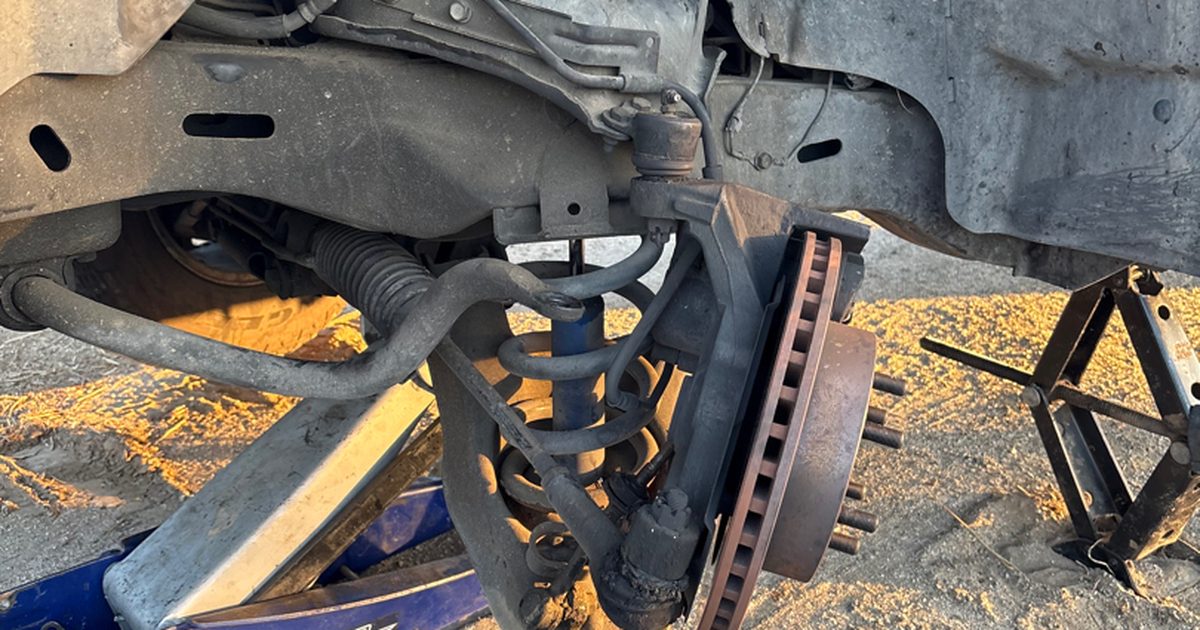
What ball joints do, and how they wear
Every front corner needs a connection that can do three things at once: carry load between the control arm and the steering knuckle, pivot as the wheel steers, and articulate as the suspension travels. The ball joint is that connection — a hardened steel ball in a polymer-lined socket, sealed under a grease-filled rubber boot, doing structural duty at every moment the car moves.
Cars have one or two per side depending on design: strut-suspension cars typically carry a single lower joint per side (the strut itself handles the upper pivot), while double-wishbone trucks and SUVs carry upper and lower joints — with the 'loaded' joint (the one carrying spring force, usually the lower) wearing fastest and mattering most.
The wear story is the same as every sealed joint on the car: the boot is the life-limit. Intact, the grease stays in, grit stays out, and joints run 100,000+ miles. Once the boot tears — age, heat, an errant pry bar at a tire shop — water and grit grind the socket loose in months. Wear shows up as play: the ball rattling in its worn socket produces clunks over bumps, wander under braking, and the alignment-destroying wobble that feathers tire edges. The end state, separation, is rare and almost always preceded by months of ignored warnings — which is exactly why the warnings matter.
Diagnosis — measured play, not guesswork
Ball joints share their symptom set with tie rods, wheel bearings, and bushings, so conviction requires hands and measurement, not just ears. The standard test: wheel raised (with the suspension loaded correctly for the design — supporting the control arm on loaded-joint layouts, a detail that separates techs who do this often from those who don't), then the tire rocked at 12 and 6 o'clock. Vertical play with a visible clunk at the joint is the finding; play at 3 and 9 instead points to tie rods. A pry bar under the tire, watching the joint itself for lift, quantifies it.
Some joints carry built-in wear indicators (a grease fitting shoulder that recedes as the joint wears); some manufacturers publish measurable play specs. Torn boots count as findings even without play — a breached joint is on the clock. And the corroborating evidence rounds out the case: inner-edge tire wear, a memory of clunks that grew over months, grease slung around a split boot.
Insist on the show-me standard here just as with tie rods: real play is visible and demonstrable in seconds on a lift. Given the stakes in both directions — driving on a failing joint versus paying for a healthy one — this is a category where a second opinion on a big surprise quote is always reasonable, and where a shop's willingness to demonstrate is its own credential.
Press-in, bolt-in, or the whole control arm
The part is cheap; the design decides the labor, and knowing your configuration before quoting is half the negotiation. Bolt-in joints (common on trucks) swap with hand tools once the taper breaks loose — the friendly version. Press-in joints are interference-fit into the control arm or knuckle and must be forced out and in with a press — fine work on a clean southern truck, a rust-welded fight on a northern one, and the version where labor estimates earn their range.
The modern pattern changes the question: most current cars integrate the lower ball joint into the control arm as a riveted, non-serviceable unit, and the correct repair is the complete arm — new joint, new bushings, new arm, bolted in as an assembly. It sounds bigger and often isn't: arm assemblies for high-volume cars are aggressively priced, the labor is bolt-work instead of press-work, and you retire the arm's tired bushings (fellow clunk suspects) in the same stroke.
Pairs logic mirrors the rest of the front end: joints don't mandate pairs, but same-age joints fail on similar schedules, and the alignment that must follow covers one repair or both sides equally. One side failed by age with the other showing a torn boot or early play — do both, share the alignment. One side failed by pothole violence — inspect the survivor and let findings decide.
What the job should include
However the joint arrives (pressed, bolted, or aboard a new arm), the quality markers are consistent: the taper seated and torqued to spec (castle nuts get new cotter pins, torque-to-yield hardware gets replaced, not reused), the boot intact and correctly seated after installation — a boot torn during install is a joint pre-loaded with its own failure — and greaseable joints actually greased until the boot swells, then put on the maintenance schedule.
While the corner is apart, the adjacent suspects get inspected in the same look: the other joint on multi-joint designs, tie rod ends inches away, sway bar links, and bushings — clunk diagnoses are frequently plural, and labor overlaps generously down here. On trucks, the 4WD-specific hardware (axle boots, hub components) shares the neighborhood and the inspection.
Then the alignment — mandatory, same logic as tie rods and struts: the joint's position defines wheel geometry, and a new joint sits differently than the worn one it replaced (that's the point). Camber and toe move; only the machine puts them back. The finish line: no play at any joint by the same tests that found the problem, torque verified, a straight-tracking test drive, and an alignment printout in your hand.
How to save money on this repair
Boots and grease are the whole prevention story: greaseable joints greased at every oil change effectively don't wear out, and catching a torn boot early — at tire rotations, when it's a free glance — is the difference between a joint replaced on your schedule and a corner reassembled on the road's. Ask for a boot check whenever the wheels are off; it costs nothing.
At repair time, know your design before comparing quotes (press-in labor and bolt-in labor are different products, and integrated-arm cars should be quoted arms, not joints), bundle both sides and any adjacent worn parts around the single alignment, and buy quality: name-brand or OEM joints, greaseable where offered, because bargain ball joints in a safety-structural role is a false economy shops get to say told-you-so about. On trucks that work for a living, heavy-duty joints amortize beautifully.
Mobile mechanics handle bolt-in joints and complete-arm swaps well — driveway-appropriate work, alignment scheduled right after, same as tie rods. Press-in jobs on rusted arms belong at a shop with a press and a torch. And the universal rule of this category: whichever route you take, take it promptly — ball joints are the rare part where the deferred-maintenance discount is negative and occasionally catastrophic.
Signs you need this repair
- Clunking or knocking from a front corner over bumps, growing louder over months
- Squeaking or creaking from the front end when turning or over dips — a dry joint
- Wandering, imprecise steering that needs constant correction, worse under braking
- Uneven or inner-edge front tire wear from geometry the worn joint no longer holds
- Shudder or wobble through the floor at speed, distinct from wheel-balance vibration
- Visible grease slung around a torn ball joint boot at the control arm
- A front wheel visibly leaning (camber collapse) — late-stage, stop-driving territory
Cost by vehicle type
| Vehicle | Typical range | Notes |
|---|---|---|
| Compact / economy car | $145, $520 | Most use lower joints integrated into the control arm — the repair is the complete arm assembly, which keeps labor sane and often prices barely above a pressed joint anyway. Aftermarket arm availability is excellent. |
| Midsize sedan / small SUV | $155, $550 | Same integrated-arm pattern for most; a control-arm-with-joint replacement plus alignment is the standard repair. Multi-link designs on some models carry more than one joint per corner — inspection names the worn one. |
| Full-size truck / large SUV | $180, $635 | The classic ball joint population: upper and lower joints at each front corner, serviceable and press- or bolt-in, working hard under weight, towing, and plows. 4WD trucks are the highest-wear case on the road, and quality greaseable joints repay their price here. |
| Luxury / European | $220, $775 | Multi-link front ends with several small joints and arms per corner — diagnosis is more nuanced and parts are OEM-priced. Aluminum arms and knuckles punish hammer-based technique; this is precision work at shops that know the platform. |
| Hybrid | $170, $605 | Same job as the conventional twin, with the standing note that battery weight loads the front joints a bit harder over the years. Nothing hybrid-specific about the repair itself. |
| Electric vehicle | $180, $630 | Conventional work, heavier duty: EV curb weights load ball joints meaningfully harder than the same-size gas car, and wear arrives earlier on heavy models. Inspection at every rotation is cheap; the joints holding up an extra 800 pounds deserve it. |
| Diesel / heavy duty | $215, $755 | Heavy diesel front ends — especially 4WD with plow duty — are where ball joints live hardest and die youngest. HD joints, sometimes twice per truck lifetime, are a known cost of the configuration; greaseable heavy-duty parts are the right spend. |
Ranges assume national-average labor rates ($95, $140/hr) and quality aftermarket parts.
Cost by state
State ranges reflect typical independent-shop labor rates for a midsize vehicle.
Common questions
How dangerous is a worn ball joint?
It's the suspension part with the worst worst-case: a joint that separates disconnects the wheel from the control arm, folding that corner under the car — total loss of control, at any speed, without further warning. The saving grace is that separation is almost always preceded by months of clunks and play. Respect the warnings and it's a routine repair; ignore them and you're gambling with the steering axle.
Can I drive with a bad ball joint?
With confirmed serious play: to the shop, gently, or ideally not at all — this is one of the few repairs where a tow is a defensible choice. With early symptoms (occasional clunk, slight wander): days to a couple of weeks of gentle driving while the appointment arrives, not a season of hoping. Potholes and hard braking are what finish marginal joints; avoid both en route.
Why is the quote for a whole control arm when only the ball joint is bad?
Because on most modern cars the lower joint is riveted into the arm as a non-serviceable unit — the arm is the part. It's usually good news in disguise: arm assemblies for common cars are competitively priced, the labor is bolt-on rather than press-work, and the arm's bushings (the other usual clunk suspects) come new in the same purchase. Pressing a joint into an arm not designed for it is the corner-cut to decline.
Upper and lower ball joints — do both need replacing?
Only what's worn, but understand the roles: on double-wishbone trucks the loaded joint (usually lower) carries the weight and wears fastest, while the upper follows. If the loaded joint has failed at high mileage, its same-age partner deserves honest measurement — doing both while the corner is apart shares labor and the alignment. On strut cars there's typically only the one lower joint per side to worry about.
Do I need an alignment after ball joint replacement?
Yes — the ball joint's position is part of the wheel's geometry, and the new joint standing at full height moves camber and toe from wherever the worn one had let them sag. Skipping it trades a modest alignment charge for accelerated tire wear. Same rule as tie rods and struts: front-end structural repairs end at the alignment machine.
Can a mobile mechanic replace ball joints?
Bolt-in joints and complete control arm swaps, yes — well-scoped driveway work with the alignment booked right after. Press-in joints are the honest dividing line: some mobile techs carry on-car press kits and handle them, but rusted press-fit joints in northern control arms want a shop press and sometimes a torch. Describe your vehicle and let the tech tell you which side of the line it's on.
Related repair guides
Sources and further reading
Primary sources behind this page. Federal safety, emissions and consumer-protection references, worth reading before you authorize any repair.
- NHTSA TireWise Federal guidance on tire age, load ratings, pressure and tread depth.
- NHTSA recall & complaint lookup Check any symptom against open recalls and technical service bulletins before paying for a repair.
- FTC auto repair basics Your rights on estimates, authorization and disputed repair bills.
- DOE Alternative Fuels Data Center: electric vehicles Federal reference on EV drivetrains, batteries and charging.
Need work done? Get a free quote.
Tell us what the car is doing. A local mechanic calls you back, most requests get a call back the same day. No fee, no obligation.