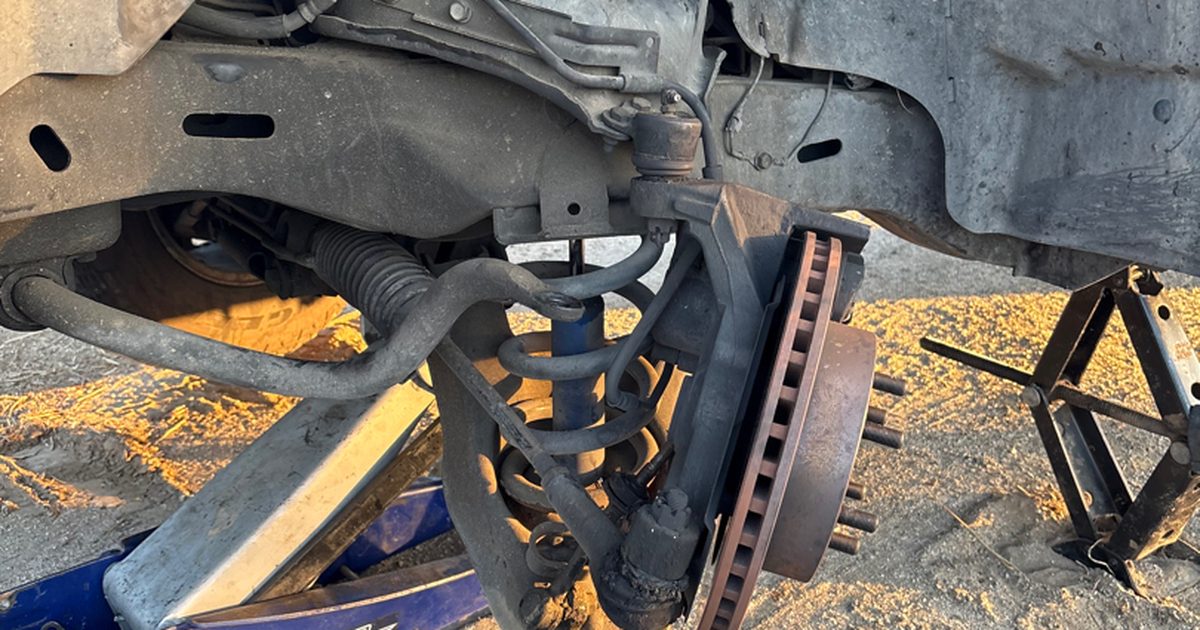
What tie rods do, and how they wear
Turn your steering wheel and the motion travels down the column, through the rack, and out to each front wheel through a two-piece link: the inner tie rod (a ball joint threaded into the rack, hidden inside the rubber bellows) and the outer tie rod end (the ball-and-socket you can see, connecting to the steering knuckle). Two joints per side, four chances for play — and the geometry is unforgiving: these joints don't just push the wheels, they hold the toe angle, the single alignment setting tires care most about.
The joints wear the way all ball-and-sockets do: grease ages, the boot cracks and admits water and grit, and the polished ball wears its socket loose. Potholes and curb strikes accelerate everything — a hard curb hit can damage a tie rod in one event, which is why 'it started after I hit that pothole' is a sentence alignment techs hear daily.
Wear announces itself in two languages. To your hands: vagueness on-center, wander that needs constant correction, a knock or clunk over bumps, sometimes a shimmy after hits. To your tires: inside or outside edges scrubbing away in a feathered pattern — toe error converting rubber into noise, mile after mile.
Confirming it — the checks that separate tie rods from lookalikes
Loose steering has a full cast of suspects — ball joints, wheel bearings, control arm bushings, a worn rack — and tie rods are convicted by hand, not by vibes. The classic test: car raised, tech grips the tire at 3 and 9 o'clock and rocks it. Play at 3-and-9 with a visible clunk at a tie rod end is the finding; play at 12-and-6 instead points at ball joints or bearings. A helper wiggling the steering wheel while the tech watches each joint move (or lag) pinpoints which of the four joints is loose.
The boot check matters even without play: a torn boot on a joint that still feels tight is a joint on the clock — water is in, and the wear is coming. Inner tie rods get checked through the bellows by feel; a worn inner clunks with side-to-side wheel rock while the outer stays visibly tight.
Insist on being shown, not told. A good shop will happily demonstrate the play with your own eyes on the joint — it takes ten seconds and ends all doubt. Steering-part replacements sold from a printout, without a physical wiggle test, deserve a second opinion; this is a category where honest inspection is cheap and visible.
What the job should include — and why the alignment isn't optional
The outer tie rod swap: loosen the jam nut, mark or count threads so the new end starts at the old one's position, separate the tapered stud from the knuckle, spin the old end off and the new one on to the marked position, torque the stud and jam nut, and repeat the hand-check for play elsewhere while it's all visible. Inners add the bellows removal and the special socket that reaches the joint at the rack. Grease fittings, where the new parts have them, get filled — and the parts with fittings (greaseable designs) are often the longer-lived choice.
Then the alignment — and here's why it's structural to the job, not an upsell: the tie rod's threaded position sets toe, and thread-counting only gets the new part close. 'Close' in toe terms is measured in fractions of a degree, and a quarter-degree of toe error scrubs tires sideways a few feet per mile — invisible from the driver's seat, ruinous over ten thousand miles. Every tie rod replacement changes toe; every tie rod replacement ends with an alignment. Quotes that omit it aren't cheaper, they're incomplete.
Done right, the finish line is: no play at any joint, steering wheel centered, toe set to spec on the machine, and a test drive with straight, self-centering tracking.
Inner, outer, one side or both — scoping honestly
Outer tie rod ends fail most often — they live exposed, swing through the biggest angles, and get the road spray. Inners fail less but aren't rare, and on some cars the honest move when one inner goes is the inner-and-outer pair on that side, since the labor overlaps and the assembly's other half has identical history.
Sides are an inspection call with a pragmatic twist: tie rods don't require pairs the way struts do — a tight joint is a tight joint. But both sides share every mile and pothole, so when one side fails of age (not impact), its twin is usually close behind. The economics tip the decision: the alignment you must buy covers one repair or four joints equally, so doing the marginal second side now — rather than paying for a second alignment in six months — is often the cheaper total path. When the failure was a curb strike on one side, by contrast, the other side needs nothing but a look.
While everything's apart, adjacent wear gets one glance: sway bar end links (fellow clunk-makers), ball joints, and the rack bellows themselves — a torn bellows is cheap now and an inner tie rod killer later.
How to save money on this repair
Catch it at the tire stage, not the failure stage: feathered edge wear on front tires is toe error announcing itself, and the inspection it should trigger costs nothing at any tire or brake visit. Finding a worn tie rod early buys you scheduling freedom and saves the tires — which usually cost more than the repair.
Bundle around the alignment, the job's fixed cost: worn tie rods on both sides, an alignment-disturbing strut job you've been deferring, or that sagging ball joint all share one alignment if they share one visit. Choose greaseable, name-brand parts over sealed bargain units — steering joints are a longevity-matters category, and the parts price difference is small against the labor and alignment around them.
Mobile mechanics handle outer tie rods well (it's compact, driveway-friendly work) — just plan the mobile repair and the alignment shop as one project, driving gently in between. And after any serious pothole or curb strike, spend the few minutes on an inspection rather than waiting for symptoms: single-event damage found same-week keeps the repair small, the alignment single, and the tires alive.
Signs you need this repair
- Vague, wandering steering that needs constant small corrections to hold a lane
- Clunking or knocking from the front end over bumps, felt through the floor or wheel
- Feathered or scalloped wear on the inside or outside edges of the front tires
- A shimmy or vibration in the steering wheel, especially after hitting a bump
- The steering wheel off-center or the car pulling after a pothole or curb strike
- Play you can feel: the wheel turns slightly before the car responds
- A front tire visibly toed in or out compared to its partner — late-stage and urgent
Cost by vehicle type
| Vehicle | Typical range | Notes |
|---|---|---|
| Compact / economy car | $110, $340 | Cheap parts, standard rack-and-pinion layout, quick labor — one of the least expensive steering repairs there is. Alignment usually costs more than the part. |
| Midsize sedan / small SUV | $115, $360 | Textbook work on nearly all models. If both outer ends are worn at similar mileage, doing both sides in one visit shares the single alignment you'd pay for anyway. |
| Full-size truck / large SUV | $135, $420 | Bigger joints at higher prices, and trucks with steering dampers or off-road duty chew tie rods faster. Solid-axle HD trucks use different linkage (drag links, center links) with its own parts and pricing. |
| Luxury / European | $165, $515 | OEM-quality parts matter here — steering feel is the product on these cars, and bargain tie rods with vague on-center behavior are a known regret. Some models sell the complete inner-and-outer assembly only. |
| Hybrid | $130, $395 | Identical job to the conventional twin. Extra battery weight over the nose adds steering load over the years — hybrids aren't special, just a bit heavier on their front ends. |
| Electric vehicle | $135, $415 | Same conventional job — EVs have ordinary tie rods. The pattern to know: EV weight plus instant torque loads front-end components hard, and tie rods on heavy EVs earn inspection at every tire rotation. |
| Diesel / heavy duty | $160, $500 | Heavy front axles, plow duty, and big tires multiply steering loads — HD tie rod and linkage parts price accordingly, and seized adjusters on work trucks add labor. Commercial applications exceed this estimate. |
Ranges assume national-average labor rates ($95, $140/hr) and quality aftermarket parts.
Cost by state
State ranges reflect typical independent-shop labor rates for a midsize vehicle.
Common questions
How dangerous is a worn tie rod, really?
Worn-but-attached: it degrades steering precision and eats tires — a prompt repair, not a panic. The danger is the end state: a tie rod that separates disconnects that wheel from your steering entirely, instantly, at whatever speed you're doing. That's why play found at inspection gets fixed in days, not seasons. There's a wide warning window; the mistake is spending all of it.
Do I really need an alignment after a tie rod replacement?
Yes — it's part of the repair, not an add-on. The tie rod's threaded length physically sets your toe angle, and installing a new one lands only approximately where the worn one sat. Toe error you can't feel still scrubs tires sideways every mile; skipping a $100-ish alignment reliably costs a set of front tires. Any complete quote includes it.
What's the difference between inner and outer tie rods?
They're the two halves of each side's steering link. The outer end is the visible ball joint at the wheel — exposed, hardest-working, most often replaced. The inner is a joint threaded into the steering rack, hidden inside the rubber bellows, needing a special tool and a bit more labor. A hands-on inspection tells which is loose; sometimes the honest answer on one side is both.
Should I replace tie rods on both sides at once?
Judgment call, tilted by the alignment. Both sides share every mile, so age-related failure on one side usually means the other is close — and since one alignment covers everything done in the visit, finishing both sides often beats paying for a second alignment within the year. Impact damage is the exception: a curb-strike casualty says nothing about the other side's health.
Can a bad tie rod cause my steering wheel to be crooked?
Yes — unevenly worn or previously mis-adjusted tie rods change each wheel's toe, and the steering wheel sits off-center as a result. It's also the fix: during the alignment, toe is set at the tie rods' adjusters with the wheel locked straight. A crooked wheel after front-end work just means the final alignment step was skipped or rushed.
Can a mobile mechanic replace tie rods?
Outer tie rod ends, absolutely — it's compact, jack-stands-and-hand-tools work that suits a driveway, and mobile pricing tends to be friendly for it. Inners depend on the tech carrying the inner-tie-rod tooling. The one logistical note: you still need the alignment right after, so book the mobile repair and the alignment as one plan and drive gently in between.
Related repair guides
Sources and further reading
Primary sources behind this page. Federal safety, emissions and consumer-protection references, worth reading before you authorize any repair.
- NHTSA recall & complaint lookup Check any symptom against open recalls and technical service bulletins before paying for a repair.
- NHTSA TireWise Federal guidance on tire age, load ratings, pressure and tread depth.
- FTC auto repair basics Your rights on estimates, authorization and disputed repair bills.
- DOE Alternative Fuels Data Center: electric vehicles Federal reference on EV drivetrains, batteries and charging.
Need work done? Get a free quote.
Tell us what the car is doing. A local mechanic calls you back, most requests get a call back the same day. No fee, no obligation.