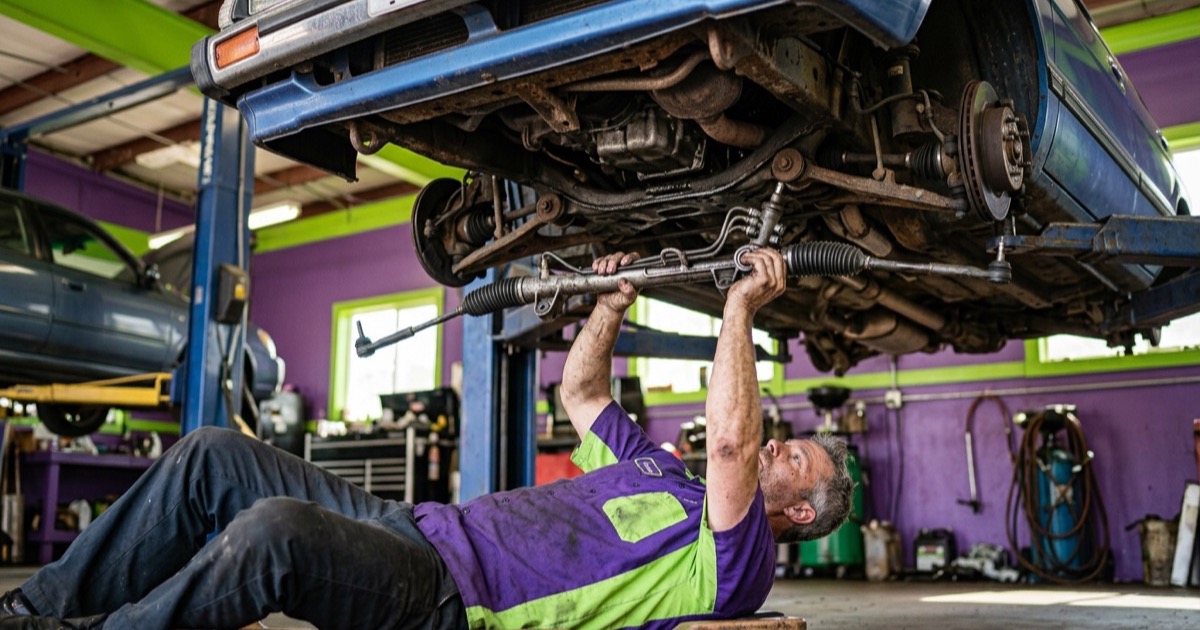
What the Job Is and What You Are Paying For
The rack is a long metal tube mounted across the front of the car. Inside is a toothed bar. A small gear, the pinion, sits on the end of your steering shaft and meshes with that bar. Turn the wheel, the pinion spins and the bar slides left or right. Tie rods on each end push the front wheels to steer.
Power assist makes it easy to turn. Older and many truck racks use hydraulic assist from a belt driven pump. Most newer cars use electric assist with a motor on the rack or the column.
A rack replacement means removing the tie rod ends from the steering knuckles, disconnecting the steering shaft, and on hydraulic racks unhooking the pressure and return lines. On many cars the subframe is lowered or other parts are moved. The new rack goes in, everything gets reconnected, and the system is bled of air on hydraulic racks.
The job always ends with a front wheel alignment. A new rack changes the toe setting, and skipping the alignment will wear out tires quickly. Electric racks also need a steering angle sensor calibration.
Why the Price Varies From Car to Car
The part is the biggest factor. A remanufactured hydraulic rack for a common car can cost $250 to $500. A remanufactured electric rack often costs $500 to $1,200. New factory racks, especially for European cars, can cost two to three times as much.
Access is next. On some cars the rack comes out after a few bolts. On others the subframe has to be supported and lowered, the exhaust moved and the engine mounts loosened. That can double the labor.
Whether the rack comes with outer tie rod ends matters. Many racks come with inner tie rods only. Rusty outer tie rod ends that will not come off cleanly add parts and time.
The alignment is a separate line on most quotes, usually $100 to $200. Electric racks may also need a calibration fee.
Dealers charge the most and usually use new factory racks. Independents often use quality remanufactured racks with a good warranty. That choice alone can cut the bill by a third or more.
What Usually Gets Done at the Same Time
A rack job has a few add ons that are worth it and a few that are upsells.
Always needed is a front wheel alignment. Plan for it in the price.
Worth it on hydraulic racks is a power steering fluid flush with the right fluid. Old fluid full of metal from a worn rack can damage the new one. Many rack warranties require a flush.
Worth it if worn are the outer tie rod ends. If they have play or torn boots, replace them now while the alignment is being done anyway.
Worth it if leaking or cracked are the power steering hoses. A new rack with an old leaking hose still leaks.
Worth checking is the power steering pump on hydraulic systems. A whining pump that was starved for fluid may not last long, but do not replace a quiet, healthy pump.
Usually an upsell is a new steering column or intermediate shaft with no clunk or play.
- Front wheel alignment: always required
- Power steering fluid flush on hydraulic racks: yes
- Outer tie rod ends: yes if loose or the boots are torn
- Leaking or cracked steering hoses: yes
- Power steering pump: only if it whines or tests weak
- Steering column or shaft with no play: usually skip
Make Sure It Is Really the Rack
A rack is an expensive guess, so diagnosis matters.
Fluid leaks are the most common reason for a hydraulic rack. Look for wet fluid at the ends of the rack where the rubber boots sit. If you squeeze a boot and it feels full of fluid, the inner seals are leaking. Fluid near the top of the rack may be a hose or line fitting, which is a much cheaper fix.
Loose steering needs a careful check. With the car on the ground, have someone rock the steering wheel back and forth while you watch the tie rods and the rack. Play in the outer tie rod end, the inner tie rod or the intermediate shaft feels like a bad rack but costs far less.
Heavy steering on a hydraulic car often comes from low fluid, a slipping belt or a weak pump. Heavy steering on an electric car can come from a low battery, a bad ground or a sensor fault. A scan tool helps here.
A clunk over bumps can be a loose rack mount bushing, a sway bar link or a ball joint. Check those first.
A whine that gets louder when you turn usually points to the pump or low fluid, not the rack.
Questions to Ask Before You Approve the Quote
These questions make sure the rack is really the problem and that the quote covers the whole job.
- What exactly is wrong with the rack, a leak, play or an electric fault?
- Did you check the tie rods, intermediate shaft and hoses first?
- Is the new rack remanufactured, new aftermarket or factory?
- Does the rack come with inner tie rods, and are outer tie rods included?
- Is the alignment included in the price?
- Is a power steering flush included, and is it required for the warranty?
- Does my electric rack need a calibration, and is that in the price?
- What is the warranty on the rack and the labor?
Can a Mobile Mechanic Do It?
Sometimes. On compacts and smaller crossovers where the rack comes out without dropping the subframe, an experienced mobile mechanic can do it in a driveway with good jack stands.
The catch is the alignment. A mobile mechanic can set the toe close by measuring the old tie rods, but you still need a real alignment at a shop within a day or two. Many mobile techs arrange it for you.
Cars that need the subframe lowered, and racks on European cars or EVs that need dealer level software, are better done at a shop with a lift.
Ask the mobile mechanic if they have done your model before and how they handle the alignment.
How Long a New Rack Lasts
A good rack often lasts 100,000 to 150,000 miles. A new or quality remanufactured rack can do the same if it is set up right.
On hydraulic racks, clean fluid is the key. Use the fluid type in your owner's manual, keep it full and fix hose leaks early. Running the system low wears both the pump and the rack.
Do not hold the steering wheel at full lock for long. That is the highest pressure point for a hydraulic system and the hardest work for an electric motor.
Torn rack boots let in dirt and water that wear the inner tie rods and seals. Replace a torn boot as soon as you see it.
Hitting curbs and potholes hard bends tie rods and loads the rack. A straight steering wheel after a hard hit is worth checking.
Signs you need this repair
- Power steering fluid leaking near the front wheels or under the engine
- Steering that feels heavy, especially at low speeds
- Loose or wandering steering with play in the wheel
- Clunk or knock felt in the steering wheel over bumps
- Steering that is harder in one direction than the other
- Power steering warning light on cars with electric steering
- Grinding or binding when turning the wheel
Cost by vehicle type
| Vehicle | Typical range | Notes |
|---|---|---|
| Compact / economy car | $625 to $1,860 | Most compacts have an electric power steering rack bolted to the rear of the subframe. A remanufactured rack is often $300 to $700, and labor usually runs three to four hours plus an alignment. |
| Midsize sedan / small SUV | $685 to $2,040 | Midsize cars may use either hydraulic or electric racks depending on the year. Some V6 models require the subframe to be lowered, which pushes labor toward five or six hours. |
| Full-size truck / large SUV | $815 to $2,425 | Many full size trucks use a recirculating ball steering gear box instead of a rack, which is a different repair. Newer trucks and most crossovers use racks, often electric, which cost more as parts. |
| Luxury / European | $1,010 to $3,010 | European racks, especially electric ones with active steering, can cost $1,200 to $3,000 or more for the part. Some need dealer software to set up. |
| Hybrid | $755 to $2,245 | Hybrids use electric power steering so the steering works when the engine shuts off. Rack replacement is similar to a gas car, but the angle sensor and assist must be set up with a scan tool. |
| Electric vehicle | $790 to $2,345 | EVs use electric racks only. Replacement needs software setup, and some models only have factory racks, so plan on the high end of the range. |
| Diesel / heavy duty | $970 to $2,890 | Most heavy duty trucks use a steering gear box with a separate linkage, not a rack. If yours has a rack, it is likely large and heavy, with labor at the top of the range. |
Ranges assume national-average labor rates ($95, $140/hr) and quality aftermarket parts.
Cost by state
State ranges reflect typical independent-shop labor rates for a midsize vehicle.
Common questions
How much does it cost to replace a rack and pinion?
Most drivers pay about $800 to $2,000 at an independent shop with a remanufactured rack, plus the alignment. Electric racks and European cars often run $2,000 to $3,500. Dealers with new factory parts sit at the top of that range or above it.
Can I drive with a leaking rack and pinion?
For a short time, if it is a slow seep and you keep the fluid full. Check the level often. If the steering gets heavy, noisy or loose, stop driving and get it fixed, because a rack that runs dry fails fast.
Do I need an alignment after replacing the rack and pinion?
Yes, always. A new rack changes the toe setting of the front wheels. Skipping the alignment makes the car pull and can ruin a set of tires in a few thousand miles.
Is it worth buying a remanufactured rack and pinion?
Yes, for most cars. A quality remanufactured rack has new seals and bushings and often comes with a lifetime or multi year warranty. It costs much less than a new factory rack.
Will power steering stop leak fix a leaking rack?
It can slow a small seep for a while by swelling the seals. It does not fix worn or torn seals, and it will not help play or electric faults. Use it only as a short bridge until you can make the real repair.
How long does it take to replace a rack and pinion?
About three to six hours on most cars, plus an hour for the alignment. Cars that need the subframe lowered take longer.
Is a rack and pinion worth fixing on an old car?
It depends on the car's value. On a car worth $4,000 or more that runs well, a $1,200 rack job usually makes sense. On a car worth $1,500 with other problems, it may not, and a slow leak with frequent top ups can buy time.
Related Repair Guides
Sources and further reading
Primary sources behind this page. Federal safety, emissions and consumer-protection references, worth reading before you authorize any repair.
- FMVSS 203 Steering Control Impact Protection (49 CFR 571.203) The federal safety standard covering the steering control system and driver protection.
- FMVSS 126 Electronic Stability Control (49 CFR 571.126) Stability control depends on a correct steering angle signal, which is why electric racks need calibration.
- EPA household hazardous waste How to dispose of used automotive fluids like power steering fluid safely.
Need Work Done? Get a Free Quote.
Tell us what the car is doing. A local mechanic calls you back, most requests get a call back the same day. No fee, no obligation.