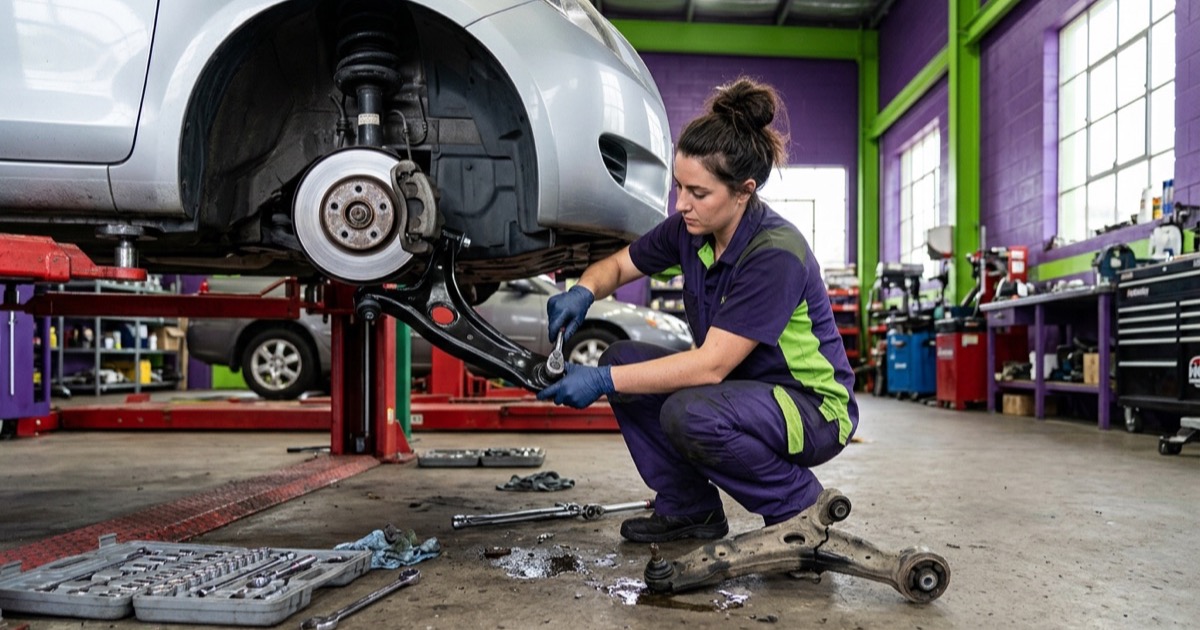
What a Control Arm Is and What the Job Includes
Each wheel needs to move up and down over bumps while staying in line. The control arm makes that happen. One end bolts to the frame through rubber bushings. The other end connects to the steering knuckle, usually through a ball joint.
Most cars have a lower arm at each front wheel. Many trucks and some cars also have an upper arm. Many rear suspensions use several arms per side.
The job usually goes like this. The wheel comes off. The ball joint is separated from the knuckle. The frame bolts come out and the arm drops free. The new arm goes in, the bolts are snugged, and the car is lowered so the final bushing torque is set with weight on the wheels. Then an alignment sets the wheel angles back to spec.
Most quotes run about $250 to $900 per arm, including the part and labor but not always the alignment.
On rust belt cars, the tech may need heat or a cutting tool to free seized bolts. A good shop warns you of this up front instead of surprising you at the counter.
If the ball joint is pressed into the arm on your car, the shop may quote a new arm with the joint already in it. That is often the fastest and best fix.
Whole Arm or Just the Bushings?
When only the bushings are worn, you have a choice. You can replace the whole arm, or press new bushings into your old arm.
On most mainstream cars, replacing the whole arm is cheaper. A complete arm with new bushings and a new ball joint often costs less than the labor to press bushings in and out. It also fixes everything at once.
Bushing only replacement makes sense on cars where the arm is expensive, like many luxury cars with aluminum arms, or trucks with heavy forged arms. It also makes sense when the arm is fine and only one bushing is torn.
Pressing bushings needs a hydraulic press or special tools, so it adds labor. Ask the shop to quote both ways if your arm is costly.
There is a quality question too. Some aftermarket arms come with bushings that are softer or harder than the original. Softer ones can feel vague. Harder ones pass more road noise into the cabin. If ride quality matters to you, ask for OEM or a brand known for matching the original feel.
Some shops sell polyurethane bushings as an upgrade. They last a long time but ride harsher and can squeak. On a daily driver, rubber that matches the original is usually the better choice.
Why the Price Varies
The part is the biggest factor. A stamped steel lower arm for a compact can be under $80. An aluminum arm for a luxury car or an EV can be $300 or more per side.
Part quality matters. Bargain arms often have weak ball joints and bushings that wear out fast. A known brand or OEM arm lasts longer.
Rust adds labor. Seized bolts on older trucks and cars in snow states can double the time.
The alignment adds about $100 to $200 if it is not in the quote.
Dealers charge the most. Independent shops and mobile mechanics are usually cheaper. A mobile tech can swap most lower arms in a driveway, but you will still need an alignment at a shop.
Your local labor rate changes the total too. Two hours at $95 and two hours at $160 differ by $130 on the same arm. Upper arms on trucks are often quicker than lower arms, while rear arms on some sedans need the subframe loosened.
What Often Gets Done at the Same Time
Some add ons save money. Others are just sales.
- Wheel alignment: needed after almost every control arm job. Not optional.
- Arm on the other side: worth it at high mileage if it shows the same wear. Not required on a newer car.
- Sway bar links: cheap and often worn at the same time.
- Tie rod ends: worth checking, since you are paying for an alignment anyway.
- Struts: only if they leak or are worn. Do not let a control arm job turn into a full suspension rebuild without proof.
Is It Really the Control Arm?
Clunks and loose steering have many causes. A good check rules them out.
Sway bar links are the most common source of a clunk over small bumps and are much cheaper than an arm.
Tie rod ends cause loose steering and uneven wear on the tire edges.
Worn struts or strut mounts cause clunks and bouncing.
A wheel bearing hums with speed and can make the wheel feel loose when rocked.
The tech should lift the car and use a pry bar to check each bushing and joint for play. Torn rubber, cracks, or the arm moving where it should not are the signs that point to the arm.
A road test helps too. A clunk over bumps that also happens on braking points to the lower arm bushings. A pull that changes when you brake points the same way. A clunk only when turning at low speed points more toward a strut mount or sway bar link.
Questions to Ask Before You Approve the Quote
These questions help you pay for the right fix.
- Is it the bushings, the ball joint, or both? Can you show me the play?
- Is this price per arm, and is it upper or lower?
- Is it cheaper to replace the whole arm or just the bushings on my car?
- Which brand of arm are you using?
- Is the alignment included in the price?
- Will you torque the bushings with the car on the ground?
How to Make It Last
Most control arms last 90,000 to 150,000 miles. Potholes, curbs, and rough roads shorten that.
Torque the bushings at ride height. This one step stops most early bushing tears.
Get the alignment done right after. A bad alignment wears tires fast and can hide a problem.
Fix oil leaks above the arms. Oil softens rubber bushings and makes them fail early.
Signs you need this repair
- A clunk or knock over bumps or when braking
- Steering that wanders or pulls on the highway
- Uneven or fast wear on the inside or outside edge of the tires
- A shimmy or vibration in the steering wheel
- Steering wheel off center after hitting a pothole
- Cracked or torn rubber bushings you can see under the car
- The car shifts or dives more than normal when you brake
Cost by vehicle type
| Vehicle | Typical range | Notes |
|---|---|---|
| Compact / economy car | $215 to $860 | Most use a lower arm with the ball joint built in. Parts are cheap and access is easy, so this is the lowest cost version. |
| Midsize sedan / small SUV | $235 to $940 | Some have upper and lower arms on each side. Many lower arms come with the ball joint and both bushings already fitted. |
| Full-size truck / large SUV | $275 to $1,120 | Trucks have upper and lower arms and heavier parts. Rust on the bolts is common, which can add labor. |
| Luxury / European | $340 to $1,390 | Many have several arms per corner, and some use fluid filled bushings. Parts cost more, and replacing them in sets is common. |
| Hybrid | $255 to $1,035 | Same job as the regular version of the car. The extra battery weight can wear the rear bushings sooner. |
| Electric vehicle | $270 to $1,085 | Heavy EVs work the bushings hard, and many use aluminum arms that cost more. Rear arm wear is common on some models. |
| Diesel / heavy duty | $330 to $1,335 | Heavy front ends wear bushings and ball joints faster. Parts cost the most and rust adds time. |
Ranges assume national-average labor rates ($95, $140/hr) and quality aftermarket parts.
Cost by state
State ranges reflect typical independent-shop labor rates for a midsize vehicle.
Common questions
How much does it cost to replace a control arm?
Most single control arm jobs cost about $250 to $900 at an independent shop. Luxury cars, EVs and rusted trucks run higher. Add an alignment if it is not included.
How much does control arm bushing replacement cost?
Replacing just the bushings often costs $200 to $500 per arm, mostly in labor. On many cars the whole arm costs about the same, so ask for both quotes.
Can I drive with a bad control arm?
For a short time with worn bushings, carefully. A loose ball joint on the arm is dangerous, because it can separate and drop the wheel. Get it checked soon.
Do I need an alignment after replacing a control arm?
Yes, almost always. The new arm changes the wheel angles. Without an alignment, your tires can wear out fast.
Should I replace control arms in pairs?
Not always. If both sides are worn, it makes sense. If only one side is bad on a newer car, replace just that one.
Can a mobile mechanic replace a control arm?
Yes, on many cars. Most lower arms are a driveway job. You will still need to take the car to a shop for an alignment.
How long does a control arm replacement take?
Usually one to three hours per arm. Rusted bolts and complex suspensions take longer.
How much does a control arm replacement cost at a dealer?
Dealers often charge $500 to $1,200 per arm with OEM parts. An independent shop or mobile mechanic using a quality aftermarket arm is usually much cheaper.
Related Repair Guides
More Suspension Repair Costs
Sources and further reading
Primary sources behind this page. Federal safety, emissions and consumer-protection references, worth reading before you authorize any repair.
- fueleconomy.gov maintenance guide Federal guidance on how alignment and maintenance affect fuel economy.
- ASE certification Look for ASE certified techs in suspension and steering.
- DOE Alternative Fuels Data Center: electric vehicles Federal reference on EV design, including weight and maintenance.
Need Work Done? Get a Free Quote.
Tell us what the car is doing. A local mechanic calls you back, most requests get a call back the same day. No fee, no obligation.