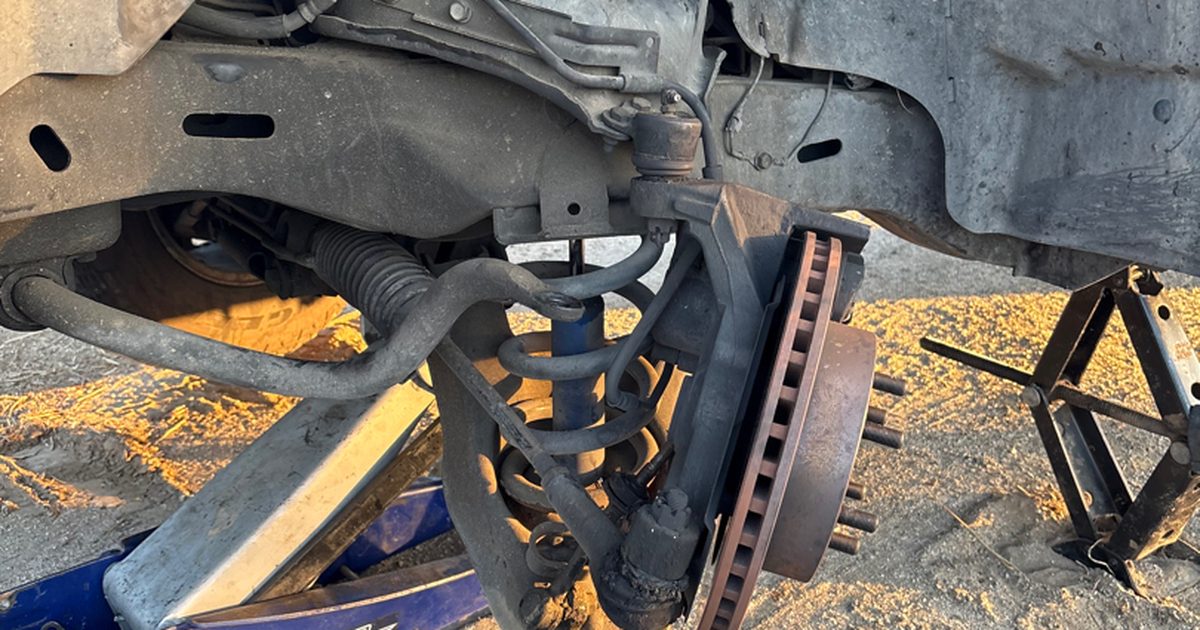
What struts do — and how they differ from shocks
Every corner of your car has a spring to absorb bumps and a damper to stop the spring from bouncing forever. A shock absorber is just the damper — a sealed hydraulic cylinder mounted separately from the spring. A strut is the damper, the spring, and a structural steering pivot combined into one assembly: it physically holds the wheel upright and forms part of the steering geometry. Most modern cars use struts in front and either struts or shocks in the rear.
The distinction matters for your wallet. Because the strut is structural, replacing it disturbs the suspension geometry — which is why strut jobs need an alignment afterward and shock jobs often don't. It's also why strut labor runs higher: the assembly carries the spring, so it either has to be rebuilt with a spring compressor or replaced as a complete loaded unit.
Inside, both wear the same way: the hydraulic fluid and valving that convert motion into heat gradually lose effectiveness, and the seals eventually let the fluid weep out entirely. It's a wear item, not a lifetime part — it just wears too slowly for your daily commute to notice.
How to know they're actually worn
Struts have a diagnosis problem: they degrade over 50,000-plus miles, and you adapt to the decline day by day. Drivers routinely describe a car with fully shot struts as "riding fine" — then can't believe the difference after replacement.
The honest indicators: oil visibly leaking down the strut body (a wet, grimy film — failed, replace now), cupped or scalloped tire wear (little dips around the tread from the tire hopping), nose dive under braking, the rear squatting hard under acceleration, floaty or wallowy motion after bumps, and clunking over potholes from a worn strut mount. The old push-down bounce test only catches struts that are completely gone.
Mileage is a rough guide, not a rule: 50,000 to 100,000 miles is the typical service window, with rough roads, towing, and heavy loads pulling that in. What you should not do is replace struts purely by mileage with no symptoms and no inspection — have a shop check them during a brake or tire visit, which usually costs nothing extra.
Loaded assemblies vs. bare struts
This choice drives both the quote and the quality of the result. A bare strut replacement reuses your original spring, mount, and bearing: the assembly comes off, a spring compressor captures the coil, the old damper is swapped for new, and everything is rebuilt. It uses the cheapest part but the most labor — and it reuses a 100,000-mile spring, mount, and bearing on a new damper.
A loaded (complete/quick) strut assembly arrives with a new damper, new spring, new mount, and new bearing already assembled. It bolts in as a unit: less labor, no spring compressor, and every wear part at that corner is new. For most mainstream vehicles the loaded assembly is the better job and often barely more expensive once you count the labor difference — which is why most shops quote it by default.
Bare struts still make sense on vehicles with no loaded option, on lowered or modified cars keeping specific springs, and on some luxury models where the loaded assembly doesn't exist. If two quotes are far apart, this is the first thing to check — they may not be quoting the same style of job.
Why you replace them in pairs — and align afterward
Struts are replaced per axle — both fronts or both rears — even if only one is leaking. A new damper next to a worn one gives the two front wheels different control over the same pavement, which shows up exactly where you don't want it: uneven braking grip and unpredictable behavior in an emergency swerve. The second strut of the pair also has the same age and miles as the one that just failed; its remaining life is measured in months. Estimates on this page reflect a pair.
The alignment afterward is not an upsell. The strut locates the top of the wheel, and on many cars the camber setting literally lives in the strut-to-knuckle bolts. Disturb it and the wheel sits at a slightly different angle — a degree you'll never see by eye but your tires will document faithfully in accelerated edge wear. Budget the alignment into the job (many shops bundle it at a discount) and you protect several hundred dollars of tires with one $100-ish line item.
While everything is apart, sway bar end links and strut mounts are cheap add-ons if worn — they're frequent culprits behind suspension clunks and cost little extra labor when the corner is already disassembled.
Why the price varies so much
A pair of struts installed quotes anywhere from about $450 to over $1,100 on mainstream vehicles, and the variables are consistent. Loaded assembly versus bare strut rebuild moves the number first. Parts tier moves it second — economy house brands, name-brand standard (KYB, Monroe, Bilstein and similar), and OEM can each step the parts bill up 30-50%.
Vehicle class is third: heavier vehicles need heavier dampers, and anything with electronically adjustable or air suspension leaves this price chart entirely — a single air strut on a luxury SUV can exceed the cost of four conventional ones. Rust is the wildcard: in salt states, seized strut-to-knuckle bolts can turn a two-hour job into a four-hour fight, and honest shops in the rust belt quote accordingly.
When comparing quotes, ask three questions: loaded or bare, what brand of parts, and is the alignment included? Those three answers explain almost every price gap you'll see.
How to save money on this repair
Get the wear confirmed during a visit you're already paying for — any brake or tire appointment includes eyes on the struts for free, and "leaking" versus "aging" changes your timeline by a year or more.
On mainstream cars, quality name-brand loaded assemblies hit the sweet spot of parts cost, labor cost, and result — premium dampers are worth it for towing, performance driving, or keeping the car past 200,000 miles, but the standard tier serves most commuters perfectly. Bundle the alignment with the strut job rather than booking it separately, and if your tires are near the end anyway, do tires, struts, and alignment in one visit — new struts protect the new rubber, and you skip one alignment charge.
This is also a job where mobile mechanics and independent shops quote well below dealers with identical parts. The work is standard across brands; pay for parts quality, not the badge on the building.
Signs you need this repair
- Oil leaking down the strut body — a failed seal, and the definitive sign the strut is done
- Cupped or scalloped tire wear: rhythmic dips in the tread from the tire skipping on the pavement
- The nose diving hard under braking, or the rear squatting under acceleration
- A floaty, wallowing ride that keeps moving after the bump is gone
- Clunking or knocking over potholes and speed bumps, often from the strut mount
- The car bouncing more than once after you push down hard on a corner and release
- Noticeably longer stopping distances or nervous, wandering highway behavior
Cost by vehicle type
| Vehicle | Typical range | Notes |
|---|---|---|
| Compact / economy car | $400, $1,000 | Simple MacPherson struts with excellent aftermarket support — loaded assemblies for popular compacts are inexpensive and this is the cheapest version of the job. |
| Midsize sedan / small SUV | $440, $1,090 | Straightforward strut layouts front and often rear. Loaded-assembly availability is excellent for high-volume sedans and small SUVs, keeping both parts and labor near the middle of the range. |
| Full-size truck / large SUV | $520, $1,290 | Many trucks use heavier struts up front (or shocks with separate springs), and 4WD models add bulk and rusted hardware. Heavier components and higher spring rates push parts toward the top of the range. |
| Luxury / European | $645, $1,595 | Electronically adaptive dampers and air struts change this job entirely — a single adaptive or air strut can cost more than a full set of conventional ones. Verify what your car has before comparing any quotes; the range shown assumes conventional struts. |
| Hybrid | $485, $1,200 | Mechanically identical job to the gas version of the same model, but battery weight works the suspension harder — hybrids often need struts a bit earlier than their conventional twins. |
| Electric vehicle | $505, $1,255 | EVs carry several hundred extra pounds of battery, and that mass works the dampers constantly — EV struts and bushings tend to wear on the early side. The job itself is conventional; parts for heavier EVs price toward the upper end. |
| Diesel / heavy duty | $620, $1,535 | Heavy-duty front ends on diesel trucks use commensurately heavy (and pricier) dampers, and seized hardware on work trucks adds labor. Expect the top of the range. |
Ranges assume national-average labor rates ($95, $140/hr) and quality aftermarket parts.
Cost by state
State ranges reflect typical independent-shop labor rates for a midsize vehicle.
Common questions
How long do struts last?
Typically 50,000 to 100,000 miles, with road quality, loads, and climate deciding where in that window you land. Smooth-road highway commuters see the high end; rough roads, towing, and salt shorten it. Because wear is so gradual, have them inspected at brake and tire visits rather than waiting for symptoms you've learned not to feel.
Can I replace just one strut?
If one is damaged by a pothole or accident and the other is nearly new, yes. Otherwise no — the pair ages together, and mismatched damping across an axle degrades braking and emergency handling exactly when you need them most. The second strut has the same miles as the one that failed; you'd be paying labor twice within the year.
Do I really need an alignment after strut replacement?
Yes. The strut is a structural locating component — on many cars camber is set by the very bolts the shop just removed. Skip the alignment and the misalignment quietly eats the edges of your tires, which cost more than the alignment did. Any quote that doesn't mention alignment is leaving a required step out of the total.
What's the difference between a quick strut and a regular strut?
A quick (loaded) strut is the complete corner in a box — new damper, spring, mount, and bearing pre-assembled. A regular (bare) strut is just the damper, reusing your old spring and mount via a spring-compressor rebuild. Loaded costs more in parts, less in labor, and renews everything; it's the default recommendation on mainstream vehicles where it's available.
Are worn struts actually dangerous, or just uncomfortable?
Both. The damper's real job is keeping the tire pressed to the road; worn dampers let the tire skip over bumps, which reduces braking grip and can add a car length or more to a hard stop from highway speed. They also worsen handling in sudden swerves and accelerate wear on tires and other suspension parts. It's a slow-burn safety item, not just ride comfort.
Can a mobile mechanic replace struts?
Yes, if you're using loaded assemblies — that version needs jack stands, hand tools, and torque, all fine in a driveway. Bare-strut rebuilds involving spring compressors are better left to a shop. Remember the car still needs an alignment afterward, so plan the mobile strut job and an alignment-shop visit as one project.
Related repair guides
Sources and further reading
Primary sources behind this page. Federal safety, emissions and consumer-protection references, worth reading before you authorize any repair.
- NHTSA TireWise Federal guidance on tire age, load ratings, pressure and tread depth.
- NHTSA recall & complaint lookup Check any symptom against open recalls and technical service bulletins before paying for a repair.
- FTC auto repair basics Your rights on estimates, authorization and disputed repair bills.
- DOE Alternative Fuels Data Center: electric vehicles Federal reference on EV drivetrains, batteries and charging.
Need work done? Get a free quote.
Tell us what the car is doing. A local mechanic calls you back, most requests get a call back the same day. No fee, no obligation.