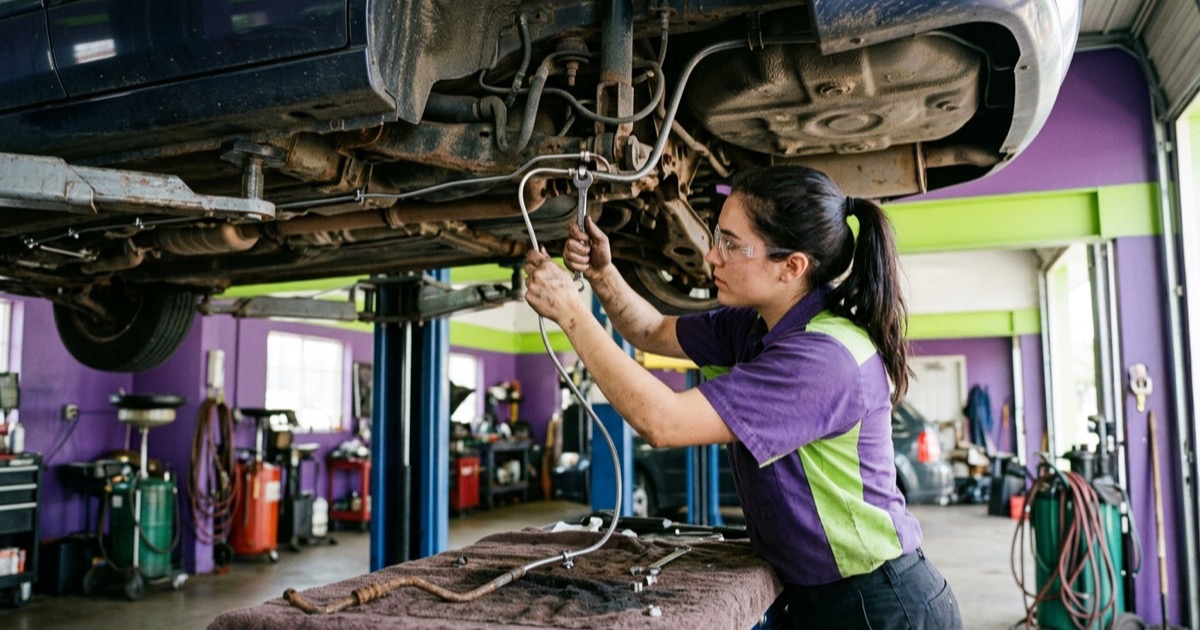
What the Job Is and What You Are Paying For
Your brake system has two kinds of lines. Hard lines are steel tubes, about the width of a pencil, that run from the master cylinder along the body to each corner. Flexible hoses are short rubber hoses at each wheel that let the suspension and steering move.
A brake line job means finding the leak, removing the bad section, and installing a new line or hose with the right fittings and flares. Then the shop bleeds the system to push every bubble of air out. Air in brake fluid squeezes, so a system with air in it gives you a soft, spongy pedal.
The price depends on how much line is bad. One rubber hose is a short job. One rusted steel section from the junction to the rear wheel is a medium job. A full set of steel lines from the front of the car to the rear is a big job because the lines are long, held in many clips and often routed over the fuel tank.
Most of what you pay is labor. A length of steel or nickel copper line costs a few dollars a foot. A rubber hose costs $15 to $60. A preformed line kit for a truck can cost a few hundred dollars. The time it takes to free rusted fittings and bleed the brakes is where the money goes.
Why the Price Varies From Car to Car
Rust is the biggest factor. In dry states a brake line can outlast the car. In states that salt their roads, lines on trucks and older cars rot from the outside in. Rusted fittings often snap or round off, and one bad line turns into two or three.
Routing matters next. Some lines run straight along the floor where a tech can reach them on a lift. Others run over the fuel tank, above the rear subframe or behind the engine. If the tank has to come down, the job gets longer.
The line material changes the price a little. Plain steel is cheapest. Coated steel lasts longer. Nickel copper line costs more, bends easily by hand and does not rust, which is why many shops use it for repairs in salt states.
The flare type matters too. American and Asian cars mostly use double flares. Many European cars use bubble flares, also called ISO flares. The wrong flare will leak, so the shop needs the right tool.
Then comes the shop. Dealers often sell the whole factory line set instead of making a section. Independents usually make a repair section from bulk line. Mobile mechanics can do hoses and some short sections in a driveway, but long rusted line runs go faster on a lift.
What Usually Gets Done at the Same Time
Some add ons make real sense once the system is open. Others are upsells.
Worth it almost every time is a full brake fluid flush instead of a quick bleed of one wheel. Fluid absorbs water over time, and the system is already open. If your fluid is more than two or three years old, flush it.
Worth it on rusty vehicles is replacing the matching line on the other side or the next section over. If one rear line rotted through, its partner is usually close behind. Paying for the labor once is cheaper than paying twice.
Worth it if they are cracked or swollen are the rubber hoses. If a shop is already at a wheel with a hose that is cracked, bulged or over ten years old, change it now.
Worth checking are calipers and wheel cylinders with seized bleeder screws. A bleeder that snaps off during the bleed can force a caliper replacement. A good shop will warn you before they try.
Usually an upsell is replacing every line on a car with no rust just because one hose leaked. Ask to see the old line and the others before you agree.
- Brake fluid flush: yes if the fluid is over two or three years old
- Matching line on the other side: yes on rusty vehicles
- Cracked or old rubber hoses: replace while the shop is at that wheel
- Calipers with seized bleeders: only if the bleeder breaks or will not open
- Full line set on a clean, rust free car: usually skip
Make Sure It Is Really a Brake Line
A soft or sinking pedal has several causes. A brake line leak is common, but it is not the only one.
The easy check is fluid. Look at the master cylinder reservoir. If the level is dropping and you find wet, oily fluid along a line, at a fitting or inside a wheel, you have an external leak. Brake fluid feels slippery and often looks clear to amber.
If the level is full and the pedal still sinks slowly at a stop, the master cylinder may be leaking inside. That is a different part and a different repair.
A pedal that feels spongy right after other brake work often means air in the system, not a bad line. A proper bleed fixes it.
Fluid at the inside of a wheel can be a caliper seal or wheel cylinder, not the hose. On drum brakes, a leaking wheel cylinder soaks the shoes.
A hard pedal that takes a lot of force to stop the car points to the brake booster, not a line.
A rubber hose can also fail on the inside. The lining collapses and acts like a one way valve, so one brake stays applied and the car pulls or that wheel runs hot. The hose looks fine from the outside.
Questions to Ask Before You Approve the Quote
A good brake line quote names which line, how long, and what happens if a fitting breaks. These questions keep the price honest.
- Which line or hose is leaking, and can you show me the wet spot or a photo?
- Are you replacing a section or the whole line from end to end?
- What line material are you using, steel, coated steel or nickel copper?
- Are you using the right flare type for my car?
- Does the price include a full brake fluid flush or just bleeding one wheel?
- What happens to the price if a fitting or bleeder breaks?
- How do the other lines look, and are any close to failing?
- What is the warranty on the parts and the labor?
Can a Mobile Mechanic Do It?
Yes, for many versions of this job. Rubber brake hoses at the wheels are a driveway job for a mobile mechanic with a jack, stands and a bleeder kit. Short steel sections near a wheel are often fine too.
Long steel lines that run under the whole car are better on a lift. A tech on their back on a driveway with a two foot jack lift has a hard time feeding a new line over the tank and through the clips.
Hybrids and EVs with electronic brake units need a scan tool to bleed right. Many mobile techs carry one, but ask before you book.
If the pedal goes to the floor, a mobile mechanic coming to you is safer than driving the car to a shop.
How to Make New Brake Lines Last
A properly made brake line in a dry climate can last 20 years or more. In salt states, plain steel lines often rust through in 10 to 15 years.
If you live where roads get salted, wash the underside of the car through the winter and in spring. Salt that sits on the lines is what eats them.
Ask for coated or nickel copper line when you replace a section. It costs a little more and resists rust much better than plain steel.
Make sure every clip goes back on. A line that vibrates against the frame wears a hole through itself.
Change your brake fluid on the schedule in your owner's manual. Old fluid holds water, which rusts the lines and parts from the inside.
Signs you need this repair
- Brake pedal that feels soft, spongy or sinks toward the floor
- Brake warning light on the dash with a low fluid level
- Wet, oily spots near a wheel or along the frame under the car
- Brake fluid reservoir that keeps going down
- Car pulls to one side when braking
- Rusty, flaking steel lines visible under the car
- Cracked, bulging or swollen rubber brake hoses at the wheels
Cost by vehicle type
| Vehicle | Typical range | Notes |
|---|---|---|
| Compact / economy car | $120 to $770 | Most compacts route steel lines along the floor pan with plastic clips, which makes access fair. A single rear line section or one front hose is often an hour or a little more. |
| Midsize sedan / small SUV | $125 to $810 | Midsize cars price like compacts for a single hose or line section. If the line runs over the fuel tank or rear subframe, expect the shop to drop a heat shield or the tank strap, which adds time. |
| Full-size truck / large SUV | $140 to $930 | Trucks in salt states are where full line replacement happens most. The long run to the rear axle, the frame mounted junction blocks and rusted fittings often push labor to four hours or more, and some owners choose a full preformed kit. |
| Luxury / European | $170 to $1,130 | European cars often use metric bubble flares and lines routed above the subframe. Parts cost a bit more and access can be tight, so plan for the upper part of the range. |
| Hybrid | $140 to $890 | Hybrids use regular hydraulic lines at the wheels, but many have an electric brake actuator that needs a scan tool for a proper bleed. Make sure the shop has the right tool before they open the system. |
| Electric vehicle | $145 to $930 | EVs use the same steel lines and rubber hoses as gas cars. Many use an electronic brake booster that needs a scan tool bleed procedure after any line is opened. |
| Diesel / heavy duty | $170 to $1,105 | Heavy duty trucks have long lines, larger calipers and often a hydraulic booster. Full line jobs on these trucks are among the longest brake jobs a shop does, and many shops quote them by the hour. |
Ranges assume national-average labor rates ($95, $140/hr) and quality aftermarket parts.
Cost by state
State ranges reflect typical independent-shop labor rates for a midsize vehicle.
Common questions
How much does it cost to replace a brake line?
Most drivers pay about $125 to $400 to replace one brake hose or one section of steel line at an independent shop. A full set of steel lines on a truck can run $600 to $1,200 or more. The price is mostly labor, so rust and routing decide the bill.
Can I drive with a leaking brake line?
No, not safely. Every drop of fluid that leaks out reduces your braking. Even if the pedal still works, it can fail suddenly on the next hard stop. Have the car towed or get a mobile mechanic to come to you.
How long does it take to replace a brake line?
About one to two hours for one hose or a short section of steel line. A full set of lines on a rusty truck can take four to six hours. Bleeding the brakes is part of the time.
Can you replace just part of a brake line?
Yes, as long as the rest of the line is solid. A shop cuts out the bad part, makes new flares and joins a new section with the right union fitting. If the rest of the line is also flaking with rust, replacing the whole run makes more sense.
Is it safe to use compression fittings on brake lines?
No. Compression fittings are made for low pressure plumbing and can blow off under brake pressure. A proper brake repair uses double flares or bubble flares with brake rated unions.
Do I need to bleed all four brakes after replacing a brake line?
Usually yes, or at least every wheel on that circuit. Air can travel through the system when a line is open. Many shops do a full flush so every wheel gets fresh fluid and no air.
Are rusty brake lines worth fixing on an old car?
Yes, if the rest of the car is sound. Brakes are not optional, and a line repair costs far less than most other major repairs. If the frame and other parts are rotted too, compare the full cost against what the car is worth.
Related Repair Guides
More Brakes Repair Costs
Sources and further reading
Primary sources behind this page. Federal safety, emissions and consumer-protection references, worth reading before you authorize any repair.
- FMVSS 106 Brake Hoses (49 CFR 571.106) The federal safety standard that sets strength and burst rules for brake hoses and fittings.
- FMVSS 135 Light Vehicle Brake Systems (49 CFR 571.135) The federal standard for passenger car brake performance, including split systems and warning lights.
- FMVSS 116 Brake Fluids (49 CFR 571.116) The federal standard that defines DOT brake fluid grades used after a line repair.
Need Work Done? Get a Free Quote.
Tell us what the car is doing. A local mechanic calls you back, most requests get a call back the same day. No fee, no obligation.