What the Job Is and What You Are Paying For
Gasoline is always giving off vapor. Federal rules require your car to trap those fumes and burn them in the engine. The parts that do this are the gas cap, the filler neck, the fuel tank and its seals, a charcoal canister that soaks up vapor, a purge valve that lets the engine pull the vapor in, a vent valve that seals the system, and the hoses between them.
Because the system is sealed, the computer can test it. When the car sits, or during certain drives, the computer closes the vent valve and watches the pressure. If pressure leaks away too fast, it sets a code. P0455 means a large leak, like a missing gas cap. P0456 means a very small leak, about the size of a pinhole, often listed as 0.020 inch. P0442 is a small leak on many cars.
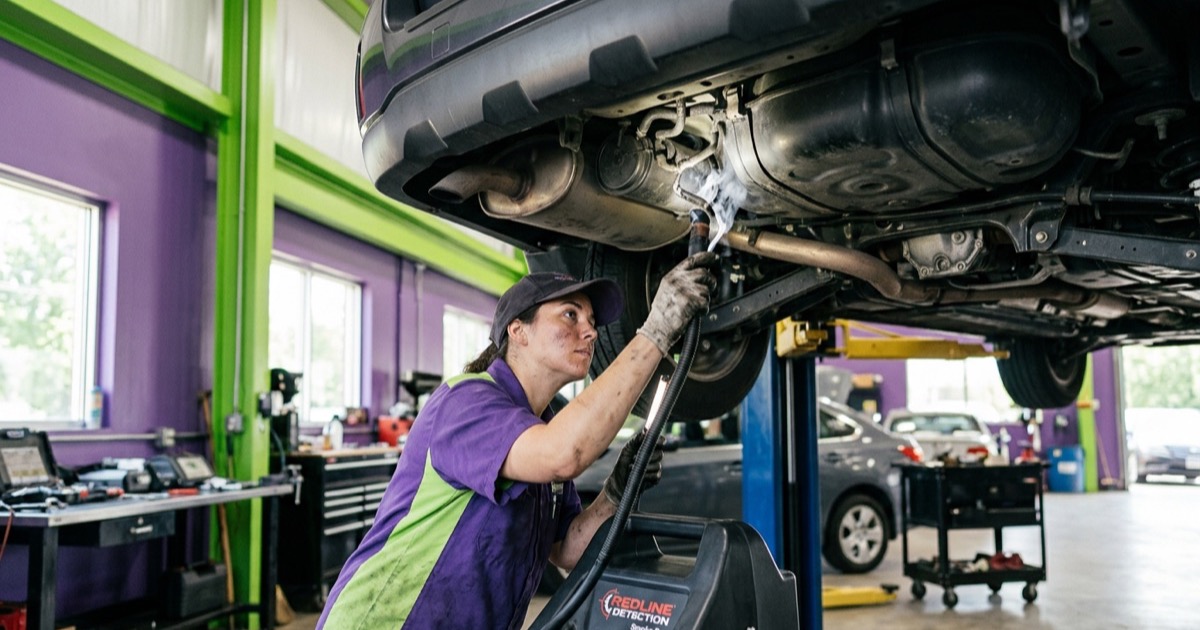
An EVAP leak repair has two parts. The first is finding the leak. A shop seals the system and fills it with harmless smoke from a smoke machine. The smoke comes out wherever the leak is.
The second part is fixing what the smoke shows. That can be a new gas cap, a hose, a vent or purge valve, a filler neck, a tank seal, or the canister.
The price on this page covers a smoke test plus the most common fixes. A loose cap fix might cost almost nothing. A rusted filler neck or a tank seal can cost more.
Check the Gas Cap First
Before you pay for anything, check the gas cap. It is the most common cause of EVAP leak codes, and it is free to check.
Take the cap off and look at the rubber seal. It should be soft, round and free of cracks. Put it back on and turn it until it clicks. If the seal is cracked or flat, a new cap costs about $15 to $40. Buy a quality cap made for your car, since cheap caps often do not seal well.
Then drive normally for a few days. The light will not go out right away. The computer has to run its EVAP test several times and pass before it turns the light off, and that can take a week or more of normal driving.
If the light comes back, or you have a P0455 large leak code even with a good cap, it is time for a smoke test.
- Look for a cracked, flat or torn rubber seal on the cap
- Tighten the cap until it clicks
- Replace a bad cap with a quality part made for your car
- Drive normally for a week before deciding it did not work
- If the code returns, get a smoke test
Where EVAP Leaks Usually Come From
After the gas cap, these are the usual suspects, roughly in the order shops find them.
The canister vent valve is a big one. It sits near the canister, often under the car by the tank, and it gets dirt, water and road salt. When it sticks open, the system can never seal, and you get a large leak code.
The purge valve is next. A purge valve stuck open can leak the system into the engine and set leak or flow codes.
EVAP hoses and plastic lines crack with age and heat, and the small quick connect fittings can break.
The filler neck rusts on older cars, especially in salt states. A rust hole where the neck meets the tank, or a cracked filler neck hose, is a common large leak.
The charcoal canister itself can crack, or its seals can fail.
Tank seals, like the fuel pump module seal on top of the tank, can leak too. These are less common but cost more, because the tank or the pump access cover has to come off.
On some cars, the fuel tank pressure sensor fails and reports a leak that does not exist. A good smoke test that finds nothing points the shop toward the sensor.
Why the Price Varies So Much
The leak point decides the bill. A gas cap is cheap. A hose or a vent valve is moderate. A filler neck or a tank seal costs more because of the labor to reach it.
The smoke test itself usually runs about $100 to $180 at an independent shop. Some shops credit part of that fee toward the repair.
Location matters. Parts under the car near the tank need a lift. Parts in the engine bay are quick. Rust slows everything down, since old fittings and bolts can snap.
Your car matters too. Hybrids and many European cars have more complex systems with leak detection pumps or sealed tanks, and those parts cost more.
Dealers charge the most and use factory parts. Independents usually charge less. A mobile mechanic with a smoke machine can find and fix many of these leaks in your driveway.
Questions to Ask Before You Approve the Quote
EVAP repairs are a place where guessing gets expensive. A shop that found the leak can show you. Ask these first.
- Did you check and test the gas cap first?
- Did you do a smoke test, and can you show me a photo or video of where the smoke came out?
- Which code did you find, P0455, P0456, P0442 or another, and does the part you found match it?
- Does the smoke test fee count toward the repair?
- Does the repair need a lift or lowering the tank?
- Are you quoting a factory part or aftermarket?
- Will you run the EVAP self test after, or how long should I drive before an emissions test?
Can a Mobile Mechanic Do It?
Often, yes. Some mobile mechanics carry a smoke machine and can find the leak in your driveway. Gas caps, engine bay hoses and purge valves are easy driveway fixes.
Vent valves and canisters near the tank can often be reached with the car on ramps or jack stands.
Filler necks and tank seals are better done at a shop with a lift. Working on a fuel tank on the ground is slow and harder to do safely.
When you call, ask whether they carry a smoke machine. Without one, they are guessing.
How to Keep the Light Off
Stop filling the tank after the pump clicks off. Topping off forces liquid fuel into the charcoal canister, which can ruin the canister and the valves around it.
Always tighten the gas cap until it clicks, and do not leave it hanging loose at the pump.
If you live where roads are salted, rinse the underside of the car in winter. Salt rusts filler necks and seizes vent valves.
After any EVAP repair, give the car a week of normal driving before an emissions test so the system has time to run its check and show ready.
Signs you need this repair
- Check engine light with P0455, P0456, P0442 or a similar EVAP code
- Light comes on soon after a fill up
- Gas smell near the back of the car or around the filler door
- Gas cap seal looks cracked, flat or torn
- Dashboard message to check or tighten the gas cap
- Trouble filling the tank, with the pump clicking off over and over
- Failed emissions test because the EVAP monitor is not ready
Cost by vehicle type
| Vehicle | Typical range | Notes |
|---|---|---|
| Compact / economy car | $110 to $605 | Compacts often have short EVAP lines and the canister near the tank, and many leaks turn out to be the gas cap or the filler neck seal. Smoke tests are quick on these cars. |
| Midsize sedan / small SUV | $115 to $650 | Midsize cars commonly leak at the canister vent valve, the purge valve, or an EVAP hose near the tank. Some put the canister in the engine bay, which makes the repair cheaper. |
| Full-size truck / large SUV | $130 to $760 | Trucks have long EVAP lines along the frame and the canister and vent valve near the tank, exposed to road dirt and salt. Rusted filler necks and seized vent valves are common, so labor often lands at the high end. |
| Luxury / European | $155 to $935 | Many European cars use a leak detection pump to test the system, and that pump fails often. Parts cost more, and some leaks are at seals on top of the tank that need the tank lowered. |
| Hybrid | $125 to $715 | Many hybrids use a sealed or pressurized fuel tank because the engine runs less. The system is more complex, the parts cost more, and some need a dealer tool to run the leak test. |
| Electric vehicle | Electric cars have no gas tank and no EVAP system, so there is nothing to leak. | |
| Diesel / heavy duty | $155 to $905 | Diesel fuel gives off little vapor, so most diesel trucks have no EVAP system. Gas powered heavy duty trucks have the same parts as regular trucks, with long lines and a lot of road exposure. |
Ranges assume national-average labor rates ($95, $140/hr) and quality aftermarket parts.
Cost by state
State ranges reflect typical independent-shop labor rates for a midsize vehicle.
Common questions
How much does an EVAP leak repair cost?
Most drivers pay about $115 to $650 at an independent shop, including a smoke test and the most common fixes. If the leak is the gas cap, it can cost under $40. A rusted filler neck, a tank seal or a hybrid system can cost more.
Can a loose gas cap cause a check engine light?
Yes. A loose or worn gas cap is the most common cause of an EVAP leak code. Tighten it until it clicks, or replace it if the seal is cracked, then drive normally for several days for the light to clear.
What is the difference between P0455 and P0456?
P0455 means the computer found a large leak in the EVAP system, often a missing or loose gas cap, a stuck vent valve, or a disconnected hose. P0456 means a very small leak, about pinhole size, which is often a worn cap seal, a cracked hose, or a tiny seal leak.
Can I drive with an EVAP leak?
Yes. An EVAP leak does not hurt the engine or affect how the car drives. It does keep the check engine light on and fails most emissions tests, so fix it before your next inspection.
How much is an EVAP smoke test?
Most independent shops charge about $100 to $180 for an EVAP smoke test. Some count part of that fee toward the repair if you have them fix the leak.
How long does it take for the check engine light to go off after fixing an EVAP leak?
It can take several days to a week or more of normal driving. The computer has to run its EVAP test and pass before it turns the light off. A shop can clear the code right away, but the monitor still has to finish before an emissions test.
Will an EVAP leak fail an emissions test?
Usually, yes. Most state tests read the onboard computer, and a check engine light or an EVAP monitor that is not ready can fail you. Fix the leak and drive for a week before you retest.
Can an EVAP leak cause a gas smell?
Yes, especially a large leak at the filler neck, a vent valve or the canister. A strong raw fuel smell can also mean a liquid fuel leak, which is more serious, so have it checked soon.
Related Repair Guides
More Exhaust Repair Costs
Sources and further reading
Primary sources behind this page. Federal safety, emissions and consumer-protection references, worth reading before you authorize any repair.
- fueleconomy.gov maintenance guide DOE and EPA guidance noting a check engine light can be as minor as a loose gas cap.
- EPA vehicle inspection and maintenance programs How state emissions programs read onboard diagnostics, including the EVAP monitor.
- Federal onboard diagnostic rules, 40 CFR 86.1806 The federal rule that requires cars to detect evaporative system leaks and turn on the check engine light.
- EPA ground level ozone basics Why fuel vapor matters. Gasoline vapors help form ground level ozone, which is what the EVAP system is there to prevent.
Need Work Done? Get a Free Quote.
Tell us what the car is doing. A local mechanic calls you back, most requests get a call back the same day. No fee, no obligation.