What the Job Is and What the Price Covers
Fuel leaves the tank, goes through the filter, and then reaches the fuel rail and injectors. The filter has a paper or synthetic element that traps rust from old tanks, dirt from fuel stations and bits of debris. When it fills up, flow drops.
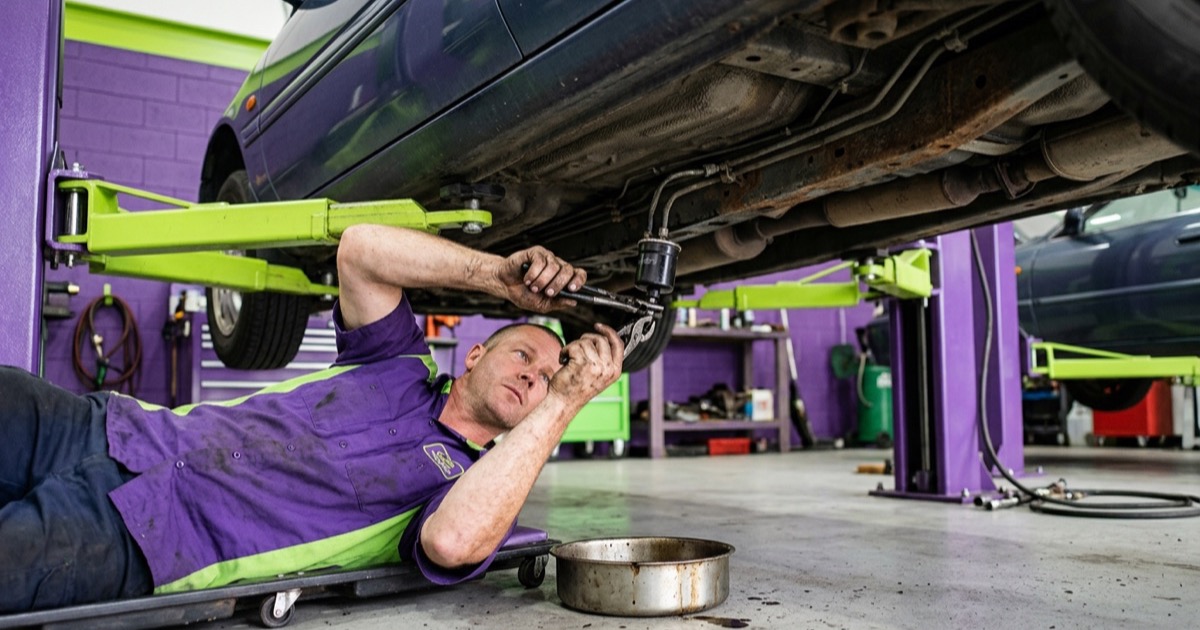
A standard service covers relieving fuel pressure, disconnecting the lines, swapping the filter, checking flow direction, and running the engine to check for leaks. On a diesel it should also include draining the water separator and priming or bleeding the system so no air reaches the injectors.
The price on this page is for a serviceable filter that sits outside the tank. If yours lives inside the tank with the pump, that is a different job priced like a fuel pump replacement.
Most filters have an arrow printed on the side that shows which way fuel flows. Installing one backward can restrict flow or push debris toward the engine. A careful tech checks the arrow before tightening anything.
Does Your Car Even Have a Replaceable Filter?
This is the question that saves the most money. Many gas cars built in the last fifteen to twenty years use a filter sock and a fine filter built into the pump module inside the tank. The maker calls it a lifetime part. There is nothing to change on a schedule.
Other cars, many trucks and nearly every diesel still have an external filter with a service interval. Your owner's manual will say. If it does not list a fuel filter interval, you likely do not have a separate filter.
Be careful with quick-lube menus that list a fuel filter for every car. Ask the shop to point to the part on your vehicle before you say yes.
Why the Price Varies
Location is the main driver. A filter on the frame rail with quick-connect fittings can be done in half an hour. A filter tucked above a heat shield, or one with rusted steel fittings, can take an hour or more.
Diesels cost more because the filters cost more, many trucks have two, and the system has to be bled. A dealer will also charge more for OEM filters and higher labor.
A mobile mechanic can do most inline gas filters and diesel spin-on filters in a driveway. They will bring a drain pan and fittings tools. In-tank filters need the tank dropped or the pump removed through an access panel, which is better done in a shop.
Older cars may have threaded steel lines instead of quick-connect clips. These need two line wrenches, one to hold the filter and one to turn the nut. If the nut is rusted to the line, the tech may have to replace a short piece of fuel line, and the quote should allow for that.
What Often Gets Done at the Same Time
A fuel filter is a small job, so the add-ons should stay small too.
- Worth it on diesels: drain the water separator and replace both filters if the truck has two
- Worth it if old: new fuel line clips or O-rings if the old ones are cracked
- Worth it if due: engine air filter, since it is cheap and quick
- Ask for proof first: a fuel pump, unless a pressure test shows low pressure
- Usually skip: a full fuel system cleaning package with no symptom to fix
Is a Clogged Filter Really the Problem?
A clogged filter feels like the engine is running out of breath. Power fades on hills, on the highway, or when you are towing. Idle is often fine because the engine needs little fuel there.
A weak fuel pump, a failing pressure regulator and a clogged catalytic converter all feel very similar. The honest test is a fuel pressure and volume test. The shop connects a gauge and sees whether pressure holds under load. If pressure is low with a new filter, the pump is the problem.
If your car has an in-tank filter, a low pressure reading usually means the whole pump module, not just the filter. That is why the test should come before the quote.
Bad gas is another cause that gets missed. A tank of fuel with water or too much ethanol for your engine can cause the same stumbling. If the trouble started right after a fill-up, mention that to the shop.
How Often to Change It and How to Make It Last
Follow the interval in your owner's manual. Older gas cars often called for one every 30,000 miles or so. Diesels are often much shorter, sometimes every oil change or two on hard-working trucks.
You can help the filter last. Buy fuel from busy stations. Do not run the tank nearly empty all the time, since the pump can pull sediment from the bottom. On a diesel, drain the water separator when the light comes on and buy fuel where trucks fill up.
If a new filter clogs quickly, something is wrong upstream. A rusty tank or contaminated fuel will keep killing filters, and that needs fixing first.
Cars and trucks that sit for months are a special case. Old gas breaks down and leaves varnish that clogs filters and injectors. A fuel stabilizer before storage helps, and so does starting the season with a fresh tank.
Questions to Ask Before You Approve the Quote
Fuel filter quotes are where honest shops and menu sellers split apart. These questions keep it straight.
- Where is the fuel filter on my car, and can you show me?
- Is it an inline filter or part of the in-tank pump module?
- Did you test fuel pressure, and what was the reading?
- What brand of filter are you using?
- On a diesel, does the price include bleeding the system and draining water?
- Will you check the fittings and clips for leaks after the swap?
Signs you need this repair
- Hesitation or bucking when you accelerate hard
- Loss of power going uphill, on the highway or while towing
- Engine stalls under load but idles fine
- Hard starting or long cranking
- Fuel pump whine that is louder than usual
- Water in fuel warning light on a diesel
Cost by vehicle type
| Vehicle | Typical range | Notes |
|---|---|---|
| Compact / economy car | $50 to $200 | Many newer compacts have no serviceable filter at all because it lives in the in-tank pump. Older compacts often have a cheap inline filter on the frame rail. |
| Midsize sedan / small SUV | $55 to $210 | Most late-model sedans use a lifetime in-tank filter. If a shop quotes a fuel filter on one, ask them to show you where it is on your car. |
| Full-size truck / large SUV | $60 to $240 | Many gas trucks still have a frame-mounted inline filter that is easy to reach. Rusty fittings on older trucks can add time. |
| Luxury / European | $75 to $295 | Some European models put the filter in the tank or under a cover that needs more time to reach, and OEM filters cost more. Expect the upper half of the range. |
| Hybrid | $60 to $230 | Hybrids usually have the filter in the tank with the pump, so it is rarely a separate service. Gas sits longer in a hybrid, so fuel quality matters more. |
| Electric vehicle | Battery electric cars have no fuel tank or fuel filter, so this service never applies. | |
| Diesel / heavy duty | $70 to $285 | Diesels need filter service on schedule, often with two filters and a water separator. Parts run higher and bleeding the system adds time, so expect $150 to $350 or more. |
Ranges assume national-average labor rates ($95, $140/hr) and quality aftermarket parts.
Cost by state
State ranges reflect typical independent-shop labor rates for a midsize vehicle.
Common questions
How much does a fuel filter replacement cost?
Most gas cars with an external filter cost about $55 to $210 at an independent shop. Diesels cost more, often $150 to $350, because the filters cost more and the system has to be bled. If the filter is inside the tank, expect fuel pump pricing instead.
How do I know if my car has a fuel filter?
Check your owner's manual maintenance schedule. If it lists a fuel filter interval, you have one to change. If it does not, the filter is most likely built into the fuel pump inside the tank and is meant to last the life of the pump.
Can a clogged fuel filter damage the fuel pump?
Yes, over time it can. The pump has to push harder against the blockage, which makes it run hotter and wear faster. Replacing a cheap filter on time is much cheaper than a new pump.
Can I drive with a clogged fuel filter?
You can usually drive gently for a short time, but power will keep fading. The risk is stalling while merging or climbing a hill. On a diesel with water in the fuel, stop driving and drain the separator, because water can ruin injectors.
Why does the quick lube shop want to change my fuel filter?
Many quick-lube menus list a fuel filter for every car, even when the car has no external filter. Ask them to show you the filter on your car. If they cannot point to it, say no.
Is a fuel filter replacement worth it on an old car?
Yes, if the car has an external filter that has never been changed. It is one of the cheapest services on the car and it protects the pump and injectors. If the car runs fine and the filter is inside the tank, leave it alone.
How long does it take to replace a fuel filter?
Most external filters take 20 minutes to an hour. Diesels with two filters and a bleed procedure can take longer. In-tank filters are part of a fuel pump job and can take two to four hours.
Can a mobile mechanic replace a fuel filter?
Yes, most inline gas filters and diesel spin-on filters are easy driveway jobs. A mobile tech brings a drain pan, line tools and a primer if needed. In-tank filters need the tank dropped or the pump pulled, which is a shop job on most cars.
Related Repair Guides
More Fuel Repair Costs
Sources and further reading
Primary sources behind this page. Federal safety, emissions and consumer-protection references, worth reading before you authorize any repair.
- fueleconomy.gov: Keeping Your Vehicle in Shape DOE and EPA guidance on following the maintenance schedule in your owner's manual.
- DOE Alternative Fuels Data Center: Biodiesel Federal reference on diesel and biodiesel blends, which affect filter life on diesel trucks.
- ASE certification Ask for an ASE certified tech to run the fuel pressure test before replacing parts.
Need Work Done? Get a Free Quote.
Tell us what the car is doing. A local mechanic calls you back, most requests get a call back the same day. No fee, no obligation.