What the Job Is and What You Are Paying For
Inside each door is a frame that holds the glass and moves it up and down. That frame is the regulator. Most modern cars use a cable and pulley design, with thin steel cables wound around a drum on the motor. Older cars and many trucks use a scissor style arm with a toothed gear.
The weak spots are the cables, the plastic pulleys and the plastic clips that grip the bottom of the glass. Cables fray and snap. Pulleys crack in the cold. Clips break and let the glass tilt or fall into the door.
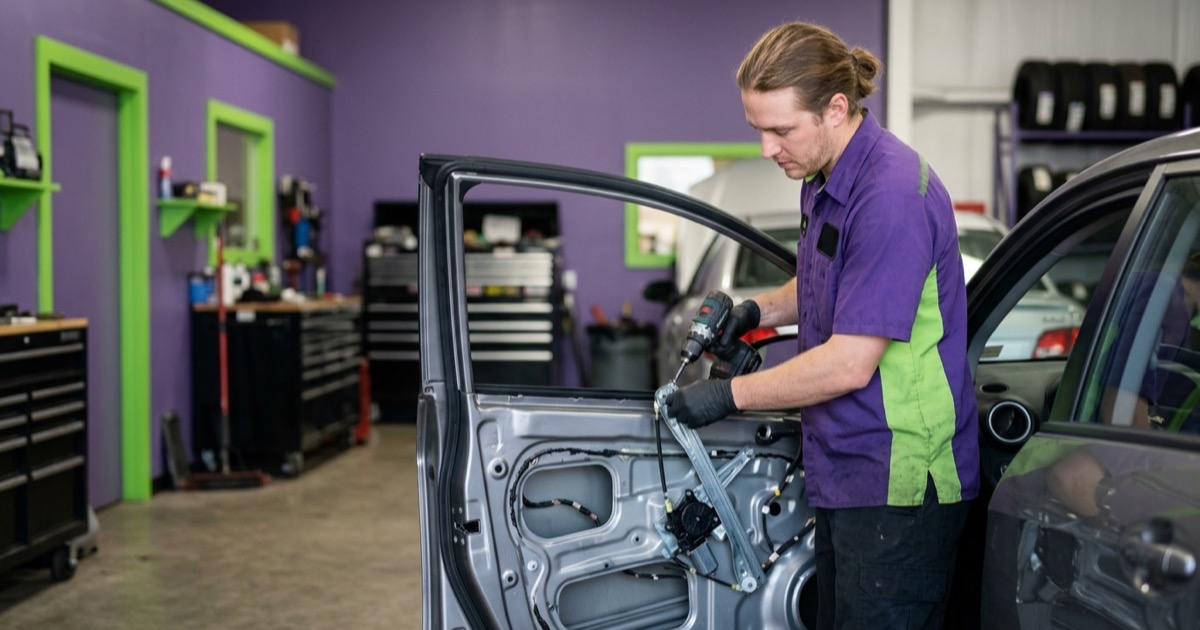
A proper job means removing the door panel, peeling back the plastic water shield, securing the glass, unbolting the old regulator and motor, and bolting in the new one. Then the glass gets clamped back on, lined up so it seals against the top of the frame, and tested a few times before the panel goes back on.
On most cars the regulator and motor are sold together. That costs a little more than the regulator alone, but it saves a second door teardown when an old motor quits six months later. If your motor still runs strong and you buy them separately, the regulator alone is cheaper.
The price you see is mostly door panel labor and the part. There is no fluid, no lift time on most cars and no special parts beyond clips and sometimes new water shield adhesive.
Why the Price Varies So Much
The part is the biggest swing. A quality aftermarket regulator with motor for a common compact can cost under $100. The same assembly from a dealer can be $250 to $400. European cars with door carrier modules can go higher still.
Door design is next. A front door on a common sedan is quick. A rear door with a fixed vent glass takes longer. A frameless door, like on many coupes, convertibles and some EVs, needs careful glass alignment and sometimes a scan tool to teach the window its stops.
The condition of the door matters too. Rusted bolts, rivets instead of bolts, and broken panel clips all add time. Some regulators are riveted in at the factory and need the rivets drilled out.
Then comes the shop. Dealers charge the highest hourly rate and use factory parts. Independents usually use aftermarket assemblies. Mobile mechanics are often the cheapest, and this job is a natural fit for a driveway because it needs no lift.
What Usually Gets Done at the Same Time
Some add ons are smart because the door panel is already off. Others are padding.
Worth it almost every time is a new set of door panel clips. Old ones break when they come out, and a panel that rattles or sits loose looks bad. A bag of clips costs a few dollars.
Worth it if the old motor is slow is replacing the motor with the regulator. If the window was crawling before it broke, the motor is likely tired too.
Worth checking is the window switch. A window that works from the driver's master switch but not from its own door switch has a switch problem, not a regulator problem. Test both before paying for parts.
Worth it if torn is a new water shield or fresh butyl tape. A torn shield lets water onto the door panel and into the speaker and switch wiring.
Usually an upsell is replacing the regulator on the other side because it is the same age. Only do it if that window is also slow, noisy or crooked.
- Door panel clips: replace the broken ones every time
- Window motor: replace with the regulator if it was slow
- Window switch: test it before you buy parts
- Water shield or butyl tape: reseal if torn
- Window run channel: replace if torn or stiff
- Matching regulator on the other door: skip unless it shows symptoms
Make Sure It Is Really the Regulator
A window that does not move has four common causes. The regulator, the motor, the switch, and the wiring or fuse. Each one points to a different repair.
If you hear the motor whir or click but the glass does not move, or the glass drops into the door, the regulator is almost always the problem. A grinding or popping sound as the glass moves also points to a broken cable or pulley.
If you hear nothing at all, check the other windows first. If none work, look at the fuse, the relay, or the driver's master switch. If only one is dead, test the switch and then the motor. A shop can put a meter on the motor plug to see if power arrives when you press the switch.
A window that goes up slow and stops halfway often has dry, stiff rubber run channels. Silicone spray on the channels can fix that for a few dollars.
On many newer cars with one touch auto up, a window that bounces back down when it nears the top is the anti pinch safety feature doing its job after a battery disconnect. A reset procedure, usually holding the switch up for a few seconds after the glass closes, fixes it with no parts.
Questions to Ask Before You Approve the Quote
A good quote names the door, the part and whether the motor is included. These questions help you catch guessing and padding.
- Did you test power at the motor plug, or are you guessing it is the regulator?
- Is the quote for the regulator alone or the regulator with motor?
- Is the part aftermarket or factory, and what is its warranty?
- Will you replace any broken door panel clips?
- Does my door need a window learn or glass height setup after the repair?
- Will you reseal the water shield so water does not get onto the panel?
- Is the other side showing any signs, or are you just matching it?
- What is the labor warranty if the glass rattles or does not seal?
Can a Mobile Mechanic Do It?
Yes. This is one of the best jobs for a mobile mechanic. It needs no lift, no fluids and no special equipment on most cars. A mobile tech can do it in your driveway or at your office in an hour or two.
The versions better left to a shop are frameless doors that need a scan tool to set glass height, and European door carrier modules where the tech wants a clean bench to work on. Many mobile techs carry the scan tool too, so ask.
Give the year, make, model and which door when you call. Regulators are door specific, front and rear, left and right, so the part has to match exactly.
How to Make the New Regulator Last
A good regulator should last 100,000 miles or more. The ones that fail early usually fail from extra strain.
Keep the rubber run channels clean and slick. A spray of silicone lubricant on the channels once or twice a year lets the glass glide instead of drag. Do not use oil based spray, which attracts dirt.
In freezing weather, do not force a window that is iced shut. Let the defrost and heat free it first. Forcing frozen glass is a top cause of snapped cables and cracked pulleys.
Do not hold the switch after the glass reaches the top or bottom. That keeps the motor pushing against a stop and loads the cables.
If the window starts to sound different, click, or tilt, get it checked early. A regulator caught before the cable snaps can sometimes be fixed without the glass falling and scratching.
Signs you need this repair
- Window drops into the door and will not come back up
- Motor runs or clicks but the glass does not move
- Grinding, popping or clunking from inside the door when you use the switch
- Glass goes up crooked or tilts forward or back
- Window moves very slowly or stops partway
- Glass rattles or shakes inside the door on bumpy roads
- Window will not close fully or leaves a gap at the top
Cost by vehicle type
| Vehicle | Typical range | Notes |
|---|---|---|
| Compact / economy car | $170 to $590 | Most compacts use a cable and pulley regulator sold as one piece with the motor, and the door panel comes off with a few screws and clips. This is usually a one hour job and lands near the bottom of the range. |
| Midsize sedan / small SUV | $185 to $640 | Midsize sedans are mostly straightforward, one to one and a half hours per door. Rear doors on some models hide a fixed glass section that has to come out first, which adds time. |
| Full-size truck / large SUV | $215 to $750 | Trucks have big doors with lots of room, so access is good, but the glass is heavy and the regulator is a larger part. Crew cab rear doors and power sliding rear windows are separate jobs with their own prices. |
| Luxury / European | $270 to $930 | Many German cars mount the regulator to a door carrier panel that must come out as a unit, and some frameless doors need the glass height set with a scan tool. Expect the top of the range and OEM parts that can cost $300 or more per side. |
| Hybrid | $205 to $700 | Hybrids use the same doors as their gas models, so the job and price are the same. There is no high voltage wiring inside the doors. |
| Electric vehicle | $215 to $735 | EVs price like their gas counterparts. Frameless door EVs often need the window learn or short drop function reset after the repair, which a good shop does with the car's menu or a scan tool. |
| Diesel / heavy duty | $260 to $895 | Heavy duty trucks share their doors with the half ton models in most cases. Price is about the same as a full size truck, with heavier glass and a beefier regulator. |
Ranges assume national-average labor rates ($95, $140/hr) and quality aftermarket parts.
Cost by state
State ranges reflect typical independent-shop labor rates for a midsize vehicle.
Common questions
How much does it cost to replace a window regulator?
Most drivers pay about $200 to $600 per door at an independent shop or mobile mechanic. Common compacts with an aftermarket regulator and motor sit at the low end. Luxury cars, frameless doors and dealer parts push it toward the top, and a dealer can go higher still.
Can I drive with a broken window regulator?
Yes, if the window is closed and secured. If the glass is stuck down, your car cannot be locked and rain gets in, so tape it up or have it wedged closed until it is fixed. Glass that is loose in the door can also slide down or break on rough roads.
Is it the window motor or the regulator?
If you hear the motor run but the glass does not move, it is usually the regulator. If you hear nothing at all, check the switch, fuse and motor first. On most cars the two are sold as one assembly anyway.
How long does it take to replace a window regulator?
About one to two hours for most doors. A simple front door on a compact can be done in under an hour. Rear doors with fixed glass, frameless doors and European door modules take longer.
Should I replace the motor with the window regulator?
Usually yes, if the motor is original and the window was slow before it broke. Many regulators come with the motor attached for a small price difference, and it saves taking the door apart twice.
How do I keep my window up until I can fix it?
Pull the glass up by hand and hold it with strong painter's tape over the top of the door frame, or wedge it with a rubber door stop inside the door. Do not keep pressing the switch, because that can damage the motor or drop the glass.
Is a window regulator worth fixing on an old car?
Yes, almost always. A car that cannot be locked or that leaks rain loses value fast, and aftermarket regulators for older cars are cheap. A $250 repair on a $3,000 car is a good trade.
Related Repair Guides
More Electrical Repair Costs
Sources and further reading
Primary sources behind this page. Federal safety, emissions and consumer-protection references, worth reading before you authorize any repair.
- FMVSS 118 Power Operated Window Systems (eCFR) The federal safety standard for power windows, including the auto reverse rules behind anti pinch windows.
- ASE certified technicians Look for ASE certified electrical and body technicians before you approve a quote.
Need Work Done? Get a Free Quote.
Tell us what the car is doing. A local mechanic calls you back, most requests get a call back the same day. No fee, no obligation.