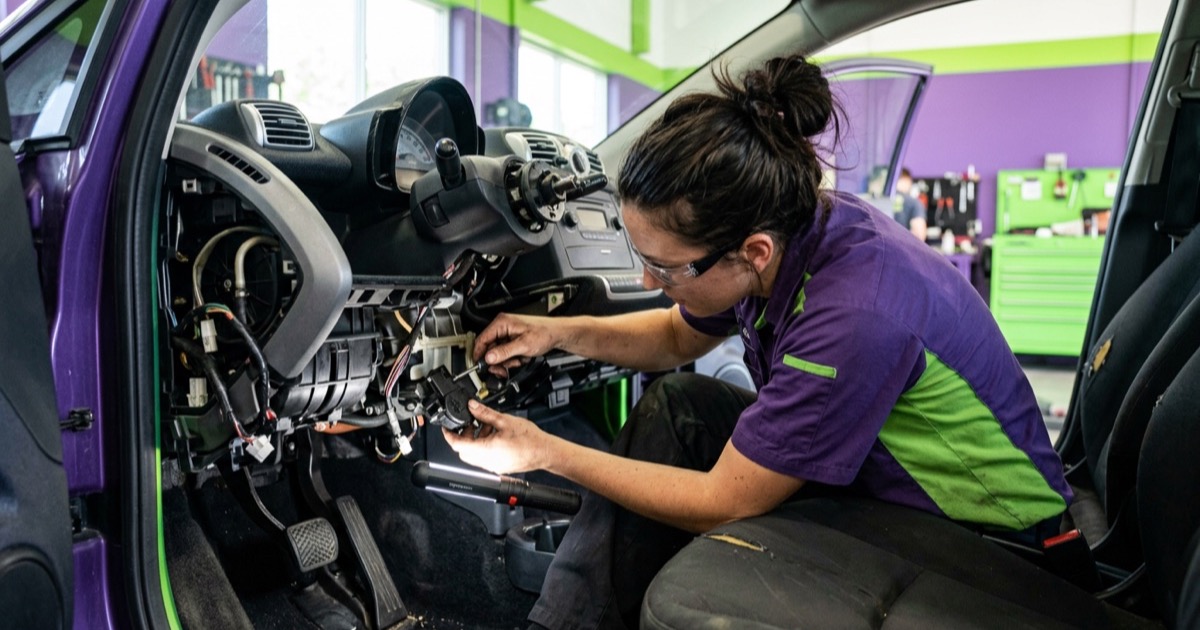
What a Blend Door Actuator Does
Inside the HVAC box behind your dash, air from the blower can go two ways. It can pass through the heater core and get warm, or it can skip it and stay cool from the AC evaporator. A flap called the blend door picks the mix.
The blend door actuator is the small plastic motor that moves that flap. When you turn the temperature knob, the climate computer tells the actuator where to go. A sensor inside the actuator reports back where the door actually is.
Most cars have more than one actuator. Dual zone cars have a blend actuator for each side. There is usually a mode actuator that picks face, feet, or defrost, and a recirc actuator for outside or inside air. They look alike, so the first job is figuring out which one is acting up.
What Is Included in the Price
A proper job starts with a quick diagnosis. The tech listens for clicking, runs the temperature from hot to cold, and on newer cars scans the HVAC module for codes. Many climate systems store a code that names the bad actuator.
Then the tech removes whatever trim is in the way, unplugs the actuator, takes out its screws, and fits the new one onto the door shaft. On many cars that is the glove box and a lower dash panel. On others it is the center console, radio, or the whole dash.
Last is calibration. The climate computer has to learn where full hot and full cold are for the new motor. Some cars do it on their own when you cycle the key. Others need a battery disconnect, a button sequence, or a scan tool. Skipping this step is why some new actuators click right away or stop short of full heat.
The part is often $40 to $150 aftermarket. Labor is the swing, from under an hour to three or more.
Why the Price Varies
Location is the whole story. An actuator behind the glove box can be a half hour swap. The same part tucked against the transmission tunnel or behind the center stack can take two to three hours. A few models need the dash pulled, which pushes the job toward heater core territory.
Which actuator failed matters too. On a dual zone car, the driver side motor may be easy and the passenger side one buried, or the other way around.
Parts tier matters a little. Good aftermarket actuators work well on most domestic and Asian cars. Some European models only behave with OEM parts and need coding.
Shop type matters too. Dealers charge more per hour but have the scan tool for calibration. Independents with a good scan tool can do the same job for less. Mobile mechanics are often the best price when the actuator is reachable without pulling the dash.
Is It the Actuator, the Door, or Something Else?
Clicking behind the dash is the classic sign of a bad actuator. The plastic gears inside strip a tooth, and the motor keeps trying to move past the gap. You hear it when you start the car or change the temperature.
Sometimes the actuator is fine and the door itself is broken. Some trucks and SUVs are known for blend doors that snap at the shaft. A new actuator will spin, but nothing moves. If the tech pulls the actuator and the shaft turns with no resistance, the door is the real problem, and that can mean a much bigger job.
Other things look like a bad actuator. Low coolant or a stuck thermostat gives weak heat. Low refrigerant or a dead compressor gives warm AC. A bad temperature control head or a wiring fault can keep the actuator from getting the right signal. A clogged cabin filter makes everything feel weak.
The simple test is this. If the air temperature does not change at all when you swing the knob from full hot to full cold, the blend door system is the first suspect. If it changes but not enough, look at the heating or cooling side instead.
What Usually Gets Done at the Same Time
If one actuator in your car has failed from age, the others are the same age. On models where they are all easy to reach behind the glove box, replacing a second one that is starting to click can save a second visit. If the others are buried and quiet, leave them alone.
The cabin air filter often sits right next to the actuators. Swapping it during this job takes a minute and helps airflow.
Be wary of a full HVAC box removal quote for an actuator alone. That is only justified when the door itself is broken or the actuator truly cannot be reached another way.
- Worth it: cabin air filter while the glove box is out
- Worth it if easy to reach: a second actuator that is already clicking
- Worth it: HVAC calibration with a scan tool after the swap
- Ask why: replacing every actuator in the car when only one has failed
- Ask for proof: a broken blend door that needs the dash pulled
Questions to Ask Before You Approve the Quote
These questions help you avoid paying for the wrong motor.
- Which actuator failed, blend, mode, or recirc, and how did you confirm it?
- Did the HVAC module store a code for it?
- Where is it on my car, and does any of the dash have to come out?
- Is the door shaft OK, or is the door itself broken?
- Is calibration included, and do you have the scan tool for my car?
- Is the part aftermarket or OEM, and what warranty comes with it?
How Long the New One Lasts
A good actuator usually lasts many years, often the rest of the car's life. Cheap ones with weak plastic gears can fail in a year or two.
Most early failures come from a bad calibration. If the computer thinks full hot is a little past where the door stops, the motor drives against the stop every time and strips its own gears. That is why the calibration step matters.
You can help by not spinning the temperature knob back and forth over and over. If you hear clicking come back soon after a repair, go back right away while it is under warranty.
If the clicking comes back on a different part of the dash, it may be a different actuator. Cars with several motors often lose them one at a time over a few years, so a new noise is not always a bad repair.
Signs you need this repair
- Clicking or tapping behind the dash or glove box, often at startup
- Temperature stuck on hot or cold no matter where you set the knob
- One side of the car blows hot and the other blows cold on a dual zone system
- Air comes out of the wrong vents, like the floor when you picked the face
- Defroster will not switch on or barely blows on the windshield
- Temperature drifts on its own while you drive
- Climate screen or HVAC module shows a door or actuator fault code
Cost by vehicle type
| Vehicle | Typical range | Notes |
|---|---|---|
| Compact / economy car | $135 to $660 | Most compacts have one to three actuators, often reachable behind the glove box in under an hour. The part is usually inexpensive aftermarket. |
| Midsize sedan / small SUV | $140 to $690 | Dual zone climate means two blend actuators, plus mode and recirc motors. One of them is often easy and another is buried, so ask which one failed. |
| Full-size truck / large SUV | $160 to $790 | Many trucks are known for clicking blend door actuators, and some models have a weak door shaft that breaks too. Access ranges from easy under dash to dash removal on certain years. |
| Luxury / European | $195 to $955 | These cars can have six or more actuators and a climate module that needs coding after a swap. Expect OEM part prices and scan tool time. |
| Hybrid | $155 to $760 | Same actuators as the gas version of the car. Hybrids may run the HVAC more often with the engine off, so a sticking door shows up quickly. |
| Electric vehicle | $160 to $795 | EVs use the same kind of motors, sometimes more of them because of heat pump and battery loops. Calibration often needs a factory level scan tool. |
| Diesel / heavy duty | $190 to $935 | Work trucks see dust, heat, and long hours, which wear actuator gears faster. Rear climate units add more actuators that can fail. |
Ranges assume national-average labor rates ($95, $140/hr) and quality aftermarket parts.
Cost by state
State ranges reflect typical independent-shop labor rates for a midsize vehicle.
Common questions
How much does a blend door actuator replacement cost?
Most drivers pay about $150 to $400 at an independent shop when the actuator is behind the glove box or under the dash. Buried actuators that need dash work can run $500 to $700 or more. The part is usually under $150.
Can I drive with a bad blend door actuator?
Yes, it will not harm the engine. The real concern is visibility. If you cannot get heat or defrost on the windshield in cold or wet weather, get it fixed before you need it.
What does a bad blend door actuator sound like?
It usually sounds like a steady clicking or tapping behind the dash, often right after you start the car or move the temperature knob. The sound comes from stripped plastic gears inside the motor.
Can I replace a blend door actuator myself?
Often, yes. On many cars it sits behind the glove box and comes out with a few small screws. Check where yours is before you buy the part, and look up how your car calibrates a new one.
Does a new blend door actuator need to be calibrated?
Most do. Some cars learn the new motor when you cycle the key or disconnect the battery. Others need a button sequence or a scan tool. Skipping calibration can cause clicking or missing heat.
Why is my heat blowing cold after replacing the blend door actuator?
The most common reasons are a missed calibration, the wrong actuator replaced, or a broken blend door that the new motor cannot move. Low coolant or a stuck thermostat can also cause it, so have those checked too.
How long does it take to replace a blend door actuator?
Most take 30 minutes to 2 hours when the actuator is behind the glove box or under the dash. Buried ones that need the center stack or dash pulled can take 3 hours or more. Add a few minutes for calibration and a test from full hot to full cold.
Can a mobile mechanic replace a blend door actuator?
Yes, on most cars where the actuator is behind the glove box or under the dash. It is a good driveway job. If your car needs the dash pulled, a shop is the better call.
Related Repair Guides
More Climate Repair Costs
Sources and further reading
Primary sources behind this page. Federal safety, emissions and consumer-protection references, worth reading before you authorize any repair.
- fueleconomy.gov: Fuel economy in cold weather DOE and EPA guidance on cabin heating and defrost use in winter driving.
- fueleconomy.gov: Fuel economy in hot weather DOE and EPA guidance on how AC use affects fuel use.
- ASE: National Institute for Automotive Service Excellence Find ASE certified techs, including the heating and air conditioning certification.
Need Work Done? Get a Free Quote.
Tell us what the car is doing. A local mechanic calls you back, most requests get a call back the same day. No fee, no obligation.