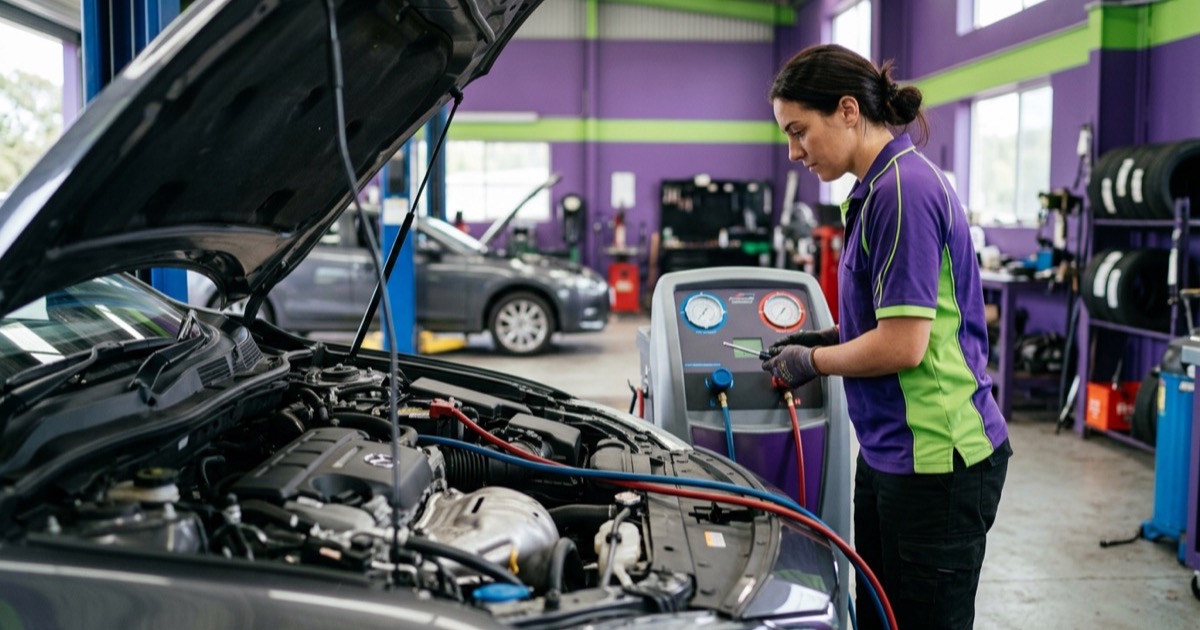
What an AC Recharge Actually Includes
A real recharge is four steps, not one. First the shop hooks a recovery machine to your service ports and pulls out whatever refrigerant is left. The machine weighs it, which tells the tech how much was missing.
Second, the machine pulls the system into a deep vacuum. This boils off moisture that got inside. Moisture plus refrigerant makes acid, and acid eats compressors from the inside.
Third, the system has to hold that vacuum for a while. If the vacuum creeps back up, there is a leak, and filling it now would waste your money. Many shops also add a small shot of UV dye so a slow leak will glow under a black light later.
Fourth, the machine charges the exact weight on the label under your hood, plus the right oil if any was lost. Then the tech checks vent temperature and high and low side pressures with the engine running. That last check is what proves the system works, not just that it is full.
If a quote for a recharge is cheaper than a tank of gas, ask which of these steps they are skipping.
Why the Price Varies: R-134a vs R-1234yf
Your car uses one of two refrigerants, and you cannot swap between them. R-134a was the standard for decades. R-1234yf replaced it because it breaks down much faster in the air and does far less to warm the planet. The switch happened model by model, so two cars from the same year can use different gas.
The price gap is real. Per pound, R-1234yf costs several times more than R-134a at the shop counter. A typical car holds 1 to 2 pounds. On an older R-134a car, the refrigerant in a recharge might cost $30 to $60. On an R-1234yf car, the refrigerant alone can run $100 to $250.
Labor is close to the same, but R-1234yf jobs take a bit longer. The machines run extra purity checks, the fittings are different, and the gas is mildly flammable, so shops follow stricter steps. Many smaller shops still do not own an R-1234yf machine at all.
To find out which one you have, open the hood and look for a sticker near the front, often on the radiator support or the underside of the hood. It names the refrigerant and the charge weight. Bring that number with you when you call for quotes.
Refrigerant type is the biggest swing. An R-134a recharge at an independent shop often lands around $150 to $250. The same job on an R-1234yf car often runs $250 to $450.
System size is second. A compact holds about a pound. A three row SUV with rear air can hold more than twice that, so the gas costs more and the fill takes longer.
Dealers tend to charge the most because of higher labor rates, but they always have the right machine. Independent shops land in the middle. Mobile techs who carry a recovery machine are often the cheapest for an R-134a car. Fewer mobile techs carry an R-1234yf machine, so ask before you book.
Watch for the headline price trap. Some shops post a low AC special that covers a performance check only, or a recharge with refrigerant charged extra by the ounce. Ask for the out the door number for your car's full charge weight.
Why a Recharge Without a Leak Check Is a Waste
AC refrigerant does not get used up. It is a sealed loop, like brake fluid. If yours is low, it leaked out somewhere. That is the most important sentence on this page.
A system that lost a small amount over eight or ten years may be fine with a careful recharge. A system that lost most of its charge since last summer has a real leak, and a recharge alone will blow cold for a few weeks or months and then quit again. You pay for the same refrigerant twice.
The worst case is a store can top off on a leaking system. Some cans contain sealer. Sealer can clog the small passages in the expansion valve and condenser, and many shops will refuse to hook their recovery machine to a car with sealer in it because it can ruin a machine that costs thousands. That turns a simple job into a bigger one.
The common leak spots are the condenser up front where rocks hit it, the compressor shaft seal, O rings at line connections, the Schrader valves inside the service ports, and the evaporator buried in the dash. Ask for the vacuum hold test and dye. If the shop finds the leak, fix it first and recharge once.
Federal Rules: Section 609 and What They Mean for You
Under Section 609 of the Clean Air Act, anyone who works on a car AC system for pay must be trained and certified through an EPA approved program. That applies no matter which refrigerant the car uses. They also have to use certified recovery equipment.
Venting refrigerant into the air on purpose is illegal. Recovered refrigerant must be recycled or reclaimed before it goes back into any car, even the one it came out of. Shops have to keep records showing their techs are certified.
What this means for you is simple. A legit shop or mobile tech will have a recovery machine and a 609 card, and they will not just crack a line open to empty your system. A guy who offers to recharge your AC with a can in a parking lot for cash is not following these rules.
If you top off your own car with a store can, you do not need a certification. You still cannot vent refrigerant on purpose. Most store cans are R-134a, and R-1234yf cans for home use are rare and pricey.
What Gets Done at the Same Time
Some add ons are worth it. A UV dye shot costs little and makes the next leak easy to find. A new cabin air filter is cheap and can fix weak airflow that people blame on low refrigerant. Replacing leaky Schrader valve cores at the service ports is a few dollars and a common fix for slow leaks.
Other add ons need proof. A condenser, compressor, or evaporator should only be quoted after the shop shows you where the dye glows or where the leak detector hits. A blind parts swap is how a $250 job becomes a $1,500 job.
AC sanitizer or odor treatment is fine if your vents smell musty, but it does nothing for cooling. A system flush is only needed after a compressor fails and sends debris through the lines. It is not a routine add on for a plain recharge.
- Worth it: UV dye, cabin air filter, Schrader valve cores
- Worth it if diagnosed: condenser, hoses, O rings at a confirmed leak
- Usually upsell on a plain recharge: system flush, additives, stop leak, odor bombs
Do You Really Need a Recharge?
Warm air has more causes than low refrigerant, so make sure the shop checks the cheap stuff first.
If the compressor clutch is not clicking on, the cause can be a blown fuse, a bad relay, a failed pressure switch, or a system so empty the switch will not let the compressor run. If air is cold on one side and warm on the other, a blend door actuator is a likely suspect. If the air is cold but barely blowing, look at the cabin filter and blower motor.
If the AC is cold on the highway and warm at stop lights, the condenser fan may have quit. If the AC gets cold, then warm, then cold again, moisture or an overcharge can be the cause.
A good tech reads pressures before recommending anything. Low on both sides with a running compressor usually does mean low refrigerant. Any other pattern points at a different part.
Questions to Ask Before You Approve the Quote
Use these to sort the honest shops from the fast ones.
- Which refrigerant does my car use, and what is the charge weight on the label?
- Will you recover the old refrigerant and tell me how much came out?
- Will you pull a vacuum and do a hold test before filling?
- Are you adding UV dye so we can find a leak later?
- Is the refrigerant included in the price, or charged by the ounce?
- What vent temperature did you get after the recharge?
- If it is warm again in a month, what does a recheck cost?
Signs you need this repair
- Air from the vents is cool but not cold, and worse at idle or in traffic
- AC that used to be cold on a 100 degree day now only works at night or on the highway
- Compressor clutch clicks on and off every few seconds
- Hissing behind the dash right after you shut the car off
- Oily residue on AC lines, fittings, or the front of the condenser
- Windows slow to defog, since the AC also dries the air
- Battery cooling warnings or slower fast charging on an EV
Cost by vehicle type
| Vehicle | Typical range | Notes |
|---|---|---|
| Compact / economy car | $135 to $380 | Small systems hold about a pound of refrigerant, so even an R-1234yf compact stays near the low end. Older R-134a compacts are the cheapest recharge on the road. |
| Midsize sedan / small SUV | $140 to $410 | Most midsize cars built in the last several model years use R-1234yf, which pushes the refrigerant cost up even though the labor is the same. Check the label under the hood before you compare quotes. |
| Full-size truck / large SUV | $160 to $480 | Trucks and big SUVs often have rear AC with extra lines running to the back, which means more refrigerant and more places to leak. Expect the upper part of the range. |
| Luxury / European | $195 to $595 | Many European cars want a specific oil type and amount, and some need a scan tool to run the compressor during the fill. Dual zone and rear climate systems hold more refrigerant too. |
| Hybrid | $155 to $450 | Hybrids use an electric compressor that runs on special insulating oil. The shop must use a machine that will not cross contaminate that oil, so tell them it is a hybrid when you book. |
| Electric vehicle | $160 to $470 | EVs also use an electric compressor with insulating oil, and on many models the AC loop also chills the battery. A low charge can limit fast charging or trigger battery cooling warnings, not just warm air. |
| Diesel / heavy duty | $190 to $575 | Heavy duty pickups and work vans often have long rear AC lines and big condensers that take a beating from road debris. Leaks are common, so a leak check first is not optional. |
Ranges assume national-average labor rates ($95, $140/hr) and quality aftermarket parts.
Cost by state
State ranges reflect typical independent-shop labor rates for a midsize vehicle.
Common questions
How much does an AC recharge cost?
Most drivers pay about $150 to $250 for an R-134a car and $250 to $450 for an R-1234yf car at an independent shop. The refrigerant type and your system size drive most of the gap. Dealers usually run higher.
Why is R-1234yf so expensive?
R-1234yf costs several times more per pound to make and buy than R-134a. It also needs its own service machine, and shops pass that cost along. The good news is it does far less harm to the climate, which is why carmakers switched.
Can I put R-134a in a car that uses R-1234yf?
No. The service fittings are different on purpose, the system is built and labeled for one gas, and mixing them contaminates the system and the shop's equipment. Use only the refrigerant listed on your under-hood label.
How often does a car AC need to be recharged?
A healthy system should never need one. It is sealed. If yours needs a recharge every year, it has a leak, and fixing the leak is cheaper than buying refrigerant every summer.
Are DIY AC recharge cans worth it?
They can buy a little time on an older R-134a car with a slow leak, but they are a gamble. The gauge only reads one side of the system, so overfilling is common, and cans with sealer can clog parts and get your car turned away at shops.
How long does an AC recharge take?
About an hour for a proper job with a vacuum hold test. Add more time if the shop has to hunt down a leak with dye or a sniffer. A ten minute recharge skipped the vacuum.
Can a mobile mechanic recharge my AC?
Yes, if they carry a recovery and recharge machine and hold a Section 609 certification. Many mobile techs have an R-134a machine, fewer have an R-1234yf one, so ask before they drive out.
Why is my AC blowing warm right after a recharge?
The most common reason is a leak that was never found, so the new charge is already escaping. Other causes are a failing compressor, a bad condenser fan, or a blend door stuck on heat. Go back to the shop and ask for a dye check.
Related Repair Guides
More Climate Repair Costs
Sources and further reading
Primary sources behind this page. Federal safety, emissions and consumer-protection references, worth reading before you authorize any repair.
- EPA: Regulatory requirements for MVAC system servicing Section 609 certification, certified recovery equipment, the venting ban, and recycling rules for car AC refrigerant.
- EPA: Section 609 technician training and certification programs The list of approved programs a tech must pass to service car AC for pay.
- fueleconomy.gov: Fuel economy in hot weather DOE and EPA guidance on how running the AC affects fuel use.
Need Work Done? Get a Free Quote.
Tell us what the car is doing. A local mechanic calls you back, most requests get a call back the same day. No fee, no obligation.