What the Job Is and What Is in the Price
Your heater core sits inside the HVAC box under the middle of the dash. Two heater hoses run through the firewall from the engine to the core and back. When you turn the knob to heat, air passes through the warm core on its way to the vents.
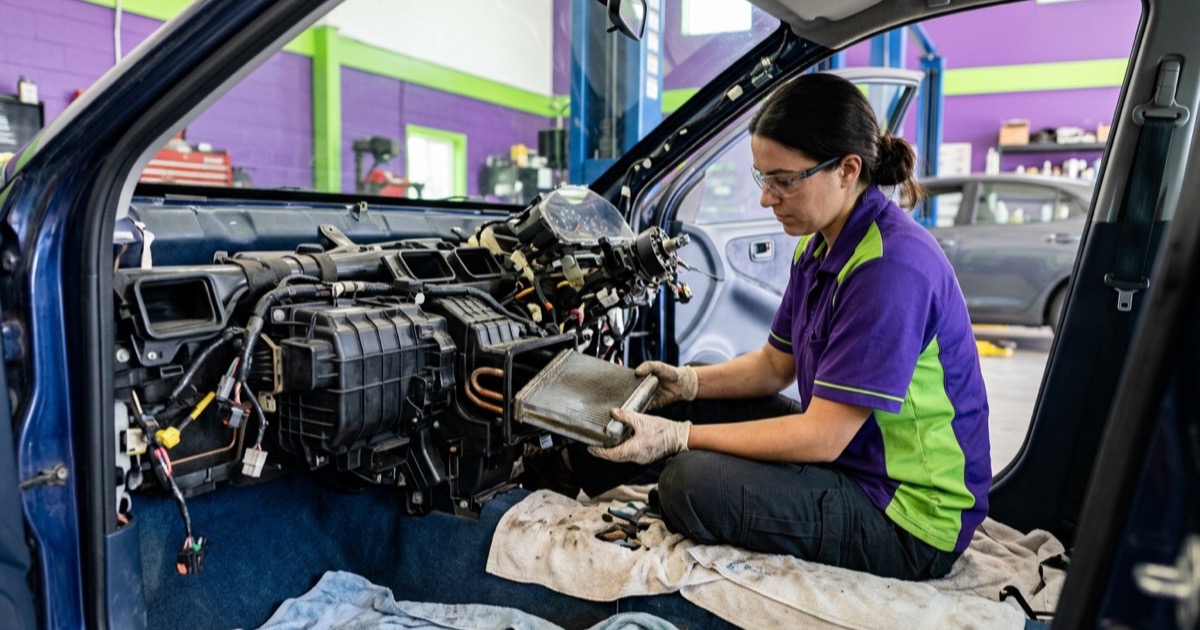
Replacing it starts with draining the coolant. Then the tech disconnects the heater hoses at the firewall and starts on the cabin. On many cars that means removing the center console, glove box, radio, airbags, steering column, and the dash itself. On some cars the HVAC box has to come out too, and that means recovering the AC refrigerant first.
With the box open, the old core slides out and the new one goes in with new seals. Then everything goes back together in reverse. The cooling system gets refilled with the correct coolant and bled of air, and the AC gets recharged if it was opened.
The price is almost all labor. A core often costs $80 to $300. Most of the bill is the hours it takes to reach it and put the dash back so nothing squeaks.
Why the Price Varies, and Who Should Do It
Access is everything. On a handful of vehicles the core is reachable in two or three hours from under the dash. On many others the book time is 6 to 10 hours because the full dash comes out. Two cars that cost the same to buy can be $500 apart on this repair.
AC work adds to it. If the HVAC box has to come out, the refrigerant must be recovered and the system recharged after. On an R-1234yf car that alone can add $150 to $300.
Parts tier matters less than on most jobs. Aftermarket cores are fine for most cars. Some European models only have OEM cores, and those cost more.
Shop type matters a lot. A dealer charging $180 an hour on an 8 hour job is a very different bill than an independent at $110. Get two quotes and compare the hours they are billing, not just the total.
This job wants a clean, dry space and a full day. Most mobile mechanics will do it only on models where the core comes out from under the dash. When the whole dash has to come out, a shop is usually the better call so the car can sit inside overnight if needed.
If AC refrigerant has to be recovered, whoever does the job needs a recovery machine and a Section 609 certification, or they need to send the car to someone who has one.
An independent shop that has done your model before is often the best value. Ask how many times they have done this exact car. A tech who knows where every clip hides will finish faster and leave fewer rattles.
Make Sure It Is Really the Heater Core
Not getting heat is the classic complaint, and the heater core is often not the cause. Check the cheap things first.
Low coolant is the number one reason for no heat. The core sits high in the system, so it is the first place to lose flow when the level drops. If the coolant is low, find out where it went.
A thermostat stuck open keeps the engine from warming up, so the heat is lukewarm. If your temp gauge sits low on the highway, suspect the thermostat. Air trapped in the system after a repair can block flow to the core. A weak water pump can also starve it.
A blend door actuator that is stuck on cold sends air around the core instead of through it. If you hear clicking behind the dash and the temperature knob does nothing, look there first.
A true leaking core has its own signs: a sweet syrup smell inside the car, a greasy film on the inside of the windshield, coolant level dropping with no outside drip, and a damp passenger side carpet. If you have those, the core is the likely culprit.
A clogged core feels different. Both heater hoses are hot going in but the outlet hose is much cooler, and the heat is weak. A flush can sometimes clear it.
Flush, Replace, or Bypass?
A clogged core that does not leak can often be flushed. The shop back flushes it with water or a mild cleaner through the heater hoses. It costs a fraction of replacement and takes an hour or so. If it brings the heat back, you are done.
A leaking core has to be replaced. Stop leak products can slow a tiny seep, but they can also clog the core and the radiator. Use them only as a short bridge if you have no other choice.
A bypass connects the two heater hoses to each other so coolant skips the core. It stops the leak and keeps the engine cool, but you lose heat and defrost. That is fine for a week in July while you save up. It is not a fix for winter, and driving without a working defroster is unsafe.
What Usually Gets Done at the Same Time
When the dash is already out, a few small jobs are almost free. Others are just upsell.
- Worth it: new heater hoses and clamps, since they are old, cheap, and right there
- Worth it: a full coolant flush with the correct coolant, since old coolant may be what ate the core
- Worth it if the HVAC box is out: blend door actuators that are clicking or slow
- Worth it if the HVAC box is out on an older car: the AC evaporator, if it is known to leak on that model
- Ask why: a new thermostat, unless it is old or the engine runs cool
- Usually upsell: radiator replacement with no sign of a leak or clog
Why Heater Cores Fail and How to Make the New One Last
Most heater cores die from the inside. Old coolant loses its corrosion fighters and starts eating thin metal tubes. Mixing coolant types can make sludge that clogs the core. Electrolysis from a bad engine ground can pit the core over time.
A failing head gasket can push exhaust gas and oil into the coolant, which gums up the core fast. If your core clogged and you also lose coolant with no visible leak, ask for a combustion leak test before replacing the core.
To make the new core last, run the exact coolant type your owner manual lists and change it on schedule. Do not top off with plain water for years. Keep an eye on the coolant level each month for the first few weeks after the job. A good replacement core should last as long as the car.
Questions to Ask Before You Approve the Quote
Ask these so you know what you are paying for.
- How did you confirm it is the heater core and not low coolant, a thermostat, or a blend door?
- How many labor hours are you billing, and does the dash have to come out?
- Does the AC have to be opened, and is the recharge in this price?
- Are new heater hoses and coolant included?
- Which coolant will you use, and will you bleed the system to the factory steps?
- What warranty covers the part and the labor, including dash rattles after?
Signs you need this repair
- Sweet syrup smell inside the car, often strongest with the heat on
- Greasy, foggy film on the inside of the windshield that is hard to wipe off
- Damp or wet carpet on the passenger side floor
- Coolant level dropping with no drip under the car
- Little or no heat even after the engine is fully warm
- Steam or vapor coming out of the vents
- One heater hose hot and the other much cooler at the firewall
Cost by vehicle type
| Vehicle | Typical range | Notes |
|---|---|---|
| Compact / economy car | $575 to $1,780 | Many compacts need the full dash out, so labor is high even though the core itself is often under $100. Some older models reach the core from below the glove box. |
| Midsize sedan / small SUV | $595 to $1,850 | Expect dash removal on most current midsize sedans, often with AC evacuation to free the HVAC housing. This is where the typical 6 to 8 hour quote comes from. |
| Full-size truck / large SUV | $670 to $2,100 | Some older full size trucks are the friendliest heater core jobs out there, with access from the engine side or under the dash. Newer trucks with big dashboards and rear climate can take longer. |
| Luxury / European | $810 to $2,540 | Long book times, OEM only cores on some models, and fragile trim make these the priciest versions. A few models are known for quick connect fittings that leak inside the cabin. |
| Hybrid | $655 to $2,035 | The heater core is the same idea, but hybrids often have an electric coolant pump and an engine that shuts off at stops. Bleeding air out of the system afterward needs the right procedure. |
| Electric vehicle | $685 to $2,130 | If your EV uses a coolant heater and a heater core, the job is similar to a gas car. Many EVs share the coolant loop with battery and motor cooling, so the bleed and fill must follow the factory steps. |
| Diesel / heavy duty | $800 to $2,495 | Diesels take a long time to warm up and big coolant systems mean more fluid to replace. Heavy duty trucks with dual climate may have a second core for the rear. |
Ranges assume national-average labor rates ($95, $140/hr) and quality aftermarket parts.
Cost by state
State ranges reflect typical independent-shop labor rates for a midsize vehicle.
Common questions
How much does a heater core replacement cost?
Most drivers pay about $600 to $1,800 at an independent shop, and more at a dealer or on luxury cars. The core itself is usually under $300. The rest is labor, because the dash often has to come out.
Why is heater core replacement so expensive?
Because the core is buried behind the dashboard. On many cars the tech has to remove the airbags, steering column, and the whole dash, which is 6 to 10 hours of labor before and after a 20 minute part swap.
Can I drive with a leaking heater core?
Only for short trips while you keep the coolant full and the windshield clear. Coolant vapor fogs the glass, and running low on coolant can overheat the engine. A temporary bypass is safer than driving on a bad leak.
Can a heater core be flushed instead of replaced?
Yes, if it is clogged and not leaking. A back flush often brings the heat back for a small fraction of replacement cost. If it is leaking, flushing will not help.
Is it worth replacing a heater core on an old car?
It depends on the car's value and your climate. If the car is solid and you need heat and defrost, it is usually worth it. If the car is worth less than the repair, a bypass for the summer and a flush or replacement before winter can stretch your budget.
Does stop leak work on a heater core?
Sometimes for a very small seep, but it is a gamble. The same particles that plug the leak can plug the core and the radiator. Use it only to buy a little time, and tell your mechanic you used it.
How long does a heater core replacement take?
Usually one full shop day. Easy access models can be done in 2 to 4 hours, and hard ones can run 10 or more. Plan to leave the car overnight.
Can a bad heater core cause overheating?
A leaking core can, because it lets coolant escape until the engine runs low. A clogged core usually does not cause overheating on its own, but it can point to bad coolant or a head gasket problem that does.
Related Repair Guides
More Climate Repair Costs
Sources and further reading
Primary sources behind this page. Federal safety, emissions and consumer-protection references, worth reading before you authorize any repair.
- fueleconomy.gov: Fuel economy in cold weather DOE and EPA guidance on cabin heating, warm up time and winter efficiency for gas, hybrid and electric cars.
- fueleconomy.gov maintenance guide DOE and EPA guidance on keeping a car in tune, including the cooling system.
- EPA: Regulatory requirements for MVAC system servicing Why AC refrigerant must be recovered by a certified tech when the HVAC box has to come out.
Need Work Done? Get a Free Quote.
Tell us what the car is doing. A local mechanic calls you back, most requests get a call back the same day. No fee, no obligation.