What the Job Is and What You Are Paying For
Your AC works by moving heat. Refrigerant picks up heat inside the dash, then the compressor squeezes it and sends it hot to the condenser at the front of the car. Air flowing through the condenser carries that heat away. If the condenser cannot do its job, the AC cannot cool.
The condenser looks like a thin radiator. It is made of small aluminum tubes and fins. It sits right behind the grille and in front of the engine radiator, which means it takes every rock, bug and bit of road salt first. Holes and corrosion are the common failures. A front end bump is another.
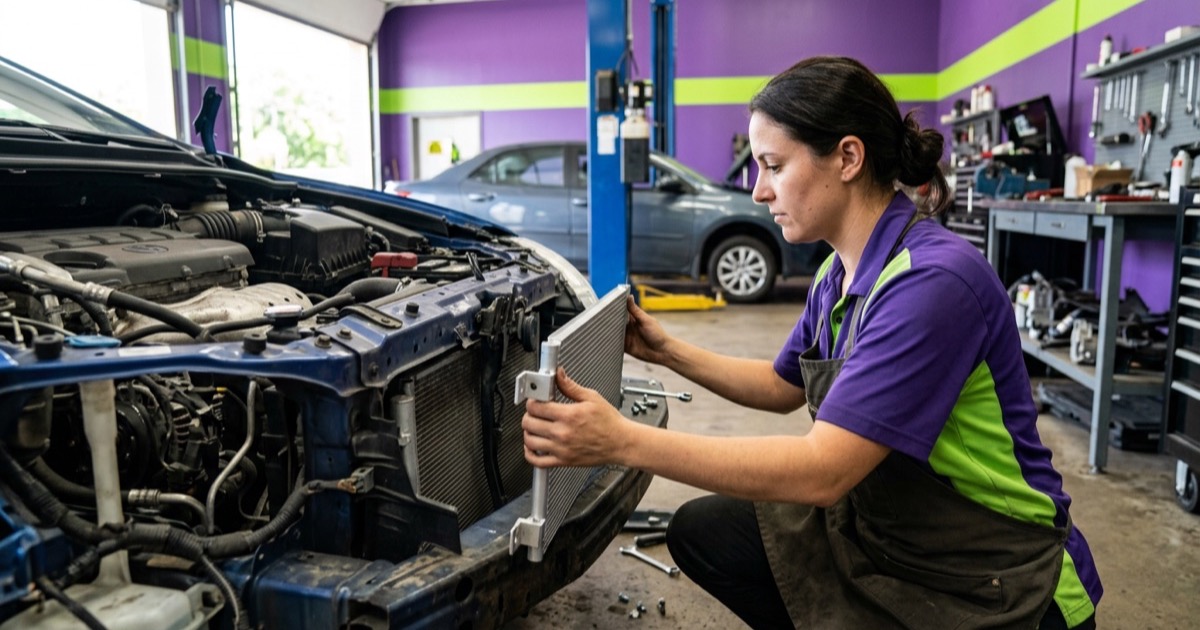
A proper job has several steps. First the shop recovers any refrigerant left in the system with a certified machine. Then the bumper cover or front support often comes off, and the old condenser comes out. The new one goes in with new O rings at each line.
The drier gets replaced too. On some cars it is a separate canister called a receiver drier or accumulator. On many newer cars it is a small cartridge or bag built into the side of the condenser. It soaks up moisture, and once the system is open it should be replaced.
Then the system is put under a deep vacuum, held to check for leaks and recharged with the exact weight of refrigerant and oil the factory calls for. The shop should finish by checking vent temperature and pressures.
Why the Price Varies So Much
The refrigerant type is a big factor. Older cars use R-134a. Most newer cars use R-1234yf, which carmakers began moving to in 2012 to cut greenhouse gas impact. It costs a lot more per pound, and it needs its own machine. Two cars with the same condenser price can end up $200 apart just on refrigerant.
Access is the next factor. Some trucks let the condenser slide out after the grille comes off. Many cars need the whole bumper cover off, and some need the front support moved forward. That turns a two hour job into four.
The part itself ranges a lot. A quality aftermarket condenser for a common car is often $100 to $250. Factory parts and condensers with a built in drier cost more. Very cheap condensers can have poor fit or thinner tubes that leak sooner.
If the compressor failed and sent metal through the system, the bill grows. Modern condensers have tiny passages that cannot be flushed clean, which is why a shop will insist on a new condenser after a compressor failure.
Then comes the shop. Dealers charge the most. Independent shops that do a lot of AC work are often the sweet spot. Mobile AC techs exist, but they need a recovery and recharge machine for your refrigerant type.
What Usually Gets Done at the Same Time
The system is open, so a few extras make sense. Others do not.
Always worth it is a new drier, receiver or accumulator. Once it has been exposed to air it has absorbed moisture and is done. Leaving the old one is how AC systems fail again in a year.
Always worth it are new O rings at every joint that was opened. They are cheap and they are the most common leak point.
Worth it if the system was low for a long time is checking the compressor. If it is noisy or the clutch is worn, it is cheaper to replace while the system is empty than to pay for another recovery and recharge later.
Worth checking is the expansion valve or orifice tube. If the compressor failed, these catch debris and usually get replaced. If the compressor is healthy, they often do not need to.
Worth it if dirty is a cabin air filter. It is cheap and helps the new AC blow full volume.
Usually an upsell on a healthy system is a full system flush when only the condenser was hit by a rock, or an AC additive or sealer. Sealers can clog the machine and the system, and many shops will not touch a car that has it.
- New drier, receiver or accumulator: yes, every time
- New O rings at every opened joint: yes
- Compressor: check it, replace only if noisy or failed
- Expansion valve or orifice tube: replace if the compressor failed
- Cabin air filter: if it is dirty
- Leak sealer additives: skip
Diagnosis First: Is the Condenser Really the Leak?
Warm AC has many causes. A good shop finds the real one before ordering parts.
The first check is pressure. If the system is empty or very low, there is a leak. The shop adds UV dye or uses an electronic leak detector, then looks for the source. A condenser leak often shows as an oily, dirty spot on the face of the condenser, or a glowing spot under a UV light.
If the system is full and still not cooling, the condenser may be fine. The next places to look are the radiator fan, which pulls air through the condenser at idle, the compressor clutch, a blend door stuck on heat, a bad pressure switch or a clogged expansion valve.
Other leaks look a lot like a condenser leak. The compressor shaft seal, the hoses and their crimped ends, the service ports and the evaporator inside the dash all leak too. A shop that just recharges without checking for the leak is selling you a few weeks of cold air.
If the condenser has a hole from a rock, it is a clear call. Patching aluminum condensers rarely lasts.
Questions to Ask Before You Approve the Quote
AC quotes can hide a lot. These questions make the price clear.
- How did you find the leak, with dye, a sniffer or by seeing damage?
- Does my car use R-134a or R-1234yf, and how much refrigerant is in the price?
- Does the quote include a new drier, receiver or accumulator and new O rings?
- Is the drier built into my condenser, or is it separate?
- Does the bumper or front support have to come off?
- Is the compressor healthy, and did you check for metal debris?
- Will you pull a vacuum and recharge by weight to the factory spec?
- What vent temperature should I see when you are done, and what is the warranty?
Can a Mobile Mechanic Do It?
Sometimes. The part swap itself is a driveway job on many cars. The catch is the refrigerant. Federal rules require techs who service car AC for pay to be certified, and the refrigerant has to be recovered, not vented. That means a mobile tech needs a recovery and recharge machine that matches your refrigerant type.
Some mobile AC specialists carry both an R-134a and an R-1234yf machine on the truck. They can do the whole job at your home. Others swap the part and send you to a shop for the recharge.
Jobs that are better in a shop include cars where the front end must be pulled apart, hybrids and EVs with electric compressors, and any car where the compressor failed and the whole system needs cleaning.
Ask the mobile tech two things when you call. Which refrigerant machines do they carry, and do they recharge by weight.
How Long a New Condenser Lasts
A good condenser often lasts 10 years or more. The ones that fail early do it because of rocks, road salt or a poor install.
You cannot stop every rock, but you can help. A gentle rinse with a garden hose clears out bugs and dirt so the fins breathe. Never use a pressure washer up close, because it bends the fins.
Run the AC for a few minutes every month, even in winter. That moves oil through the system and keeps the seals from drying out. The defroster setting on most cars does this for you.
And if the AC starts to feel a little less cold over a season, get it checked early. A small leak caught soon is a recharge and an O ring, not a compressor.
Signs you need this repair
- AC blows warm or only slightly cool
- AC cools on the highway but turns warm at idle
- Oily, dirty spot on the face of the condenser behind the grille
- Visible damage, bent fins or a hole after a rock hit or front end bump
- AC worked after a recharge, then went warm again within weeks
- Compressor clutch cycles on and off quickly
- Windshield fogs and the defroster does not clear it well
Cost by vehicle type
| Vehicle | Typical range | Notes |
|---|---|---|
| Compact / economy car | $345 to $1,030 | Compact condensers are small and cheap, often $100 to $200 for a quality aftermarket part. Many sit behind the bumper cover, which has to come off, so labor is still around two hours. |
| Midsize sedan / small SUV | $370 to $1,110 | Expect the middle of the range. Many midsize cars from the last decade use R-1234yf refrigerant, which costs far more per pound than older R-134a, and that alone can add $100 to $300 to the recharge. |
| Full-size truck / large SUV | $435 to $1,305 | Truck condensers are large but easy to reach behind a big grille, and some come out without removing the bumper. Parts cost more, labor is often moderate. |
| Luxury / European | $535 to $1,610 | European cars often need the bumper and front support moved into service position, and some condensers have the drier built in. Expect the top of the range, more at a dealer. |
| Hybrid | $405 to $1,220 | Hybrids use an electric AC compressor that needs a special oil that does not conduct electricity. The shop must use the right oil and a machine that will not mix in the wrong kind, or the compressor can be damaged. |
| Electric vehicle | $425 to $1,275 | EVs use the AC loop to cool the cabin and often the battery too, so a leak can limit fast charging on hot days. The shop needs the right electric compressor oil and should follow high voltage safety steps. |
| Diesel / heavy duty | $515 to $1,555 | Heavy duty trucks have big condensers that sit in front of a stack of coolers. They are not hard to reach, but parts are pricey and the system holds more refrigerant. |
Ranges assume national-average labor rates ($95, $140/hr) and quality aftermarket parts.
Cost by state
State ranges reflect typical independent-shop labor rates for a midsize vehicle.
Common questions
How much does it cost to replace an AC condenser?
Most drivers pay about $370 to $1,100 at an independent shop, including the recharge. Cars with older R-134a and easy access sit at the low end. Newer cars with R-1234yf, European cars and jobs that need the bumper off cost more, and a dealer adds more again.
Can I drive with a bad AC condenser?
Yes, the car is safe to drive, but do not run the AC. Running the compressor low on refrigerant and oil can damage it, and that is a much bigger bill. In wet weather your defroster may not dry the windshield as well, so give yourself extra time to clear it.
Can an AC condenser be repaired instead of replaced?
Almost never for long. The tubes are thin aluminum, and patches or sealers rarely hold. A new condenser is usually the only real fix, and on most cars it is not an expensive part.
Do I need a recharge after replacing the condenser?
Yes. The system has to be emptied before the condenser comes out, so it must be vacuumed and fully recharged after. A good shop charges by the exact weight on the label under your hood.
Why is AC repair on my newer car so expensive?
Most newer cars use R-1234yf refrigerant, which costs far more than the older R-134a and needs its own service machine. The parts may cost about the same, but the recharge costs more.
Will AC stop leak fix a condenser leak?
It might slow a tiny leak for a while, but it will not fix a hole from a rock. Sealer can also clog the expansion valve and contaminate shop machines, and some shops charge extra or refuse to work on a system that has it.
How long does an AC condenser replacement take?
About two to four hours for most cars. That includes recovering the old refrigerant, swapping the condenser and drier, pulling a vacuum and recharging. Cars that need the front end moved take longer.
Is it worth replacing an AC condenser on an old car?
It depends on the climate and the rest of the system. If the compressor is healthy and you live somewhere hot, a working AC is worth it for comfort, safety and resale. If the compressor is also failing, get a full quote first so you can decide on the whole bill.
Related Repair Guides
More Climate Repair Costs
Sources and further reading
Primary sources behind this page. Federal safety, emissions and consumer-protection references, worth reading before you authorize any repair.
- EPA motor vehicle AC refrigerants EPA page on R-134a, R-1234yf and the move to lower impact refrigerants that started in 2012.
- EPA Section 609 technician certification Federal rules on who can service car AC for pay and how refrigerant must be handled.
- 40 CFR Part 82 Subpart B The federal regulation covering servicing of motor vehicle air conditioners.
- fueleconomy.gov hot weather driving tips DOE and EPA tips on how AC use affects fuel economy in the heat.
Need Work Done? Get a Free Quote.
Tell us what the car is doing. A local mechanic calls you back, most requests get a call back the same day. No fee, no obligation.