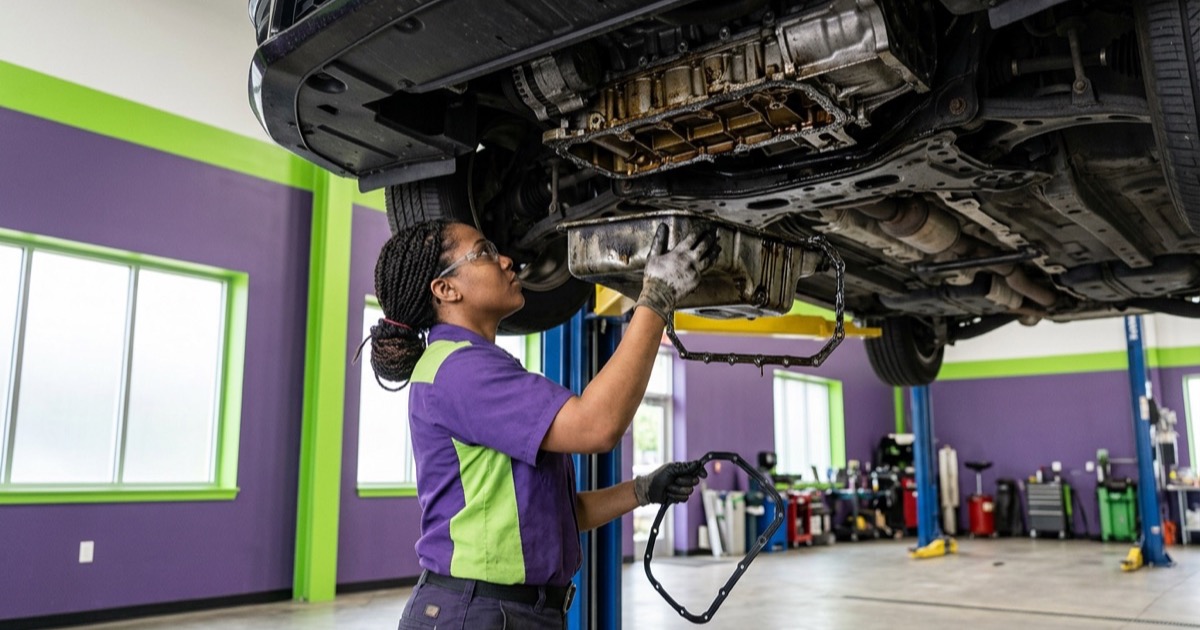
What the Job Is and What Is Included
The oil pan sits at the very bottom of the engine. It holds four to eight quarts of oil on most cars and more on trucks. The oil pump pulls from it through a pickup screen and sends oil up to the bearings, cams and chain.
The seal between the pan and the engine block is either a rubber or cork gasket or a bead of RTV sealant. Older and simpler engines often use a gasket. Many newer engines use RTV on an aluminum pan.
A proper job drains the oil, removes any splash shields and parts in the way, unbolts the pan and separates it from the block. Then the tech cleans every bit of old gasket and sealant off both surfaces. This step takes time and matters most.
The new gasket or a fresh bead of RTV goes on, the pan goes back up, and the bolts are torqued in order to spec. If RTV was used, the shop waits for it to set before adding oil. Then comes new oil, a new filter and a leak check.
The price should include the gasket or sealant, oil and filter, and all the labor to get the pan off. The parts are a small part of the bill. Access is the big part.
Why the Price Varies
Access is almost everything. On some cars the pan bolts are all in plain sight. On others the pan is boxed in by a crossmember, the steering rack, the front differential, or the transmission.
When something is in the way, the shop has to support the engine and move that part. Dropping a subframe or lowering a front axle can add three or four hours. That is why the same gasket job can cost $250 on one car and $900 on another.
The pan type matters too. A steel pan with a rubber gasket is fast. A cast aluminum pan sealed with RTV takes longer to separate and clean, and the tech has to be careful not to scratch the sealing face.
Some engines use a two piece pan. The upper part is part of the engine structure and the lower part is a thin steel tray. If only the lower pan leaks, the job is quick and cheap.
Then there is the shop. Dealers charge the highest rates. Independents charge less. A mobile mechanic can handle many easy access pans in a driveway with ramps or stands, which keeps the cost down.
What Usually Gets Done at the Same Time
The oil is coming out anyway, so a few things make sense to bundle. Others are not needed.
Always included should be fresh oil, a new oil filter and a new drain plug washer. There is no reason to put old oil back.
Worth it on some engines is a new oil pickup tube O ring and a look at the pickup screen. If the screen is clogged with sludge, that tells you a lot about how the engine has been cared for, and it is easy to clean while the pan is off.
Worth it if threads are damaged is a new drain plug or a thread repair. A stripped drain plug is a common cause of a drip that looks like a pan gasket leak.
Worth it if the pan is damaged is a new oil pan. A dented, cracked or rusted pan should be replaced, not resealed. Many aftermarket pans cost under $150.
Usually an upsell is an engine flush. If the pickup screen looks clean, you do not need one.
- Oil, filter and drain plug washer: always
- Pickup tube O ring and screen check: yes on engines that have one inside the pan
- Drain plug or thread repair: only if stripped or leaking
- New oil pan: only if dented, cracked or rusted
- Engine flush: usually skip
Make Sure It Is Really the Oil Pan
Oil on the bottom of the pan does not prove the pan gasket is bad. Oil runs down from higher leaks and collects at the lowest point, which is the pan.
Common leaks that drip from the pan area are the valve cover gasket, the oil filter housing gasket, the oil filter itself if it was not tightened right, the oil cooler lines, the timing cover, and the front or rear main seal. The drain plug and its washer are the most common of all.
A good tech starts at the top of the engine and works down. Often the shop degreases the engine, has you drive a few days, then looks again to see where fresh oil appears first. UV dye in the oil and a black light is another good way to find the source.
Look at the color, too. Engine oil is brown or black. Red or pink fluid is usually transmission fluid. Green, orange or pink with a sweet smell is coolant. Each points to a different repair.
If the shop says the pan gasket is leaking, ask where the wet line starts. If oil is above the pan seam, the source is higher up.
Questions to Ask Before You Approve the Quote
These questions help you understand the price and make sure the right leak gets fixed.
- Where does the leak start, and can you show me oil at the pan seam itself?
- Did you rule out the drain plug, filter, filter housing and valve cover?
- Does my car need the subframe, front axle or anything else moved to get the pan off?
- Is my pan sealed with a gasket or RTV, and how long will you let the sealant cure?
- Does the price include oil, filter and a new drain plug washer?
- Is my pan in good shape, or is it dented or cracked?
- What is the warranty if it leaks again?
Can a Mobile Mechanic Do It?
Yes, on many cars. If the pan comes off with nothing major in the way, a mobile mechanic can do it on ramps or jack stands in your driveway. Many older trucks and simple compacts fall in this group.
If the subframe or front axle has to drop, a lift and an engine support make the job much safer and faster. That version belongs in a shop.
Call with your year, make, model and engine size. A good mobile tech will look up the procedure and tell you which version you have before they quote it.
How to Make the Repair Last
A good oil pan reseal should last many years. Most early failures come from rushed prep.
The surfaces must be clean and dry. Any old sealant or oil film gives the new oil a path out. A good tech uses a plastic scraper and a cleaner, not a grinding disc that can leave grit in the engine.
RTV needs time. Adding oil and starting the engine too soon can blow the fresh bead out. Follow the time on the sealant tube or the factory procedure.
Do not over tighten the drain plug. A stripped plug or cracked pan from too much torque is a common way to undo a good repair. Use a new washer and a torque wrench.
Watch out for road hazards. A dent from a curb or rock can crack the pan or loosen the seal. If your car sits low, drive slow over speed bumps and debris.
Signs you need this repair
- Brown or black oil spots under the middle of the engine
- Oil level dropping between changes with no smoke from the exhaust
- Wet oil along the seam where the pan meets the engine block
- Burning oil smell if oil reaches the exhaust pipe
- Low oil pressure light or warning in severe cases
- Oil film on the splash shield under the engine
Cost by vehicle type
| Vehicle | Typical range | Notes |
|---|---|---|
| Compact / economy car | $210 to $940 | Many compacts have a pan you can reach from below once the splash shield is off, so this is often the cheapest version. Some use a two piece pan with a steel lower half that comes off easily. |
| Midsize sedan / small SUV | $215 to $960 | Expect a mid range price. A few models need the exhaust front pipe or a subframe brace removed, and V6 versions often have a larger aluminum pan sealed with RTV. |
| Full-size truck / large SUV | $240 to $1,075 | Two wheel drive trucks are often simple. Many four wheel drive trucks need the front axle or differential moved to get the pan out, which pushes labor toward the top of the range. |
| Luxury / European | $285 to $1,285 | Many European cars use a structural aluminum pan, and some need the subframe dropped or the engine raised. OEM pans and gaskets cost more, and labor is often at the top of the range. |
| Hybrid | $235 to $1,055 | Same oil pan job as the gas version. Some hybrids run high voltage cables under the car, so the shop should follow the factory safety steps before working near them. |
| Electric vehicle | Electric cars have no engine oil pan, though their drive units hold gear oil that can leak from different seals. | |
| Diesel / heavy duty | $285 to $1,270 | Diesel pans are big, hold a lot of oil and often need extra parts removed on heavy duty trucks. Expect more oil cost and labor at the high end of the range. |
Ranges assume national-average labor rates ($95, $140/hr) and quality aftermarket parts.
Cost by state
State ranges reflect typical independent-shop labor rates for a midsize vehicle.
Common questions
How much does it cost to replace an oil pan gasket?
Most drivers pay about $220 to $950 at an independent shop. Cars with easy access sit near the low end. Cars and trucks that need the subframe, front axle or engine mount moved sit near the top, and a dealer charges more.
Can I drive with a leaking oil pan gasket?
Yes, if it is a slow seep and you keep the oil full. Check the dipstick every few days. If you are adding oil often, see a lot of drips, or the oil light comes on, stop driving and get it fixed, because low oil can ruin the engine.
Why is oil pan gasket replacement so expensive?
Because of access, not parts. The gasket or sealant usually costs under $50. On many cars the subframe, steering rack or front axle sits in the way and has to be moved, which can take several hours.
Is it the oil pan gasket or the drain plug?
Check the drain plug first, because it is the most common drip at the bottom of the engine. If oil is wet around the plug and the threads or washer look bad, a new washer or plug fixes it for a few dollars. If oil is wet along the pan seam, the gasket is more likely.
Will oil stop leak fix an oil pan gasket?
It can slow a small seep from a rubber gasket for a while, but it will not fix RTV that has let go, a cracked pan or a bad drain plug. Think of it as a short term patch until you can afford the repair.
How long does an oil pan gasket replacement take?
About two to six hours. Easy access cars take two to three. Cars that need the subframe or front axle moved can take most of a day, plus time for the sealant to cure.
Is an oil pan gasket worth fixing on an old car?
Usually yes, if the engine is healthy. Running low on oil kills engines, and oil on the exhaust is a fire risk. If the repair costs more than the car is worth, keep the oil topped up and watch the level closely instead.
Related Repair Guides
More Engine Repair Costs
Sources and further reading
Primary sources behind this page. Federal safety, emissions and consumer-protection references, worth reading before you authorize any repair.
- EPA polluted runoff from urban areas How oil dripped from vehicles onto pavement washes into storm drains and local water.
- fueleconomy.gov maintenance guide DOE and EPA advice on oil grade and routine engine care.
- ASE certified technicians Look for ASE certified engine repair technicians when you get quotes.
Need Work Done? Get a Free Quote.
Tell us what the car is doing. A local mechanic calls you back, most requests get a call back the same day. No fee, no obligation.