What the Job Is and What the Price Covers
Your engine has a crankshaft at the bottom, driven by the pistons, and one or more camshafts at the top that open the valves. The timing chain links them. If they fall out of step, the engine loses power, throws codes, or stops running.
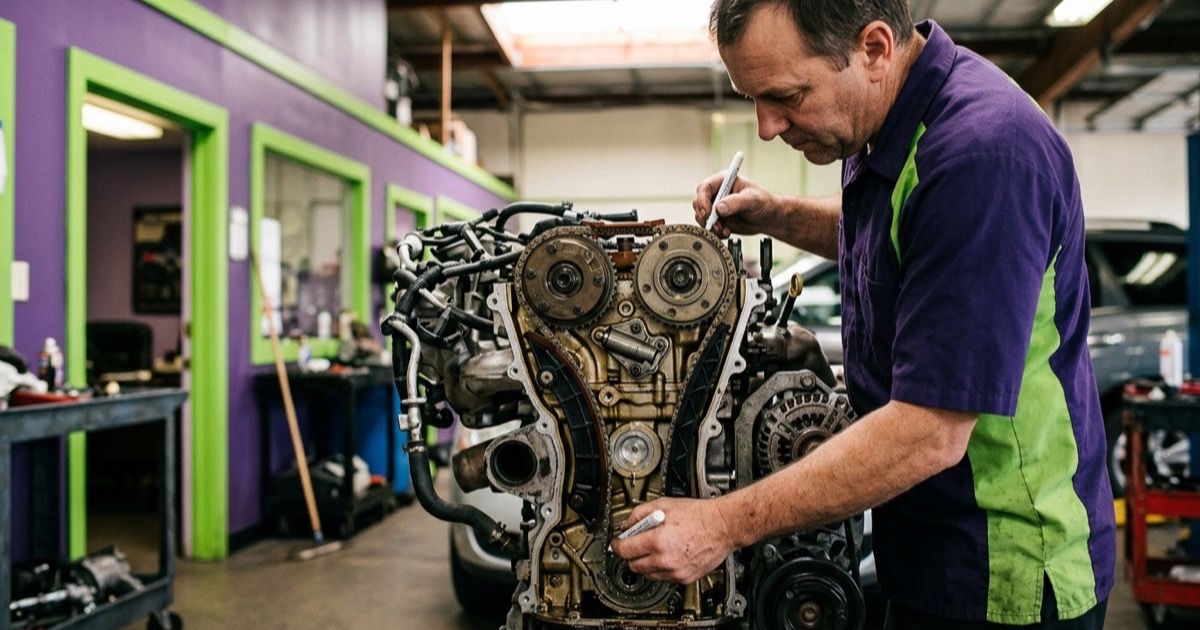
A timing chain looks like a bicycle chain. It rides on sprockets and slides along plastic guide rails. A tensioner, usually pushed by oil pressure, keeps it tight. Over time the pins and links wear, which makes the chain longer. That is what mechanics mean by a stretched chain. The guides wear grooves or break into pieces, and the tensioner runs out of travel trying to take up the slack.
A real timing chain job replaces the full set, not just the chain. That means the chain or chains, the guides, the tensioner or tensioners, and often the sprockets. It also includes a new timing cover gasket or sealant, a new front crankshaft seal, and fresh oil and filter.
The labor is the expensive part. The shop has to drain fluids, take off belts, pulleys, often an engine mount, and the timing cover. On many engines the valve cover and oil pan also have to come loose because they seal against the timing cover. Then everything is set to timing marks, locked with tools, checked, and put back together.
The price you see should be for the whole kit and all that labor. If a quote lists only a chain, ask what else is in it.
Why the Price Varies So Much
Where the chain lives is the biggest factor. A four cylinder with one chain at the front and room to work might take six hours. A V6 packed sideways into a small engine bay with three chains can take twelve or more. A rear mounted chain on some European engines can mean pulling the engine, which goes past this whole range.
The number of chains matters. Some engines have one. Many V6 and V8 engines have a primary chain plus a secondary chain for each cylinder head, with their own guides and tensioners.
Cam phasers add cost. Many modern engines use variable valve timing, and the phasers bolt to the cam sprockets. On some engines the phasers wear along with the chain and are replaced at the same time. They can add several hundred dollars in parts.
The water pump is the next one. On some engines the water pump sits behind the timing cover and is driven by the chain. If that pump fails later, the timing cover has to come off again. On those engines, replacing the pump during the chain job is smart money.
The shop type matters too. Dealers charge the most and use factory kits. Independent shops usually charge less and use quality kits from the major brands. Mobile mechanics can do some chain jobs, but most are better done with a lift and a full set of timing tools.
What Usually Gets Done at the Same Time
Because the front of the engine is already open, some extra parts cost almost nothing in labor. Others are padding. Here is how to sort them.
Always part of a proper job are the guides, the tensioners, a new front crank seal and a new timing cover gasket or sealant. A chain only job on a worn engine is a common reason for a repeat repair.
Worth it if the pump sits behind the cover is the water pump. Ask the shop if your water pump is driven by the timing chain or hidden behind the timing cover. If yes, do it now.
Worth it if they test bad are the cam phasers. A good shop checks phaser function and looks for wear. Replace them if they are noisy, stuck, or known to fail on your engine.
Cheap and smart are the valve cover gasket and the oil pan gasket or sealant where they meet the timing cover. On many engines they are disturbed anyway.
Usually an upsell, unless they are worn, are new pulleys, a new serpentine belt and new engine mounts. Replace the belt if it is old, since it is already off. Replace mounts only if they are cracked or collapsed.
- Guides, tensioners, front crank seal and timing cover seal: always
- Water pump: yes if it sits behind the timing cover
- Cam phasers: yes if noisy, stuck or a known weak point
- Valve cover and oil pan seal at the timing cover: usually yes
- Serpentine belt: yes if it is old, it is already off
- Engine mounts and pulleys: only if worn
How to Know It Is Really the Timing Chain
The most common sign is a rattle at cold start that lasts one to a few seconds and then goes away. That is the chain slapping before oil pressure pumps up the tensioner. As things wear, the rattle lasts longer or stays all the time.
The other big sign is a check engine light with cam and crank correlation codes. These are often codes P0016 through P0019, which mean the computer sees the cams and crank out of step. Some makes have their own extra codes for this.
Other problems cause the same signs. Low oil or the wrong oil can make a healthy tensioner rattle. A sticking cam phaser or a bad oil control solenoid can set timing codes with a good chain. A failing cam or crank sensor can set them too. A loose heat shield can rattle in a way that sounds like a chain.
A good shop checks oil level and condition first, then looks at live cam and crank data with a scan tool. Many engines let the tech measure chain stretch with that data or by looking through an opening at the tensioner. That diagnosis costs an hour or so and is worth it before you spend thousands.
Questions to Ask Before You Approve the Quote
A timing chain quote is big enough that it pays to ask hard questions. These help you compare two shops on the same job.
- How did you confirm the chain is stretched, and can you show me the data or the wear?
- How many chains does my engine have, and are you replacing all of them?
- Does the kit include guides, tensioners, sprockets and the front crank seal?
- Is my water pump behind the timing cover, and is it in the quote?
- Do my cam phasers need to be replaced, and how did you check them?
- Is this an interference engine, and has the chain already jumped?
- What brand is the timing kit, and is it factory or aftermarket?
- What is the warranty on parts and labor, in months and miles?
Is It Worth Fixing, and Can a Mobile Mechanic Do It?
On a car worth more than a few thousand dollars with a healthy engine otherwise, the answer is usually yes. A fresh timing set often gives you another 100,000 miles or more. On an older car with low compression, heavy oil burning or other big problems, a used engine may make more sense. Ask for a compression or leak down test before you decide.
Some timing chain jobs are possible in a driveway. A mobile mechanic with the right timing tools can handle many four cylinder engines with front access. Transverse V6 engines, rear chain engines and anything that needs the subframe lowered are better done on a lift in a shop.
Ask any shop, mobile or not, if they have done your engine before. Experience matters on this job more than most, because every engine has its own tricks and its own timing marks.
How to Make the New Chain Last
Clean oil is the single best thing you can do. The chain, the guides and the tensioner all live on oil. Old, thin or low oil wears the chain fast and starves the tensioner. Use the oil grade your owner manual calls for, change it on time, and check the level between changes.
Do not stretch your oil intervals on an engine with a known chain problem. Many people who need a chain at 90,000 miles had long oil intervals or ran the oil low.
Listen at cold start. If the rattle comes back, get it checked early. A guide or tensioner caught early is far cheaper than a chain that has jumped.
If the engine burns oil, keep it topped up. An engine a quart or two low is hard on the timing chain and on everything else.
Signs you need this repair
- Rattle from the front or side of the engine for a few seconds at cold start
- A constant rattle or slapping noise that gets worse with engine speed
- Check engine light with cam and crank correlation codes such as P0016 to P0019
- Rough idle, low power or a misfire that started along with a rattle
- Hard starting or an engine that cranks but will not start after a loud rattle
- Metal flakes or bits of plastic guide found in the oil or oil filter
- Engine running much worse right after a loud snap or clatter
Cost by vehicle type
| Vehicle | Typical range | Notes |
|---|---|---|
| Compact / economy car | $825 to $2,540 | Small four cylinder engines often have a single chain with good access once the engine mount and accessories come off. These are the cheapest chain jobs, though still several hours of labor. |
| Midsize sedan / small SUV | $870 to $2,670 | Four cylinder versions run near the low end. Transverse V6 engines often have three chains, several guides and tensioners, and the engine pushed against the firewall, which puts them in the upper half of the range. |
| Full-size truck / large SUV | $1,000 to $3,065 | Longitudinal V8 and V6 truck engines have the chain at the front with room to work, but often need the radiator, fan and front accessories out. Engines with cam phasers often need phasers at the same time, which adds real parts cost. |
| Luxury / European | $1,220 to $3,725 | Several European engines put the timing chain at the back of the engine against the transmission. Those jobs mean pulling the engine or transmission, and they can run well above this range. Get a quote for your exact engine code. |
| Hybrid | $955 to $2,935 | Many hybrid engines run less often and at lower loads, and chain wear is not a common hybrid complaint. When it is needed, the job matches the gas version, with extra high voltage safety steps if parts nearby must come off. |
| Electric vehicle | Electric motors have no camshafts and no valves, so there is no timing chain to stretch or replace. | |
| Diesel / heavy duty | $1,190 to $3,640 | Many diesels use gear driven timing that rarely wears out, while others use chains or belts. When a diesel does need chain or gear work, parts and labor both run at or above the top of this range. |
Ranges assume national-average labor rates ($95, $140/hr) and quality aftermarket parts.
Cost by state
State ranges reflect typical independent-shop labor rates for a midsize vehicle.
Common questions
How much does a timing chain replacement cost?
Most drivers pay about $900 to $2,700 at an independent shop. Simple four cylinder engines sit at the low end. Transverse V6 engines, engines with cam phasers or a water pump behind the cover, and dealers all push toward the top. Some European engines with the chain at the back cost more than that.
How long does a timing chain last?
Most timing chains are designed to last the life of the engine, often 150,000 miles or more. Some engines are known to stretch chains much earlier, often between 60,000 and 120,000 miles, usually helped along by long oil change intervals or low oil.
Can I drive with a bad timing chain?
Only for short, gentle trips until you can get it fixed. A stretched chain can jump a tooth or break, and on an interference engine that bends valves and turns a chain job into an engine job. If the rattle is getting louder or the engine runs rough, stop driving it.
What does a bad timing chain sound like?
It sounds like a rattle or a fast metal slapping from the front or side of the engine. It is usually loudest for a few seconds at cold start, before oil pressure builds. As it gets worse, the rattle lasts longer and may be there at idle all the time.
Is a timing chain better than a timing belt?
A chain usually lasts longer and has no set change interval, while a belt has to be replaced every 60,000 to 105,000 miles or so. But when a chain does wear out, it costs more to replace because it sits inside the engine and needs more parts. Neither is better in every way.
Should I replace the water pump with the timing chain?
Yes, if your water pump is driven by the timing chain or sits behind the timing cover. If that pump fails later, the shop has to tear down the same front of the engine again. If your pump is outside the cover and driven by the belt, there is no labor saving.
Is a timing chain replacement worth it on a high mileage car?
Often yes, if the rest of the engine is healthy. Ask for a compression or leak down test first. If the engine has good compression and does not burn much oil, a new timing set can give it many more years. If the engine is worn out, put the money toward a used engine or another car.
Related Repair Guides
More Engine Repair Costs
Sources and further reading
Primary sources behind this page. Federal safety, emissions and consumer-protection references, worth reading before you authorize any repair.
- fueleconomy.gov maintenance guide DOE and EPA guidance on using the right motor oil grade and keeping up with maintenance.
- ASE certified technicians Engine repair is an ASE test area, so ask whether the tech doing your timing job holds it.
- SAE International The engineering body behind diagnostic trouble code standards, including cam and crank correlation codes.
Need Work Done? Get a Free Quote.
Tell us what the car is doing. A local mechanic calls you back, most requests get a call back the same day. No fee, no obligation.