What the Job Is and What You Are Paying For
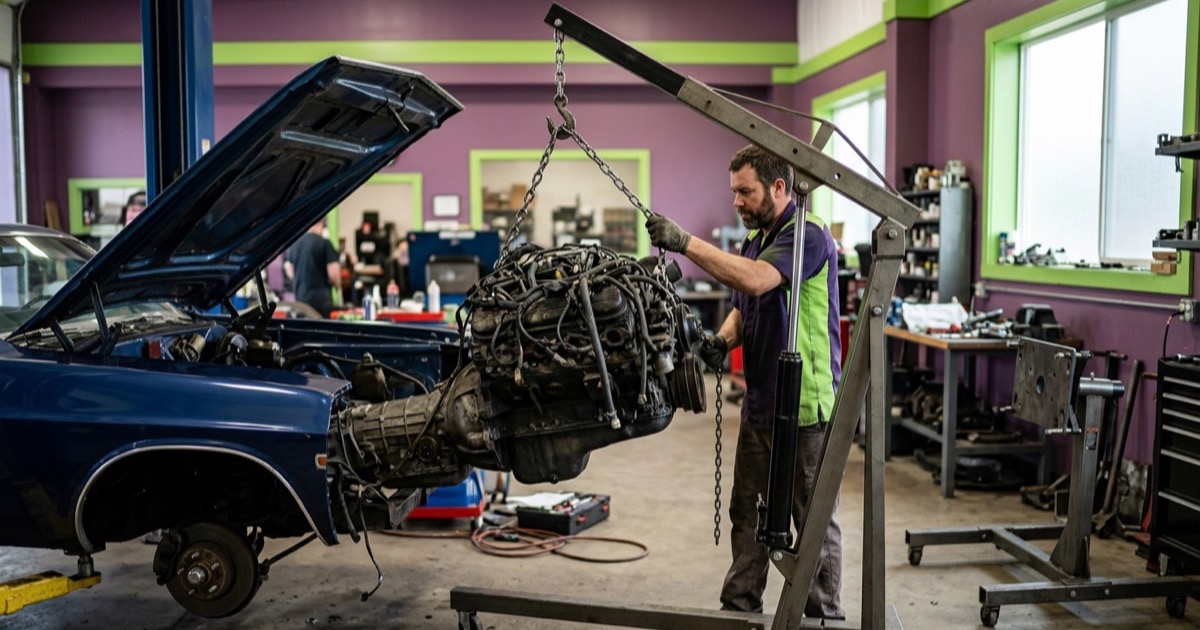
An engine replacement swaps the whole engine for another one. The shop drains the fluids, disconnects the wiring, fuel lines, hoses, exhaust and axles as needed, and lifts the engine out. Then it moves the good parts from the old engine to the new one and installs it.
Most replacements use a long block. That is the block, crank, pistons, heads and cams, already assembled. The shop moves over the intake, exhaust manifold, sensors, alternator, starter, brackets and other bolt on parts from your old engine. A short block is less, just the bottom half, and means more labor because the shop moves your heads over too.
The parts price is the engine itself plus a pile of small parts. A good job includes new engine mounts if yours are worn, new gaskets where parts move over, fresh oil and filter, new coolant, new spark plugs, and often a new water pump and thermostat. Those small parts can add $200 to $600.
Labor is the other big piece. Most cars book 10 to 18 hours. Some need the engine and transmission dropped out the bottom together, which takes longer. The national range on this page covers a used or remanufactured long block on a common car. New crate engines and luxury or diesel engines cost more.
After the swap, the first 500 miles matter. Drive at varied speeds, skip heavy towing, change the oil early at 500 to 1,000 miles, and keep every oil change receipt, because most engine warranties ask for proof of maintenance.
Used, Remanufactured or New: Which Engine to Pick
This is the biggest choice you make, and it changes the bill by thousands.
A used engine comes out of a wrecked car. It is the cheapest choice, often $800 to $2,500 for a common engine. The risk is that you do not know how it was treated. Ask for the mileage, ask for a compression test or a video of it running before removal, and get the warranty in writing. Many used engines come with only 30 to 90 days of coverage, and some cover parts only, not labor.
A remanufactured engine has been taken apart, cleaned, machined and rebuilt to spec with new bearings, rings, seals and often new timing parts. It costs more, often $2,500 to $5,000 for a common four cylinder or V6. The upside is a longer warranty, often one to three years, and sometimes the warranty covers labor too.
A rebuild of your own engine is a third path. A machine shop rebuilds your block and heads. It can make sense for rare engines, but it often costs as much as a remanufactured unit and takes longer.
A new crate engine is the most expensive and is often only sold by the dealer. It makes sense on a newer car that is still worth a lot.
Our rule of thumb is simple. On an older car you plan to drive a few more years, a low mile used engine with a solid warranty is often the smart buy. On a car you want to keep for a long time, a remanufactured engine with labor coverage is worth the extra money.
Why the Price Varies So Much
The engine type is the first factor. A common four cylinder from a popular car is cheap used and cheap remanufactured. A rare V6, a turbo engine, or a European engine costs far more, and fewer used units are out there.
Access is the second. Many trucks and rear drive cars lift the engine out the top. Many front drive cars and SUVs drop the engine and transmission out the bottom on the subframe. That needs a lift and more hours.
The third is how much moves over. If your old engine was in a fire, overheated badly, or threw a rod, some attached parts may be damaged too. Cracked manifolds, a melted wiring harness, or a burned out radiator all add to the bill.
The fourth is the shop. Dealers charge the most per hour and often only offer new or factory remanufactured engines. Independent shops give you more choice and usually charge less. A mobile mechanic can do some engine swaps on trucks and simple cars, but most need a lift and a hoist, so this is mostly a shop job.
What Usually Gets Done at the Same Time
With the engine out, some parts are easy to reach that are normally a big job. That makes a few add ons smart and a few just upsells.
Worth it almost every time is the rear main seal on the replacement engine, the timing belt and water pump if your engine has a belt, and new spark plugs. On a used engine you do not know when these were last done.
Worth it on manual cars is the clutch. The transmission is already off the engine, so a clutch kit adds parts cost and only a little labor.
Worth it if worn are engine and transmission mounts, radiator hoses, and the radiator itself. If the old engine died from overheating, a radiator that failed or a bad fan may have caused it, and putting a new engine behind that same problem is a waste.
Worth flushing is the cooling system and the oil cooler. If the old engine ate a bearing, metal may be in the oil cooler and lines. Leaving it there can kill the new engine.
Usually an upsell is a high price performance part, a fancy engine detail, or replacing every sensor on the engine at once. Swap over sensors that test good.
- Timing belt and water pump on a used belt engine: do them
- Rear main seal and spark plugs: do them
- Clutch kit on a manual: do it if worn
- Mounts, hoses, radiator: replace if worn or tied to the failure
- Oil cooler and lines: flush or replace if the old engine spun a bearing
- Every sensor new: usually skip unless one tests bad
Is Your Engine Really Done?
Before you spend this much, make sure the engine is the problem. A good shop checks first.
A no start can be a dead battery, a bad starter, a fuel pump, or a timing belt that broke. A broken belt on some engines bends valves, but on others it does no damage at all. A compression test and a scan tool tell you a lot for under $200.
A knock can be a rod bearing, but it can also be a loose heat shield, a bad torque converter bolt, or a cracked flexplate. A good tech listens with a stethoscope before calling it.
Smoke and oil loss can come from a bad PCV valve, a leaking turbo seal, or valve seals, not just worn rings. A leakdown test shows where the pressure goes.
Overheating damage is often a head gasket, not a whole engine. A head gasket job can cost far less than a swap if the block and head are not warped.
Ask for the test results in writing. Compression numbers, a leakdown percentage, or a photo of metal in the oil filter show the call is real.
Is It Worth Replacing the Engine?
Start with what the car is worth with a good engine. Look up the private party value for your year, model and miles in good running shape.
If the engine job is less than about half that value, and the body, transmission and suspension are solid, it is often worth doing. You know the history of the rest of the car, and a used car at that price has its own unknown problems.
If the job costs more than the car is worth, think hard. Selling it as is, with a bad engine, often brings a few hundred to a couple thousand dollars from a buyer who swaps engines.
Check the transmission too. A car with 200,000 miles may need a transmission soon, and paying for both can pass the value of the car fast.
In states with smog checks, a replacement engine must match the original engine family and keep its emission parts. California sends some engine changes to a referee station. Stick with the same engine type and you avoid the headache.
Questions to Ask Before You Approve the Quote
An engine quote should be very clear. These questions protect you from the most common surprises.
- Is the engine used, remanufactured, rebuilt or new, and who supplied it?
- What are the miles on a used engine, and was it tested before removal?
- Is it a long block or short block, and what parts move over from my old engine?
- How long is the warranty, does it cover labor, and do I need to keep receipts for oil changes?
- Does the quote include fluids, gaskets, spark plugs, filters and mounts?
- Are you doing the timing belt or water pump on the new engine, and is that in the price?
- What caused my engine to fail, and is that cause fixed?
- Will the engine match my original engine family for smog and emissions?
Signs you need this repair
- Loud knocking from deep in the engine that gets faster with speed
- Engine seized and will not turn over even with a good battery
- Low or zero compression on one or more cylinders
- Metal flakes in the oil or in the oil filter
- Heavy blue or white smoke with steady oil or coolant loss
- Oil mixed with coolant after a severe overheat
- Hole in the block or a cracked block after a thrown rod
Cost by vehicle type
| Vehicle | Typical range | Notes |
|---|---|---|
| Compact / economy car | $2,650 to $6,770 | Common compact four cylinder engines are cheap and easy to find used, often $1,000 to $2,500 for a low mile unit. Labor is usually 10 to 14 hours, so many compacts land in the low part of the range. |
| Midsize sedan / small SUV | $2,950 to $7,520 | Four cylinder midsize cars price close to compacts. V6 versions cost more for the engine and often take longer because the engine and transmission come out together on a subframe. |
| Full-size truck / large SUV | $3,545 to $9,020 | V8 truck engines are plentiful and many trucks pull the engine out the top, which keeps labor reasonable. A remanufactured V8 long block often runs $3,500 to $5,500 before labor. |
| Luxury / European | $4,435 to $11,275 | German and other luxury engines are expensive used and very expensive remanufactured, and labor runs long because of tight packaging and electronics. Many of these jobs pass $10,000, which often costs more than the car is worth. |
| Hybrid | $3,245 to $8,270 | Hybrid gas engines are usually the same family as the regular model, so used engines are easy to find. The shop must follow high voltage safety steps and confirm the swap does not disturb the hybrid system wiring. |
| Electric vehicle | Electric cars have no engine to replace. The closest repair is a drive unit or battery pack replacement, which is a very different job and price. | |
| Diesel / heavy duty | $4,235 to $10,775 | Diesel engines cost far more, often $8,000 to $15,000 for a remanufactured long block, and labor can run 20 hours or more. Injectors, turbo and emissions parts add more if they are swapped or replaced. |
Ranges assume national-average labor rates ($95, $140/hr) and quality aftermarket parts.
Cost by state
State ranges reflect typical independent-shop labor rates for a midsize vehicle.
Common questions
How much does it cost to replace an engine?
Most common cars land around $3,000 to $7,500 at an independent shop with a used or remanufactured engine. A low mile used engine on a simple four cylinder can come in under $3,000. Luxury, turbo and diesel engines often cost $8,000 to $15,000 or more.
Is it worth replacing the engine on an old car?
It is worth it when the job costs less than about half of what the car is worth running and the rest of the car is solid. If the transmission, rust or suspension are also bad, selling the car as is often makes more sense.
Is a used or remanufactured engine better?
A remanufactured engine is usually the safer pick because it is rebuilt to spec and carries a longer warranty. A used engine costs less and is fine on an older car if it has low miles, was tested before removal, and comes with a written warranty.
How long does an engine replacement take?
Most shops need two to five days. Book labor is often 10 to 18 hours, but the shop also has to source the engine, move parts over and test drive. Waiting for a remanufactured engine to ship can add a week.
Can I drive with a knocking engine?
You should not. A rod knock can turn into a thrown rod at any moment, which can lock the engine and crack the block. Park it and have it towed to a shop for a diagnosis.
Does a replacement engine reset the mileage on my car?
No. The odometer stays the same because it tracks the car, not the engine. Keep the paperwork that shows the engine type and miles so you can prove it when you sell.
Do I need to tell the DMV or smog station about a new engine?
In most states, a same type replacement engine needs no paperwork. In states with strict smog rules like California, a different engine must meet engine change rules and may need a referee inspection.
Does car insurance pay for a new engine?
Usually not, because insurance covers accidents, not wear. An extended warranty or powertrain warranty may cover it if the failure was not caused by neglect, so check your contract before you pay.
Related Repair Guides
More Engine Repair Costs
Sources and further reading
Primary sources behind this page. Federal safety, emissions and consumer-protection references, worth reading before you authorize any repair.
- California BAR engine changes Explains the difference between a replacement engine and an engine change, and when a referee inspection is required.
- EPA vehicle emissions inspection programs Background on the state inspection programs a replacement engine has to pass.
- fueleconomy.gov maintenance guide DOE and EPA guidance on routine maintenance that keeps an engine healthy.
Need Work Done? Get a Free Quote.
Tell us what the car is doing. A local mechanic calls you back, most requests get a call back the same day. No fee, no obligation.