What the Job Is and Why It Is Mostly Labor
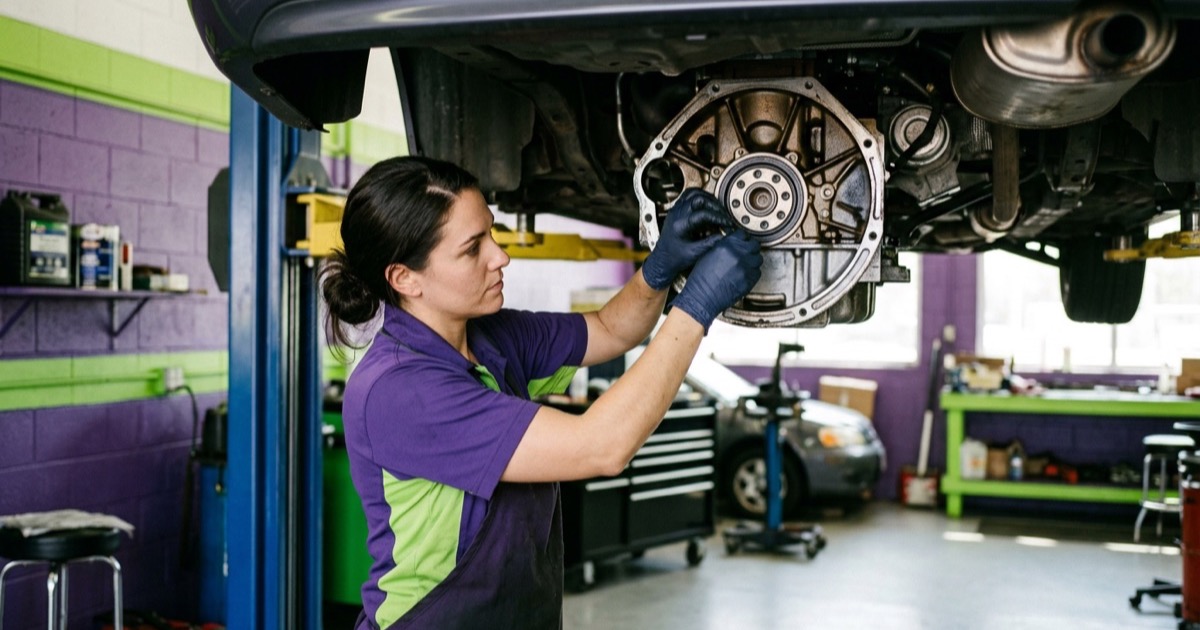
The crankshaft runs the length of the engine. At the back it comes out of the block and bolts to the flywheel on a manual car or the flexplate on an automatic. The rear main seal is a lip seal that wraps around the crank right there and keeps oil inside the engine.
The seal costs $10 to $60 for most engines. The problem is where it is. The transmission bolts right over it. To reach the seal, the shop has to remove the transmission, then the flywheel or flexplate, and sometimes a seal housing.
A proper job includes pulling the transmission, removing the flywheel or flexplate, carefully removing the old seal without scratching the crankshaft, cleaning the area, and pressing in the new seal straight and to the right depth. Then the flywheel and transmission go back in, fluids are topped off, and the car is road tested.
The tech should also check the crank surface where the seal rides. A deep groove worn into the crank can make even a new seal leak. A thin repair sleeve can fix that.
So when you see a quote of $800 for a $30 seal, the math is real. You are paying for the time it takes to take apart and rebuild the middle of the drivetrain.
Why the Price Varies
The drivetrain layout drives the price. A rear drive pickup with two wheel drive is often the easiest. The driveshaft comes out, the transmission slides back, and the seal is right there.
Front drive cars are harder. The transmission sits sideways next to the engine. Both axles come out, and the subframe often has to drop to make room. Some shops pull the engine and transmission together.
All wheel drive and four wheel drive add the transfer case or power transfer unit. That is more weight, more bolts and more time.
Manual cars add the clutch. The clutch has to come off to reach the seal anyway, which is why many owners replace the clutch at the same time.
The seal type matters a little. Most modern engines use a one piece seal, sometimes in a bolt on housing. A few older engines use a two piece seal that can be changed by dropping the oil pan instead of pulling the transmission, which can be cheaper.
Shop type matters too. Dealers charge the most per hour. Independents usually charge less. A transmission or drivetrain specialist does this kind of work every day and is often a good choice.
What Usually Gets Done at the Same Time
The transmission is out, so some parts are almost free to replace now. This is one of the few jobs where the add ons really do save money.
On a manual car, a clutch kit is worth it if the clutch has more than half its life used or if oil has reached it. An oil soaked clutch will slip and has to be replaced. Doing the clutch later would mean paying to pull the transmission again.
On an automatic, the transmission front pump seal is worth it. It is cheap and it leaks in the same spot. Also check the flexplate for cracks.
A rear main seal housing gasket or the oil pan gasket is worth it on engines where the pan seals against the seal housing.
Worth considering is a crankshaft repair sleeve if the old seal wore a groove in the crank.
Usually an upsell, unless they are actually worn, are engine and transmission mounts. Replace them only if they are cracked or collapsed.
- Clutch kit on a manual: yes if half worn or oil soaked
- Transmission front pump seal on an automatic: yes, cheap insurance
- Flexplate or flywheel: inspect, replace only if cracked or worn
- Seal housing gasket or oil pan gasket: yes on engines where they overlap
- Crank repair sleeve: only if the seal surface is grooved
- Engine or transmission mounts: only if worn
Make Sure It Is Really the Rear Main Seal
This is the most important part of the job. Many oil leaks get blamed on the rear main seal because oil ends up at the back of the engine. Oil runs down and back as you drive, and it collects at the bell housing, the lowest point between the engine and transmission.
Leaks that often fool people include the valve cover gasket, the oil pan gasket at the rear corners, the oil pressure switch, the oil filter housing, a rear cam plug on some engines, and the intake manifold gasket on some V engines.
The color tells you something. Engine oil is brown or black. Red or pink fluid at the bell housing usually means the transmission front seal, not the rear main.
A good shop cleans the engine, adds UV dye to the oil, and has you drive. Then they look with a black light. If the dye shows up only at the bell housing and the engine above it is dry, the rear main is the likely source. Some transmissions have an inspection cover that lets the tech look closer without pulling anything.
That test costs very little compared to the job. Insist on it.
Questions to Ask Before You Approve the Quote
With most of the bill being labor, these questions help you avoid paying for the wrong repair or paying twice.
- How did you confirm it is the rear main seal and not a leak higher up?
- Did you use UV dye, and can you show me where it glows?
- Does my car need the subframe or the engine moved to pull the transmission?
- Is the transmission front seal or flexplate check included?
- On my manual car, what would it cost to add a clutch kit now?
- Will you check the crank surface and use a repair sleeve if it is grooved?
- What is the warranty on the seal and the labor if it leaks again?
Should You Fix It, and Can a Mobile Mechanic Do It?
If the leak is small and the oil stays full between changes, many owners choose to wait. A high mileage oil with seal conditioners can sometimes slow a small seep by softening the rubber. That is fine as long as you check the oil level often and oil is not reaching the clutch or exhaust.
Fix it if you add oil often, if oil drips on the driveway every day, if the clutch slips, or if you are already pulling the transmission for another reason.
This job almost always belongs in a shop with a lift and a transmission jack. A few mobile mechanics have the equipment for rear drive trucks, but most front drive and all wheel drive cars need a lift to do it safely.
The best timing is when the transmission is already coming out for a clutch or transmission repair. Then the seal is nearly free.
How to Make the New Seal Last
A new rear main seal that goes in straight on a clean, smooth crank should last the life of the engine.
Crankcase pressure is the hidden enemy. A clogged PCV valve or breather pushes oil out past every seal, and the rear main is one of them. Keep the PCV system working.
Change your oil on time. Sludge and old oil are hard on seals. Use the grade your owner manual lists.
Let the engine warm up gently. Rubber seals do not like high revs on a cold engine, and they last longer when the oil is warm and flowing.
Signs you need this repair
- Oil dripping from where the engine and transmission meet
- Oil on the bottom of the bell housing or the transmission inspection cover
- Oil spots under the middle of the car that keep growing
- Oil level dropping between changes with no smoke from the exhaust
- Clutch slipping or chattering on a manual car because oil reached it
- Burning oil smell if oil reaches the exhaust
Cost by vehicle type
| Vehicle | Typical range | Notes |
|---|---|---|
| Compact / economy car | $400 to $1,565 | Front drive compacts need the transmission pulled sideways out of a tight space, often with the subframe lowered. Labor sits in the middle of the range even though the cars are small. |
| Midsize sedan / small SUV | $405 to $1,580 | Similar to compacts with a bit more weight to handle. Four cylinder versions run near the middle, and V6 versions with a bigger transmission push toward the top. |
| Full-size truck / large SUV | $450 to $1,755 | Two wheel drive trucks are often the easiest version because the transmission slides straight back. Four wheel drive adds the transfer case, which adds hours. |
| Luxury / European | $535 to $2,085 | Many European cars and all wheel drive models have tight tunnels, extra heat shields and transfer cases, so labor runs high. Some engines use a seal built into a housing that is replaced as one piece. |
| Hybrid | $445 to $1,740 | On many hybrids the transmission holds electric motors and high voltage wiring, so pulling it takes extra safety steps and more time. Leaks here are not common, but the job costs more when it is needed. |
| Electric vehicle | Electric cars have no crankshaft and no engine oil, so there is no rear main seal. | |
| Diesel / heavy duty | $530 to $2,075 | Heavy duty transmissions are big and heavy, and many diesel trucks are four wheel drive. Expect labor at or past the top of the range. |
Ranges assume national-average labor rates ($95, $140/hr) and quality aftermarket parts.
Cost by state
State ranges reflect typical independent-shop labor rates for a midsize vehicle.
Common questions
How much does it cost to replace a rear main seal?
Most drivers pay about $400 to $1,600 at an independent shop. Two wheel drive trucks can sit near the low end. Front drive cars that need the subframe dropped, all wheel drive models and European cars push toward the top, and a dealer can charge more.
Can I drive with a rear main seal leak?
Yes, if it is a slow seep and you keep the oil level full. Check the dipstick weekly. Stop and get it fixed if you are adding oil often, if it drips heavily, or if your clutch starts slipping.
Why is a rear main seal so expensive when the part is cheap?
Because the transmission has to come out to reach it. The seal sits behind the flywheel or flexplate, and pulling the transmission can take four to ten hours depending on the car.
Does stop leak work on a rear main seal?
Sometimes, for a small seep. Seal conditioner additives and high mileage oils can soften the rubber and slow the leak. They will not fix a torn seal, a seal that was installed crooked, or a grooved crankshaft.
Should I replace the clutch with the rear main seal?
Yes, if it is more than half worn or oil has reached it. The transmission is already out, so the extra labor is small. Waiting means paying to pull the transmission a second time.
How do I know if it is the rear main seal or the oil pan?
Look at where the oil is wettest. A rear main leak shows oil coming out of the gap between the engine and transmission, while an oil pan leak shows oil along the pan seam. UV dye and a black light is the best way to know for sure.
Is a rear main seal worth fixing on an old car?
Only if the leak is heavy or the car is worth it. Many owners of older cars live with a small seep and add oil. If the car is worth less than the repair and the leak is slow, topping off is a fair choice.
Related Repair Guides
More Engine Repair Costs
Sources and further reading
Primary sources behind this page. Federal safety, emissions and consumer-protection references, worth reading before you authorize any repair.
- EPA polluted runoff from urban areas Why oil leaking from vehicles onto driveways and streets matters for local water.
- fueleconomy.gov maintenance guide DOE and EPA advice on motor oil grades and routine engine care.
- ASE certified technicians Look for ASE certification in engine repair and manual drivetrain for a job that pulls the transmission.
Need Work Done? Get a Free Quote.
Tell us what the car is doing. A local mechanic calls you back, most requests get a call back the same day. No fee, no obligation.