What a Rebuild Includes
A rebuild starts with removing the transmission from the car. That means draining fluid, disconnecting axles or the driveshaft, cooler lines, wiring and the shifter, supporting the engine, and lowering the unit out.
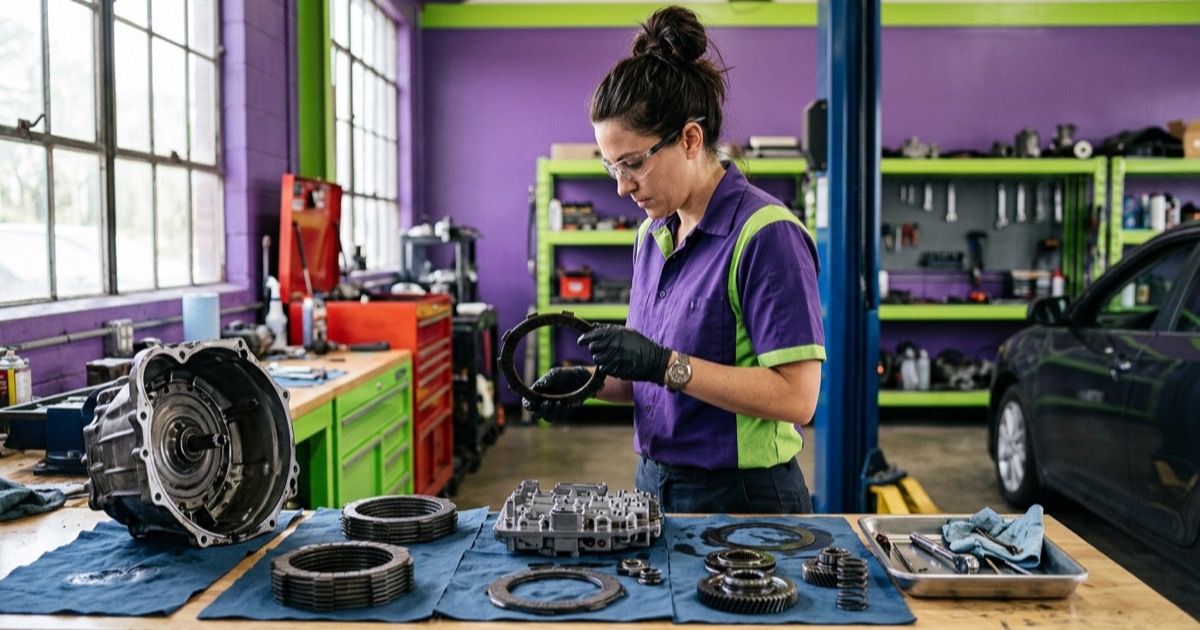
On the bench, the rebuilder takes it fully apart and cleans every part. A rebuild kit replaces the soft parts. That includes friction clutches, steel plates, seals, gaskets and rubber pistons. Hard parts like drums, gears, bushings or a solenoid pack get replaced only if they are worn or damaged.
The torque converter is usually replaced or rebuilt too, because it holds old fluid and debris. The cooler and lines should be flushed so the old debris does not get pumped right back in.
The unit goes back in, gets filled with fresh fluid, and the shop often runs a relearn with a scan tool so the computer adapts to the new clutches. A test drive should check every gear, hot and cold.
The best rebuilders also check the parts a kit does not cover. They measure clutch pack clearance, check the pump gears and bushings for scoring, and test the valve body for wear in the bores. A worn valve body is a common reason a fresh rebuild still shifts badly, so ask if it was checked or replaced.
On many modern units, the shop also updates known weak parts with improved versions. Rebuilders know which units have a weak drum, a bad sun gear or a valve body that wears. Those updates are a big part of what you are paying for.
Rebuild vs Remanufactured vs Used
You have three real choices when a transmission fails, and each has a place.
A local rebuild fixes your own unit. It is often the cheapest choice when the damage is limited to clutches and seals. Its quality depends entirely on the rebuilder's skill. A great local rebuilder can do better work than a factory reman.
A remanufactured unit is rebuilt in a factory to a set standard, with known weak points updated. It usually costs more but often comes with a longer warranty, sometimes three years or more, and it is installed fast because there is no bench time.
A used unit from a salvage yard is cheapest up front but a gamble. You do not know how it was treated. It makes sense on an old car you only need to run another year or two.
If the case is cracked or main gears are chewed up, a rebuild may cost as much as a reman. Ask the shop to call you after teardown with a firm price.
Why the Price Varies
Most local rebuilds on mainstream cars land somewhere around $2,000 to $4,500. The spread comes from a few things.
The type of transmission matters most. A simple four speed costs much less than an eight or ten speed with complex controls. CVTs are rarely rebuilt locally because parts are hard to get.
How badly it failed is next. A unit that slipped for a few weeks may need only a kit. One that was driven until it quit may need drums, a pump, a valve body or a converter. That is why many shops quote a range and give a firm price after teardown.
Access changes labor. Some front drive cars need the subframe dropped. Some AWD models add a transfer case to remove.
Venue matters. Transmission specialists usually beat dealers on price. General repair shops often send rebuilds out, which adds a markup. A mobile mechanic cannot do this job in a driveway, but some can help you diagnose before you commit.
Your location changes the labor rate. A shop charging $95 an hour and one charging $160 an hour will quote very different totals for the same 10 hours of work.
A cheap quote that leaves out the converter, the cooler flush or the relearn is not really cheaper. Compare what is included, line by line, not just the bottom number.
What Gets Done at the Same Time
Because the transmission is out, a few small jobs are cheap to add.
- Rear main seal on the engine: worth it if it shows any sign of leaking. It is right there, and later it costs a full transmission removal.
- Transmission mounts: worth checking. A torn mount can stress the new unit.
- Cooler flush or a new cooler: should be part of the job, not an extra. Debris left in the cooler can kill a fresh rebuild.
- Axle seals and CV axle inspection: cheap while things are apart.
- Shift kits or performance upgrades: an upsell on a daily driver, but useful for towing trucks.
Make Sure It Really Needs a Rebuild
Not every shifting problem means the transmission is done. A good shop checks the simple things first.
Low fluid from a leak can cause slipping and late shifts. Topping it off and fixing the leak sometimes cures it.
Faulty speed sensors, a bad shift solenoid, or a wiring problem can cause harsh shifts or stuck gears. A scan for codes and a look at live data can find these. Many are fixed for a few hundred dollars.
Some cars need a software update or a shift relearn. Check for open recalls and service bulletins on your model before paying for a teardown.
A bad engine mount or a CV axle can cause clunks that feel like the transmission. A worn torque converter can cause shudder on its own.
If a shop says rebuild without scanning, test driving and checking the fluid, get a second opinion.
Ask the shop to show you the fluid and what came out of the pan. A pan full of clutch material and metal backs up the call. Clean fluid with a shifting problem points to a control issue first.
Questions to Ask Before You Approve the Quote
A rebuild is a big bill. These questions protect you.
- Will you rebuild it in house, or send it out?
- Is the torque converter replaced or rebuilt, and is the cooler flushed?
- What does the price include, and what hard parts might add cost after teardown?
- Will you call me with a firm price after teardown before going further?
- How long is the warranty, does it cover parts and labor, and is it honored at other shops if I move?
- Do you run a relearn or software update after the install?
- How does a rebuild compare to a remanufactured unit for my car?
How to Make a Rebuilt Transmission Last
Change the fluid after the first few thousand miles if the shop recommends it, then on the severe schedule. Fresh fluid early flushes out any break in debris.
Keep it cool. If you tow, add a transmission cooler. Heat is what kills clutches.
Do not launch hard or tow at the limit for the first 500 miles. Let the new clutches seat.
Keep every receipt. Most warranties need proof of fluid service and can be voided by neglect.
Signs you need this repair
- Engine revs rise but the car does not speed up when shifting
- Delayed or no engagement into drive or reverse
- Harsh, banging shifts or flares between gears
- Transmission stuck in one gear, often called limp mode
- Burnt smelling, dark fluid with metal or clutch bits in it
- A check engine light with transmission slip or ratio codes
- Whining, grinding or clunking from the transmission area
Cost by vehicle type
| Vehicle | Typical range | Notes |
|---|---|---|
| Compact / economy car | $1,525 to $3,830 | Front drive automatics in small cars are the cheapest to rebuild. Many small cars now use CVTs, which most shops replace rather than rebuild. |
| Midsize sedan / small SUV | $1,660 to $4,160 | Six speed automatics are common and well known to rebuilders. Expect the middle of the range with good parts availability. |
| Full-size truck / large SUV | $1,960 to $4,905 | Truck transmissions are larger and heavier, and many have eight or ten speeds. They cost more in parts but are often easier to pull than a tight front drive car. |
| Luxury / European | $2,430 to $6,070 | Eight and nine speed units with complex controls push the price up. Many are best sent to a specialist, and some need dealer software after the rebuild. |
| Hybrid | $1,825 to $4,575 | Hybrid transaxles with built in motors are rarely rebuilt in local shops. Most are replaced with a remanufactured unit. |
| Electric vehicle | EVs use a single speed reduction gearbox with no clutch packs or valve body to rebuild, so this job does not apply to them. | |
| Diesel / heavy duty | $2,340 to $5,850 | Heavy duty units built for towing cost the most to rebuild, and many owners add upgraded clutches or a stronger converter at the same time. |
Ranges assume national-average labor rates ($95, $140/hr) and quality aftermarket parts.
Cost by state
State ranges reflect typical independent-shop labor rates for a midsize vehicle.
Common questions
How much does a transmission rebuild cost?
Most local rebuilds on mainstream cars cost about $2,000 to $4,500. Simple older units can be lower. Trucks, luxury cars and units with heavy damage can run higher.
Is it cheaper to rebuild or replace a transmission?
A rebuild is often cheaper when the damage is limited to clutches and seals. When hard parts are badly damaged, a remanufactured unit can cost about the same and comes with a longer warranty.
Is a transmission rebuild worth it on an old car?
It is worth it if the rest of the car is solid and you plan to keep it a few more years. If the car is worth less than the repair and has other problems, a used transmission or selling the car may make more sense.
How long does a transmission rebuild take?
Most shops need two to five days. That covers removal, teardown, parts ordering, assembly and install. Rare parts can add time.
Can I drive with a slipping transmission?
Only gently and only to a shop. Every mile of slipping adds damage and can turn a rebuild into a full replacement. Towing is often the cheaper choice.
How long does a rebuilt transmission last?
A quality rebuild can last as long as the original, often 100,000 miles or more. How long it lasts depends on the rebuilder, the parts, and how you maintain it.
Will a transmission flush fix slipping?
No. Slipping usually means worn clutches, and new fluid cannot restore them. Check the fluid level first, since low fluid can also cause slipping.
How much does a transmission rebuild cost at a dealer?
Most dealers do not rebuild in house. They install a new or remanufactured unit, which often costs $4,000 to $8,000. A local rebuilder is usually cheaper for the same car.
Related Repair Guides
More Drivetrain Repair Costs
Sources and further reading
Primary sources behind this page. Federal safety, emissions and consumer-protection references, worth reading before you authorize any repair.
- ASE certification Look for ASE certified techs in automatic transmission and transaxle work.
- SAE International The engineering body behind drivetrain and fluid standards.
- fueleconomy.gov maintenance guide Federal guidance on how routine maintenance protects the drivetrain.
Need Work Done? Get a Free Quote.
Tell us what the car is doing. A local mechanic calls you back, most requests get a call back the same day. No fee, no obligation.