What a U-Joint Does and What the Job Includes
A drive shaft cannot be perfectly straight. The transmission sits higher than the rear axle, and the axle moves up and down over bumps. A U-joint lets the shaft spin smoothly while it bends at an angle.
Each U-joint is a cross with four caps. Inside each cap are tiny needle bearings packed in grease. When the grease dries up or dirt gets in, the needles wear, the joint gets loose, and it starts to squeak and clunk.
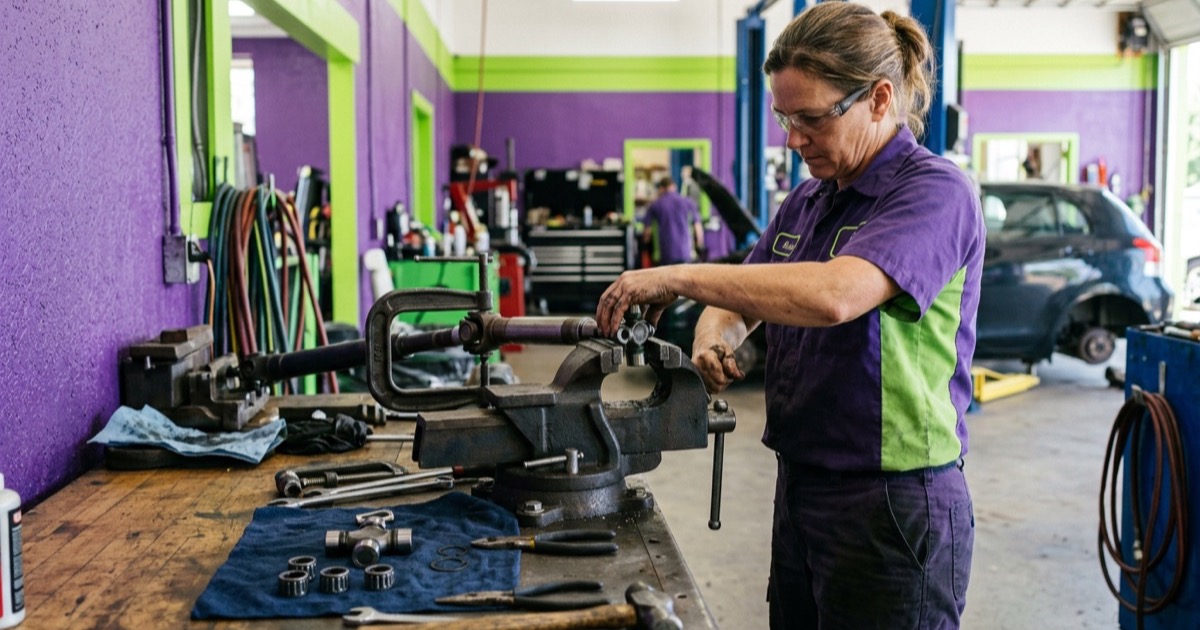
The job means marking the drive shaft, unbolting it, and taking it to a bench or a press. The old caps get pressed out, the new cross and caps get pressed in, and the clips go back in. Then the shaft goes back in the same position it came out.
Most trucks have at least two U-joints on the rear shaft. A 4WD truck has more on the front shaft and sometimes at each front wheel. The price on this page is for a typical single joint. If you replace both joints on one shaft, the second one adds less labor than the first because the shaft is already out.
The quote should include the joint, grease, and the time to remove and reinstall the shaft.
Why the Price Varies
The number of joints is the biggest factor. One joint on one shaft is the cheap version. Both ends of a shaft, or a front and rear shaft on a 4WD truck, add up fast.
The type of joint matters next. Basic joints held with snap rings are cheap and easy. Joints with a grease fitting cost a little more but can be greased later. Heavy duty joints for trucks and towing cost more.
Some shafts come from the factory with staked joints. The caps are pressed in and the metal is punched over to hold them. A shop has to machine the old stakes and use special clip style joints, which adds time. Some shops will tell you to buy a rebuilt shaft instead.
Front axle U-joints on 4WD trucks sit at each wheel inside the steering knuckle. Getting to them means taking off the brakes and hub, which costs more labor.
Then there is the shop. Dealers often push a whole new shaft. Independent shops and driveline shops usually replace the joint. Mobile mechanics can do many truck U-joints in a driveway.
What Usually Gets Done at the Same Time
With the shaft out, a few related checks make sense. Others are extra.
The other U-joint on the same shaft is worth doing if it is loose or the miles are high. The shaft is already out, so the extra labor is small.
The transmission or transfer case output seal and the pinion seal at the differential are worth checking. If either is leaking, now is the cheapest time.
The center support bearing on a two piece shaft is worth checking for torn rubber.
Shaft balancing is worth it if the old joints were very worn or if the vibration stays after the new joints go in. A driveline shop can spin the shaft and add weights.
A whole new drive shaft is not needed if the tube is straight and the yokes are not worn. Ask why if a shop wants to replace the shaft for a simple joint failure.
- Other U-joint on the same shaft: do it if loose or high miles
- Output seal and pinion seal: replace if leaking
- Center support bearing on two piece shafts: check it
- Drive shaft balancing: only if vibration remains
- Whole new drive shaft: only if the tube or yokes are damaged
Make Sure It Is Really the U-Joint
A worn U-joint is easy to check, so there is no reason to guess. With the vehicle safely raised, a mechanic grabs the shaft near each joint and twists and pushes. Any clicking or play means the joint is worn. Rust colored dust around a cap is another sign.
Some other problems feel and sound similar.
Too much slack in the driveline can cause a clunk when you shift. That slack can come from a worn differential, loose slip yoke splines, or worn transmission mounts.
A bad center support bearing on a two piece shaft causes a shudder from a stop and a rumble at speed.
Tires out of balance cause vibration at highway speed, usually felt in the steering wheel more than the seat.
A bad wheel bearing makes a hum that changes in turns.
A squeak at very low speed that matches wheel turns is classic for a dry U-joint. A shop that has checked the joints by hand can tell you in a few minutes.
Questions to Ask Before You Approve the Quote
U-joint quotes are usually simple. These questions make sure you get the right amount of work.
- Which joints are worn, and can you show me the play?
- How many joints are you quoting, and is the price per joint or per shaft?
- Are my joints serviceable, or are they staked in from the factory?
- Are you using greaseable joints or sealed joints, and what brand?
- Did you check the output seal, pinion seal and center bearing while the shaft is out?
- Will you mark the shaft so it goes back in the same position?
- If I still feel vibration, is balancing included or extra?
- What is the warranty on parts and labor?
Can a Mobile Mechanic Do It?
Yes, on most trucks and rear drive cars. A mobile mechanic can pull the shaft in a driveway, press out the old joint with a portable press or a vise on the truck, and put the shaft back in. Many do this every week.
Staked joints and balancing need a driveline shop with a lathe and a balancer. A mobile tech can still remove and install the shaft and take it to a shop.
Front axle U-joints at the wheels on 4WD trucks can be done in a driveway too, but they take longer because the hub and brakes come off.
Give the mechanic your year, make, model, drive type and which joint is making noise. That tells them what parts to bring.
How to Make U-Joints Last
A good U-joint can last 100,000 miles or more. Most fail early because of dry grease or water.
If your joints have grease fittings, grease them at every oil change. Pump in fresh grease until a little comes out of each cap seal. That pushes out water and dirt.
If you drive through deep water or off road, check the joints more often.
If you lift a truck, get the drive shaft angles checked. Steep angles make joints work harder and wear out fast.
Listen for the early squeak. A $50 joint caught early is much cheaper than a broken shaft.
Signs you need this repair
- Squeak or chirp from under the car at low speed that keeps time with the wheels
- Clunk when you shift into drive or reverse
- Vibration felt in the floor that grows with speed
- Clicking or knocking when you pull away from a stop
- Rust colored dust around the U-joint caps
- Play you can feel when you twist the drive shaft by hand
- Fluid leak at the transmission output from a shaft that is wobbling
Cost by vehicle type
| Vehicle | Typical range | Notes |
|---|---|---|
| Compact / economy car | $140 to $450 | Front drive compacts have no U-joints in the driveline. Some AWD compacts use one or two in a multi piece shaft, and some of those are only sold with the whole shaft. |
| Midsize sedan / small SUV | $145 to $470 | Rear drive midsize cars often use U-joints or rubber flex discs. Some joints are staked in from the factory and need the shaft rebuilt or replaced. |
| Full-size truck / large SUV | $165 to $535 | Pickups are where U-joints live. Most trucks have two to four, including front shaft joints on 4WD, and they are usually easy to service, so labor sits at the low end per joint. |
| Luxury / European | $195 to $645 | Many German cars use CV joints and flex discs rather than U-joints. Where they do use U-joints, they are often built into a shaft that is sold only as a whole assembly. |
| Hybrid | $160 to $515 | AWD hybrids with a rear electric motor have no drive shaft and no U-joints. Hybrid trucks with a normal 4WD layout have the same U-joints as the gas version. |
| Electric vehicle | Most electric cars use CV joints on short half shafts and have no drive shaft with U-joints. | |
| Diesel / heavy duty | $195 to $635 | Heavy duty trucks use larger U-joints sized for towing, and the front 4WD axle has U-joints at each wheel too. Parts cost more, and those front axle joints take more labor. |
Ranges assume national-average labor rates ($95, $140/hr) and quality aftermarket parts.
Cost by state
State ranges reflect typical independent-shop labor rates for a midsize vehicle.
Common questions
How much does it cost to replace a U-joint?
Most drivers pay about $150 to $450 for one U-joint at an independent shop or mobile mechanic. Doing a second joint on the same shaft adds less, because the shaft is already out. Front axle U-joints on 4WD trucks and staked joints cost more.
Can I drive with a bad U-joint?
You can drive gently a short distance to get it fixed if it only squeaks. If it clunks hard or you feel a new vibration, stop driving. A U-joint that breaks can drop the drive shaft and cause major damage or a crash.
What does a bad U-joint sound like?
It usually starts as a squeak at low speed that keeps time with the wheels. As it gets worse, you hear a clunk when you shift into gear and feel vibration at speed.
How long does it take to replace a U-joint?
About one to two and a half hours for one joint on most trucks and cars. Rusted joints and front axle joints on 4WD trucks take longer.
Should I replace both U-joints at the same time?
If both are original and the miles are high, yes, it usually makes sense. The shaft is already out, and the second joint adds little labor. If the other joint is fairly new and tight, you can leave it.
Are greaseable U-joints better than sealed ones?
Greaseable joints can last longer if you actually grease them. Sealed joints need no care and are often a bit stronger because there is no hole drilled for the fitting. If you will not grease them, sealed is fine.
Can a bad U-joint cause a vibration at highway speed?
Yes. A worn joint lets the drive shaft wobble a little, and that wobble grows as the shaft spins faster. The vibration is usually felt in the seat and floor more than the steering wheel. If new joints do not fix it, the shaft may need balancing or the tires may be the real cause.
Is a U-joint worth fixing on an old truck?
Yes. It is one of the cheapest drivetrain repairs there is, and skipping it can wreck the drive shaft and more. Even on a very old truck, a new U-joint is money well spent.
Related Repair Guides
More Drivetrain Repair Costs
Sources and further reading
Primary sources behind this page. Federal safety, emissions and consumer-protection references, worth reading before you authorize any repair.
- fueleconomy.gov maintenance guide DOE and EPA guidance on how routine maintenance keeps a vehicle running well.
- fueleconomy.gov: where the energy goes How engine power moves through the drivetrain, and how some of it is lost on the way to the wheels.
- ASE certified technicians Find shops with ASE certified drivetrain technicians before you approve a quote.
Need Work Done? Get a Free Quote.
Tell us what the car is doing. A local mechanic calls you back, most requests get a call back the same day. No fee, no obligation.