What the Differential Does and What the Service Includes
When you turn, the outside wheel travels farther than the inside wheel. The differential is a set of gears that lets the two wheels turn at different speeds while still both getting power. It sits in the middle of the axle on rear drive cars and trucks, and inside the transaxle on most front drive cars.
The gears inside are cut at an angle and slide against each other under heavy load. That takes a thick gear oil, usually 75W90 or similar, that can handle extreme pressure.
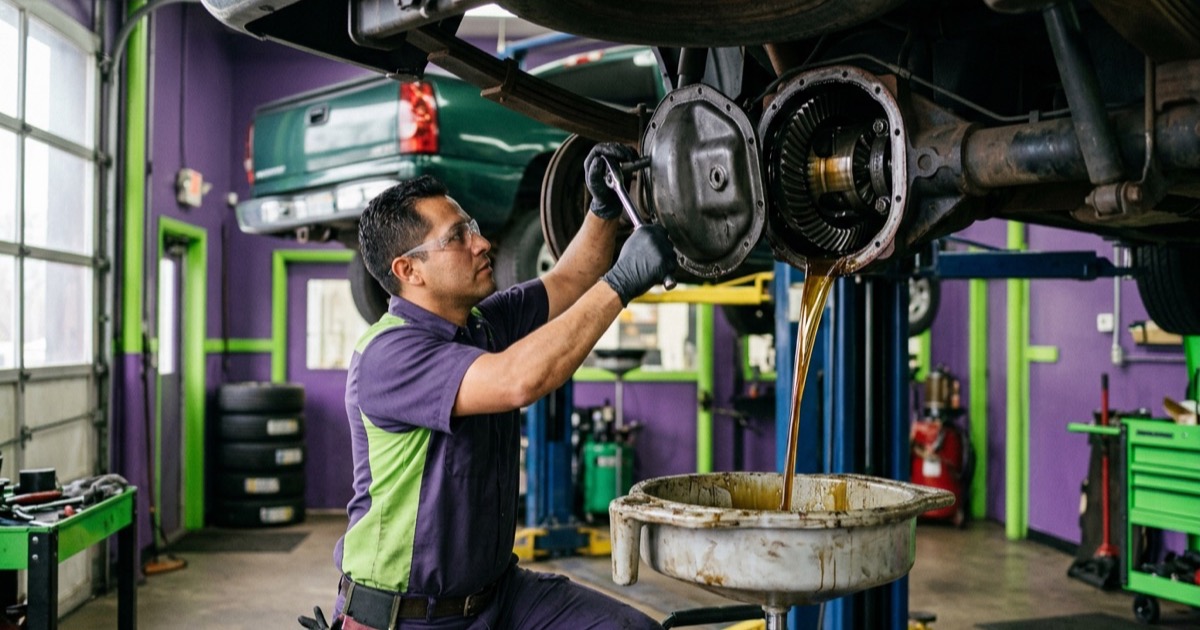
The service is simple. The tech removes the fill plug, then drains the old oil through a drain plug or by pulling the cover. If the cover comes off, the old gasket or sealant is cleaned off and a new one is used. The differential is refilled to the bottom of the fill hole. A typical bill runs about $80 to $200 per differential.
A careful tech also looks at the old oil as it drains. Clean oil that is just dark is normal. Oil with a lot of glitter, chunks of metal, or a milky look tells you something is wrong inside.
If the cover comes off, the tech can also see the gears and bearings. This is a good chance to spot chipped teeth or a worn bearing before it gets loud.
Why the Price Varies
The number of differentials is the biggest factor. A rear drive car has one. An AWD crossover may have one plus a transfer unit. A 4WD truck has a front, a rear, and a transfer case. Each one is its own service.
The oil type matters. Conventional gear oil is cheap. Synthetic oil and maker specific fluids cost more. Limited slip units need a friction modifier.
The design matters. A drain plug is quick. A unit with no drain plug means pulling the cover and resealing it, which takes longer. Some front axles are hard to reach.
Venue matters less here than on big jobs. Many quick lubes and independent shops price it fairly. A mobile mechanic can easily do it in a driveway on most trucks.
Location changes the labor rate, but this job is short, so the rate matters less than on big repairs. A quick lube price around $80 and an independent shop price around $150 are both normal.
Watch for a price that does not say how many units it covers. A 4WD truck quoted at $120 may mean just the rear axle, with the front and transfer case extra.
What Often Gets Done at the Same Time
On AWD and 4WD vehicles, a few fluids are best done together.
- Transfer case fluid: worth doing at the same visit if it is due.
- Front differential on 4WD trucks: usually on the same schedule as the rear.
- Pinion or axle seal: only if it is leaking. Do not pay to replace a dry seal.
- Magnetic drain plug check: the tech should look at what is on it. A fine gray paste is normal. Chips are not.
- Gear oil additives beyond a needed friction modifier: usually an upsell.
Do You Need It Now? What the Symptoms Mean
If the vehicle is quiet and dry and you are just on schedule, you need the service, not a diagnosis.
A whine that rises with road speed and changes when you speed up or slow down often points to worn ring and pinion gears. New oil might quiet it a little, but it will not fix worn gears.
A hum that changes when you swerve gently is more often a wheel bearing. Many people confuse the two.
A clunk when you take off can be worn gears, but it can also be a U joint, a CV axle or a mount.
Chatter in tight turns on a limited slip axle usually means it needs fresh oil with the right friction additive. That is a cheap fix.
Oil on the inside of a rear wheel points to a leaking axle seal, which can also ruin the brakes on that side.
Questions to Ask Before You Approve the Quote
This is a small job, but the details still matter.
- Is the price per differential, and how many does my vehicle have?
- What weight and type of gear oil are you using, and does it match my manual?
- Does my axle have a limited slip, and are you adding friction modifier if needed?
- Will you drain through a plug or pull the cover, and is a new gasket included?
- Will you tell me what was on the magnet or in the old oil?
How Often to Change It
Many makers list a change every 30,000 to 60,000 miles under severe use and longer under normal use. Some list it as lifetime fill, which usually means the warranty period.
Towing, plowing, off road use, and driving through deep water all count as severe use. Water can get into the differential through the vent tube and turn the oil milky. If the oil looks like a milkshake, change it right away.
On a new or rebuilt differential, an early first change helps flush out break in wear.
Keep the vent tube clear. A blocked vent can push oil past the seals.
Can You Do It Yourself or Use a Mobile Mechanic?
This is one of the easiest drivetrain jobs to do yourself on a truck or rear drive car. You need a wrench for the plugs, a drain pan, and a cheap hand pump to push oil into the fill hole.
The big rule is to open the fill plug first. If the fill plug is seized and you have already drained the oil, you are stuck.
If your axle has a cover with no drain plug, you will need to pull the cover and clean the old sealant off before putting it back with fresh sealant. Let it cure before refilling.
A mobile mechanic can do this on most trucks and many AWD vehicles in a driveway. Some front differentials sit high and are hard to reach without a lift, but most are still doable.
Dispose of the old oil at a parts store or recycling center. Gear oil has a strong smell that is hard to wash out of clothes, so wear old ones.
Signs you need this repair
- Whining or howling from the rear that changes with speed
- Chatter or shudder in tight turns on a limited slip axle
- Oil on the inside of a rear wheel or dripping from the axle center
- A burning gear oil smell after towing
- Milky gear oil after driving through deep water
- You are past the interval in your owner's manual
Cost by vehicle type
| Vehicle | Typical range | Notes |
|---|---|---|
| Compact / economy car | $70 to $215 | Most front drive cars have the differential inside the transaxle, sharing its fluid. There is no separate differential service unless the car is AWD. |
| Midsize sedan / small SUV | $70 to $230 | AWD versions have a rear differential that often takes a small amount of special fluid. Some also have a transfer unit up front with its own oil. |
| Full-size truck / large SUV | $85 to $265 | Rear and front axles each take two to three quarts. A truck with a transfer case has a third fluid to check. Towing calls for the short interval. |
| Luxury / European | $100 to $325 | Many use a maker specific gear oil that costs more, and some AWD systems have an electronic coupling with its own fluid. |
| Hybrid | $80 to $255 | AWD hybrids often drive the rear wheels with an electric motor that has its own small gearbox. Check the manual for its fluid and interval. |
| Electric vehicle | $85 to $265 | The drive unit holds a small amount of oil that lubricates the gears and the differential. Many makers list long or no change intervals. |
| Diesel / heavy duty | $100 to $315 | Heavy axles hold more oil, often run hot when towing, and should be serviced on the severe schedule. Many owners add a finned cover for cooling. |
Ranges assume national-average labor rates ($95, $140/hr) and quality aftermarket parts.
Cost by state
State ranges reflect typical independent-shop labor rates for a midsize vehicle.
Common questions
How much does a differential fluid change cost?
Most shops charge about $80 to $200 per differential. A 4WD truck with front and rear units plus a transfer case can run $250 to $450 for everything.
How often should differential fluid be changed?
Follow your owner's manual. Many call for 30,000 to 60,000 miles under severe use. Towing and off road driving count as severe use.
What happens if you never change differential fluid?
The oil breaks down and wear speeds up. Over time the gears and bearings can start to whine and fail. Replacing a differential costs many times more than the service.
Does my front wheel drive car need a differential fluid change?
Usually not as a separate service. Most front drive cars share fluid between the transmission and differential. AWD versions do have a separate rear unit.
Will new fluid stop my differential from whining?
Usually not. A whine often means the gears are worn, and fresh oil does not undo wear. It may quiet a little, so do the service, then plan for a repair if the noise stays.
Can a quick lube do a differential fluid change?
Many can, and on a simple axle with a drain plug it is a fine place to go. Make sure they use the right oil and add friction modifier on a limited slip axle.
How much does a differential fluid change cost at a dealer?
Dealers often charge $150 to $300 per differential. The higher price is mostly labor rate and OEM oil. An independent shop using the same oil spec is usually cheaper.
Is differential fluid the same as transmission fluid?
No, on most vehicles. Differentials use a thick gear oil, while automatic transmissions use a thin fluid. On some front drive cars, both share one fluid inside the transaxle.
Related Repair Guides
More Drivetrain Repair Costs
Sources and further reading
Primary sources behind this page. Federal safety, emissions and consumer-protection references, worth reading before you authorize any repair.
- fueleconomy.gov maintenance guide Federal guidance on routine maintenance and fuel economy.
- SAE International The body that sets gear oil viscosity grades like 75W90.
- DOE Alternative Fuels Data Center: electric vehicles Federal reference on EV drive units and maintenance.
Need Work Done? Get a Free Quote.
Tell us what the car is doing. A local mechanic calls you back, most requests get a call back the same day. No fee, no obligation.