What the Job Is and What You Are Paying For
In two wheel drive, the transfer case sends all the power to the rear axle. When you shift into four wheel drive, it locks the front drive shaft to the rear so both axles turn. In low range, it adds a gear reduction for crawling and towing off road.
Inside there is usually a chain that drives the front output, a set of gears for low range, and a shift fork that moves a collar to pick the mode. Many newer cases also have a clutch pack that sends power to the front only when the rear slips. An electric shift motor on the outside does the shifting on most push button systems.
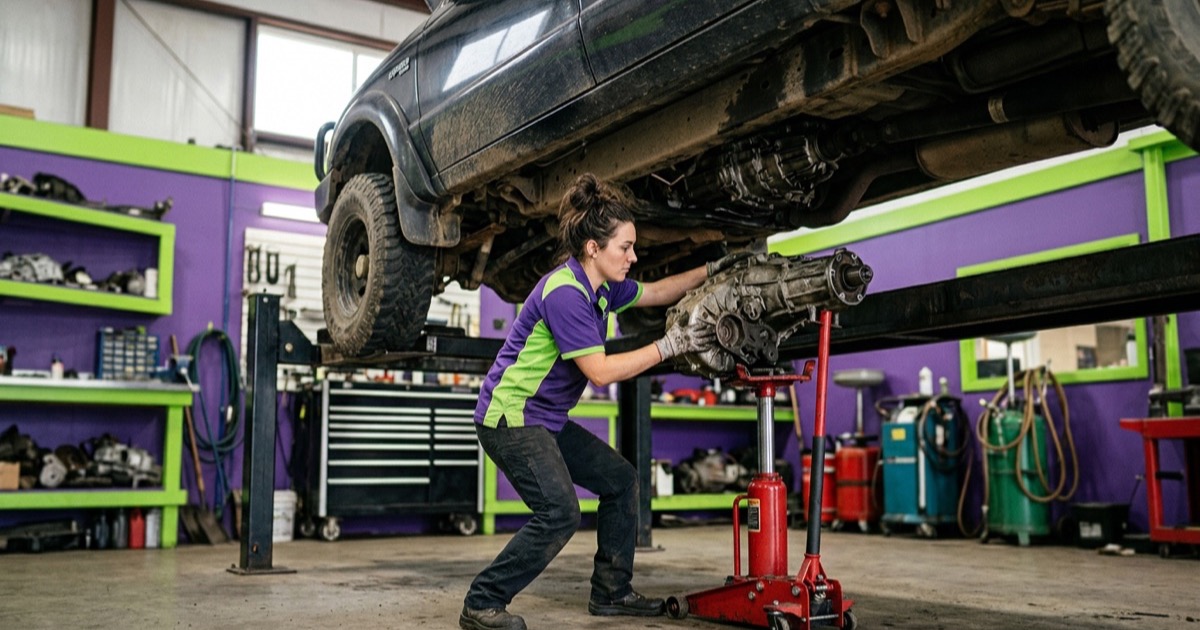
A replacement job means draining the fluid, removing the front and rear drive shafts, unplugging the shift motor and sensors, supporting the case on a jack, and unbolting it from the transmission. The new or rebuilt case goes in with a new gasket, gets filled with the correct fluid, and the shop tests every mode.
The price is mostly the part. On most trucks the case is the expensive piece, and labor is a smaller share of the bill.
That is why the type of part you pick matters so much. More on that next.
Why the Price Varies So Much
The part choice is the biggest factor. A used case from a salvage yard might cost $500 to $1,200. A remanufactured case with a warranty often runs $1,300 to $2,800. A new factory case can cost far more, especially on luxury SUVs.
What failed matters too. Many transfer case problems are not the case itself. A shift motor, an encoder, a vacuum line or a module can each cause 4WD to stop working. Those parts cost a few hundred dollars, not a few thousand.
The type of case changes the price. A simple part time 4WD case is cheaper than a full time or automatic case with a clutch pack and its own computer.
Access and setup add labor. Some vehicles need exhaust pipes, skid plates or a crossmember removed. Some need the new case or shift motor calibrated with a scan tool.
Then there is the shop. Dealers usually sell a new factory unit. Independent and drivetrain shops can offer rebuilt units or rebuild yours. A mobile mechanic can swap a bolt on case on some trucks, but most prefer a lift for this one.
What Usually Gets Done at the Same Time
With the case out, some nearby jobs cost almost nothing extra. Some are not needed.
The rear transmission seal or adapter seal is worth replacing. It sits right where the case bolts on, and a leak there is a pain to fix later.
The U-joints on both drive shafts are worth checking. The shafts are already off, and worn joints can cause the same clunks that made you suspect the case.
The shift motor is worth testing. If your new case does not include one and yours is old or slow, ask what a new one costs now.
Front axle and rear differential fluid are worth checking. A failing case can send metal or binding loads through the axles.
A transmission fluid change is not needed unless it is due. It is a separate job and a separate fluid.
Rebuilding the front axle is not needed unless it shows real wear. Some shops pair it with transfer case work by habit.
- Transmission rear seal or adapter seal: replace now
- Drive shaft U-joints: check while the shafts are off
- Shift motor and encoder: test, replace if slow or failed
- Front and rear axle fluid: check for metal
- Transmission fluid change: only if due
- Front axle rebuild: only if it shows real wear
Make Sure It Is Really the Transfer Case
A transfer case is expensive, so the cheap checks come first.
Start with the fluid. Many transfer case failures begin with a slow leak. Low fluid, burnt fluid, or fluid full of metal points to the case. Fresh fluid sometimes fixes a noisy or slow shifting case if it is caught early.
If 4WD will not engage, check the electric parts. The shift motor, the selector switch, fuses, wiring and the module can all fail. A shop can command the shift motor with a scan tool and watch what happens.
If you feel binding or hopping in turns, make sure the case is not stuck in 4WD. Driving a part time 4WD truck on dry pavement in four wheel drive causes the same feeling, and it damages parts if you keep doing it.
Some noises come from other parts. Worn U-joints clunk. A bad front hub or locking hub grinds. A worn front or rear differential whines.
A good shop will check fluid, scan codes, test each mode, and lift the truck to check for play before it quotes a whole new case.
Questions to Ask Before You Approve the Quote
Transfer case quotes are large. These questions make sure you are paying for the right fix.
- What did you find that points to the transfer case and not the shift motor, switch, or module?
- Did you check the fluid level and condition, and what did it look like?
- Is the replacement new, remanufactured, or used, and how many miles are on a used unit?
- What is the warranty on the part, and who pays labor if it fails?
- Does the price include fluid, gaskets and the rear transmission seal?
- Does my vehicle need the shift motor or module calibrated after the swap?
- Is the shift motor included with the new case, or is mine being reused?
- Can my current case be rebuilt for less?
Can a Mobile Mechanic Do It?
Some can, on some trucks. A mobile mechanic with a transmission jack can swap a transfer case on many pickups in a driveway. It is heavy and slow without a lift, so expect the labor to sit at the high end.
Mobile techs are a great fit for the smaller jobs that often fix 4WD problems. A shift motor, a selector switch, a fluid change, or a leaking output seal can all be done in a driveway.
Luxury SUVs and vehicles that need factory software to set up the new case are better in a shop.
Tell the mechanic your year, make, model, the 4WD system type and what it is doing. A good tech will tell you if it sounds like a motor problem or a case problem before you buy parts.
How to Make a Transfer Case Last
A transfer case can last the life of the truck if its fluid is changed and it is used the right way.
Change the fluid on the schedule in your owner's manual. Many owners never do, and the chain and bearings wear out early in old fluid.
Use the exact fluid the case calls for. Some use automatic transmission fluid, some use a special transfer case fluid. The wrong one can make clutch packs chatter.
Do not drive a part time 4WD truck in four wheel drive on dry pavement. The front and rear axles need to turn at different speeds in turns, and a part time case cannot allow that.
Shift into 4WD once a month for a few miles on loose ground. That keeps the shift parts moving and the seals coated.
Check for leaks at each oil change. A slow leak is the most common reason a case runs dry.
Signs you need this repair
- 4WD or AWD warning light on the dash
- Truck will not shift into or out of four wheel drive
- Grinding or clunking when you shift between 2WD, 4WD and low range
- Binding or hopping in turns when the system should be in 2WD
- Whining or rumbling from the middle of the vehicle that grows with speed
- Fluid leaking from behind the transmission
- Transfer case jumps out of four wheel drive on its own
Cost by vehicle type
| Vehicle | Typical range | Notes |
|---|---|---|
| Compact / economy car | $1,390 to $3,220 | Front drive based AWD compacts use a small power transfer unit on the transmission instead of a true transfer case. It costs less as a part, but access can be tight. |
| Midsize sedan / small SUV | $1,585 to $3,640 | AWD midsize cars and crossovers usually have a power transfer unit or a compact transfer case. Expect the low to middle of the range, and ask about a used low mileage unit. |
| Full-size truck / large SUV | $1,940 to $4,425 | Pickups and body on frame SUVs use a classic chain driven transfer case with high and low range. Used and rebuilt units are easy to find, and labor runs toward the middle of the range. |
| Luxury / European | $2,450 to $5,570 | Luxury SUVs often use an electronically controlled transfer case with a clutch pack and its own module. Parts cost more, and the shop may need factory software to set it up. |
| Hybrid | $1,745 to $4,005 | Many AWD hybrids drive the rear axle with an electric motor and have no transfer case. Hybrid pickups with a normal 4WD layout have the same transfer case as the gas version. |
| Electric vehicle | Electric cars get all wheel drive from a motor on each axle, so they have no transfer case to replace. | |
| Diesel / heavy duty | $2,320 to $5,290 | Heavy duty diesel trucks use large, heavy cases built for high torque and towing. Parts cost more and labor runs to the top of the range, but rebuilt units are common. |
Ranges assume national-average labor rates ($95, $140/hr) and quality aftermarket parts.
Cost by state
State ranges reflect typical independent-shop labor rates for a midsize vehicle.
Common questions
How much does it cost to replace a transfer case?
Most drivers pay about $1,600 to $3,600 at an independent shop for a remanufactured case. A used case on a common pickup can cost less. A new factory case on a luxury SUV or a heavy duty truck can cost more, and a dealer adds more again.
Can I drive with a bad transfer case?
You can sometimes drive in two wheel drive if the case still sends power to the rear and makes no grinding noise. If it grinds, binds in turns, or is stuck in 4WD, stop driving and get it checked. A seized case can damage the transmission and axles.
What are the signs of a bad transfer case?
The most common signs are a 4WD warning light, trouble shifting into or out of four wheel drive, grinding or clunking, and fluid leaking behind the transmission. Some trucks also jump out of four wheel drive on their own.
Is it the transfer case or the shift motor?
If the truck will not shift modes but drives fine and makes no noise, the shift motor or its switch is often the cause. A shop can command the motor with a scan tool to find out. A motor costs a few hundred dollars, so check it before you buy a whole case.
How long does it take to replace a transfer case?
About three to six hours for most vehicles. Pickups with easy access sit at the low end. Vehicles with skid plates, exhaust in the way, or a case that needs calibration take longer.
Should I buy a used or rebuilt transfer case?
A rebuilt case with a warranty is the safer choice for most people. A used case saves money but comes with unknown miles and a short warranty. If you buy used, ask for the mileage and check the fluid before it goes in.
Is a transfer case worth fixing on an old truck?
Often, yes, if you need 4WD and the rest of the truck is solid. A used case can bring the cost down. If you rarely use 4WD and the truck still drives in two wheel drive, some owners choose to wait.
Related Repair Guides
More Drivetrain Repair Costs
Sources and further reading
Primary sources behind this page. Federal safety, emissions and consumer-protection references, worth reading before you authorize any repair.
- fueleconomy.gov: where the energy goes DOE and EPA explain how power moves through the drivetrain and where some of it is lost.
- fueleconomy.gov maintenance guide Why keeping up with routine maintenance, including fluids, protects your vehicle.
- ASE certified technicians Find shops with ASE certified drivetrain technicians before you approve a quote.
Need Work Done? Get a Free Quote.
Tell us what the car is doing. A local mechanic calls you back, most requests get a call back the same day. No fee, no obligation.