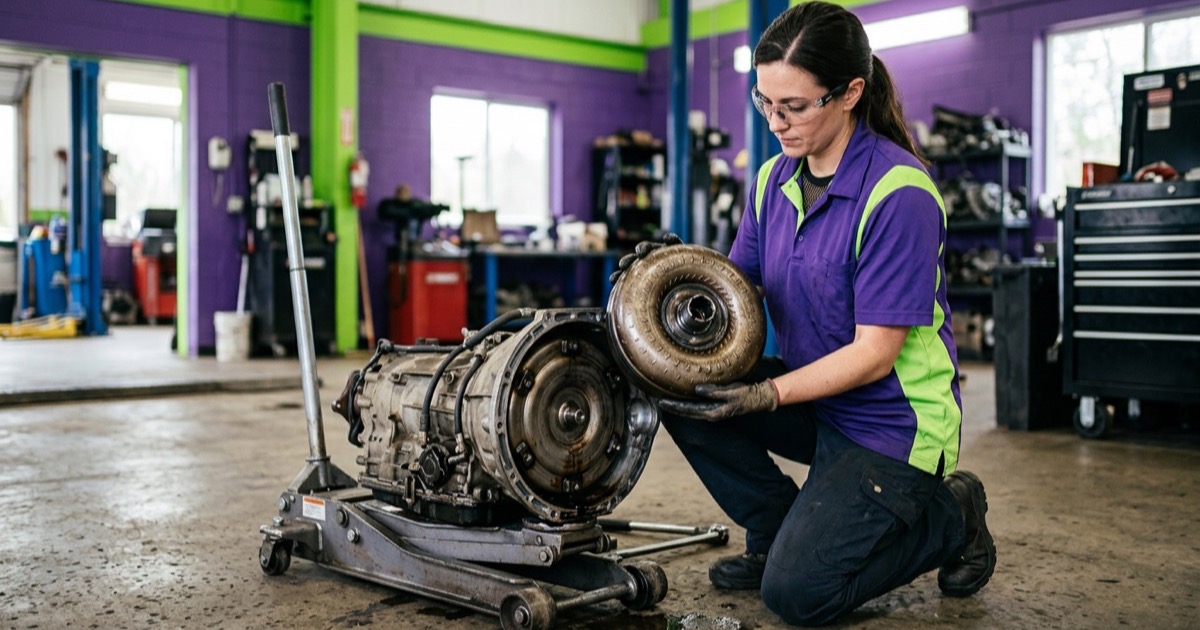
What the Torque Converter Does
Inside the converter are three sets of blades. The engine spins one set, which throws fluid at the second set, which turns the transmission. The third set redirects the fluid to multiply torque at low speed. That is why an automatic car can sit still in drive without stalling.
At cruise, a lockup clutch inside the converter locks the engine and transmission together. This stops slip and saves fuel. Most converter problems today come from that lockup clutch wearing or the computer struggling to control it.
The converter is bolted to the engine's flexplate and slides onto the front of the transmission. The only way to reach it is to remove the transmission.
Because the converter holds a lot of fluid, a drain and fill does not change the fluid inside it. That is one reason old fluid can linger and why lockup clutch problems build up slowly over time.
What the Job Includes
The shop drains the fluid, removes axles or the driveshaft, disconnects cooler lines and wiring, supports the engine, and lowers the transmission out.
The old converter slides off. The tech checks the pump bushing and front seal and replaces the front seal as a matter of course. The new converter is filled with some fluid and pushed on until it drops into the pump. A good tech checks the depth with a straight edge before bolting the transmission back up.
The cooler and lines should be flushed, because a failed converter sends debris everywhere. Then the transmission goes back in, gets fresh fluid, and the shop runs a test drive and often a relearn.
Most of the total is labor, often 5 to 9 hours. Parts usually run $200 to $700 for a quality new or remanufactured converter.
Why the Price Varies
Access is the biggest factor. A rear drive truck can be quick. A tight front drive V6 or an AWD car with a transfer case can take much longer.
The converter type matters too. Remanufactured converters are common and fine when they come from a good builder. New OEM converters cost more. Heavy duty and performance converters cost the most.
The condition of the transmission is the big wild card. If the converter failed and spread metal through the unit, a converter alone will not last. The shop may recommend a rebuild instead, and that is often the right call.
Dealers charge more per hour. Transmission specialists usually give the best value on this job. It is not a driveway job, so mobile mechanics usually do not do it, though some can scan and road test to confirm the problem first.
Your local labor rate makes a big difference. Nine hours at $95 and nine hours at $160 are almost $600 apart before parts. A quote that seems cheap may also leave out the cooler flush, the front seal or the relearn, so compare line by line.
What Gets Done at the Same Time
Since the transmission is coming out, some extras make sense.
- Transmission front pump seal: should always be replaced with the converter.
- Rear main seal: worth doing if it shows any seep. It is fully exposed.
- Flexplate inspection: a cracked flexplate can cause noises and can be swapped for little extra labor.
- Cooler flush: should be part of the job, not an add on.
- Full rebuild: only if the fluid and pan show real wear material. Otherwise it is an upsell.
Is It Really the Torque Converter?
Converter problems are easy to confuse with other faults. A careful shop tests before it pulls anything.
Shudder at steady speed between about 30 and 50 mph is the classic sign of a worn lockup clutch. But engine misfires feel very similar. Scanning for misfire data rules that out.
Some lockup shudder is caused by old fluid, not a worn converter. On some models a fluid change with the correct fluid cures it. Check for service bulletins on your model.
A bad lockup solenoid or wiring fault can mimic a bad converter. The scan tool and a look at lockup command versus actual slip tells the story.
A whine that changes with engine speed in park or neutral can be the pump, not the converter. Both are in the same area, so diagnosis takes skill.
Questions to Ask Before You Approve the Quote
These questions help you avoid paying twice.
- What tests confirmed the converter is the problem?
- Is there a service bulletin or software update for my car's shudder?
- Is the converter new, remanufactured, or upgraded, and who made it?
- Will you replace the front pump seal and flush the cooler?
- What did the fluid and pan look like? Is there metal?
- If you find more damage after removal, will you call me before going on?
- What is the warranty on parts and labor?
How to Make the New Converter Last
Change the transmission fluid on the severe schedule after the repair. Fresh fluid keeps the lockup clutch working smoothly and is the cheapest way to avoid shudder coming back.
Keep the fluid cool. Towing heavy loads without a cooler is hard on the converter. An added cooler costs little next to another converter job.
If a shudder comes back soon, go back to the shop right away. It may be a seating problem, a control fault, or debris from the old unit. Early action keeps it under warranty.
Keep your receipts. A warranty claim is easier when you can show the fluid was serviced on time.
Signs you need this repair
- Shudder or vibration at steady speed, often 30 to 50 mph, like driving over rumble strips
- Engine revs flare without the car picking up speed
- Transmission running hot or overheating warnings
- Whining or whirring noise that changes with engine speed
- Check engine light with a lockup or converter clutch code
- Car stalls when coming to a stop, from a stuck lockup clutch
- Dark fluid with glittery metal in it
Cost by vehicle type
| Vehicle | Typical range | Notes |
|---|---|---|
| Compact / economy car | $645 to $1,855 | Front drive cars often need the subframe or an engine support to drop the transaxle, which can make labor higher than on a truck. Parts are cheap. |
| Midsize sedan / small SUV | $675 to $1,960 | Expect the middle of the range. Many V6 sedans have tight access, which adds an hour or two. |
| Full-size truck / large SUV | $770 to $2,260 | Rear drive trucks are often the easiest to pull because the transmission slides straight back. Converters for big engines cost more. |
| Luxury / European | $940 to $2,760 | Converters for eight speed units cost more, and some cars need a relearn with dealer level software afterward. |
| Hybrid | $740 to $2,155 | Most hybrids use an electric drive unit with no torque converter. A few mild hybrids with a regular automatic still have one. |
| Electric vehicle | EVs have no torque converter because the electric motor makes full torque from a stop, so this repair does not apply. | |
| Diesel / heavy duty | $920 to $2,690 | Heavy duty converters built for towing cost the most, and many owners choose an upgraded billet unit at this point. |
Ranges assume national-average labor rates ($95, $140/hr) and quality aftermarket parts.
Cost by state
State ranges reflect typical independent-shop labor rates for a midsize vehicle.
Common questions
How much does it cost to replace a torque converter?
Most jobs cost about $700 to $2,000. The converter itself is often a few hundred dollars. The rest is the labor to remove and refit the transmission.
Can I drive with a bad torque converter?
You can drive gently for a short time, but it is risky. A failing converter can overheat the fluid and spread debris through the transmission, which turns a smaller repair into a rebuild.
Should I rebuild the transmission when I replace the torque converter?
Only if the transmission shows wear. If the fluid has metal and the transmission slips, a rebuild makes sense. If the fluid is clean and only the lockup clutch failed, a converter alone is fine.
Can a fluid change fix torque converter shudder?
Sometimes. On some cars the shudder comes from worn fluid, and a change with the correct fluid fixes it. Check for a service bulletin on your model before paying for parts.
How long does a torque converter replacement take?
Most shops need one to two days. The book time is often 5 to 9 hours, and parts may need to be ordered.
How do I know if it is the torque converter or the transmission?
A shop scans for codes, checks lockup slip on live data, and looks at the fluid. Shudder at steady speed points to the converter. Slipping during shifts points to the transmission.
Can a mobile mechanic replace a torque converter?
Usually not. The transmission has to come out, which takes a lift and a transmission jack. A mobile tech can scan and road test to confirm the problem before you book a shop.
Is it worth replacing a torque converter on a high mileage car?
It can be if the transmission is healthy and the rest of the car is solid. If the transmission also slips or the fluid is full of metal, a rebuild or a used unit may be a better use of the money.
Related Repair Guides
More Drivetrain Repair Costs
Sources and further reading
Primary sources behind this page. Federal safety, emissions and consumer-protection references, worth reading before you authorize any repair.
- fueleconomy.gov maintenance guide Federal guidance on how maintenance affects fuel economy and drivetrain life.
- ASE certification Look for ASE certified techs in automatic transmission work.
- SAE International The engineering body behind drivetrain and fluid standards.
Need Work Done? Get a Free Quote.
Tell us what the car is doing. A local mechanic calls you back, most requests get a call back the same day. No fee, no obligation.