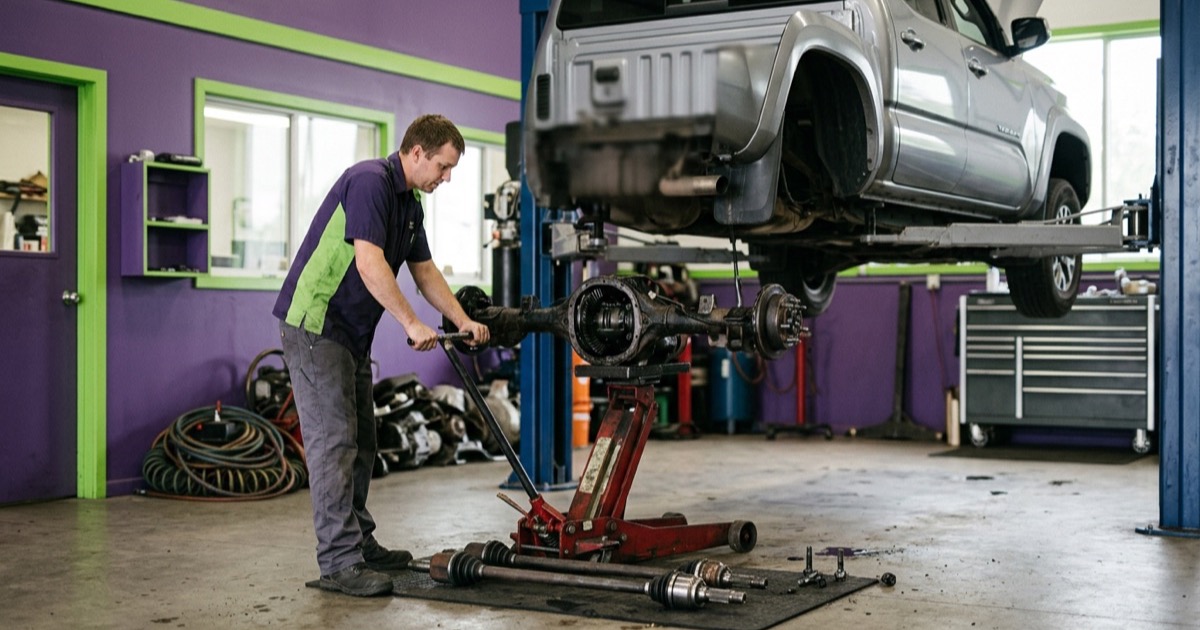
What the Job Is and What You Are Paying For
The rear differential sits in the round housing in the middle of your rear axle. The drive shaft spins a small gear called the pinion. The pinion turns a big ring gear. The ring gear spins the axle shafts that turn your wheels.
Inside there is also a set of small gears called spider gears. They let the outside wheel turn faster than the inside wheel when you turn a corner. Without them the tires would scrub and hop every time you turned.
When a shop says rear differential replacement, they can mean three different jobs. The first is replacing the ring and pinion and the bearings inside your housing. The second is swapping the whole center section, called a carrier or third member. The third is swapping the entire axle assembly, housing and all.
Which one makes sense depends on the vehicle and what failed. A truck with a solid axle often gets a gear and bearing rebuild. A car with an independent rear differential often gets a whole rebuilt unit bolted in.
Every version should include new gear oil, the right friction modifier if the differential is a limited slip, new seals where they were disturbed, and a test drive to listen for noise.
Why the Price Varies So Much
The type of part is the biggest factor. A used differential from a salvage yard can cost a few hundred dollars. A remanufactured unit with a warranty might cost $800 to $2,000. A new factory unit on a luxury car can top $3,000 on its own.
The layout matters next. A solid axle truck has the gears inside a housing you can open from the back. An independent rear differential bolts to a subframe and connects to two half shafts, so the whole unit comes out.
Gear work takes skill. Setting up a ring and pinion means measuring and shimming until the gear pattern is right. A shop that does this well charges for that skill, and it is worth paying for.
Limited slip and locking differentials cost more. They have clutches or a locker inside, and the parts and setup time both go up.
Then there is the shop. Dealers often only offer a new factory unit. Independent drivetrain shops can offer rebuilds and remanufactured parts. A mobile mechanic can sometimes swap a whole used axle or a bolt in unit, but gear setup belongs in a shop.
What Usually Gets Done at the Same Time
With the differential apart, some add ons save you money later. Others are not needed.
A new pinion seal and axle seals are worth it almost every time. They are cheap, and a leak that starts a month later can drain the new unit.
U-joints or CV joints on the drive shaft are worth checking. A worn joint can cause vibration that feels like a differential problem, and it is already easy to reach.
A new drive shaft is not needed unless it is bent, out of balance, or has joints that cannot be replaced.
Wheel bearings on a solid axle are worth a look. On many trucks the axle bearings ride in the same gear oil, and a failed bearing can send metal into the new gears.
Changing the gear ratio is an option for some truck owners who added bigger tires. It costs more, and your speedometer has to be recalibrated.
A full axle swap when only the gears are bad is often an upsell on trucks. On some independent rear differential cars it is the normal fix.
- Pinion seal and axle seals: do them now
- Fresh gear oil and limited slip additive if needed: required
- Drive shaft U-joints or CV joints: check them
- Axle wheel bearings on a solid axle: check them
- Gear ratio change: only if you changed tire size
- Whole axle swap when only gears are bad: ask why
Make Sure It Is Really the Differential
A lot of noises sound like a bad differential. Fixing the wrong part is expensive here, so diagnosis comes first.
The cheapest check is the gear oil. Low oil, oil that smells burnt, or oil with lots of metal in it all point at the differential. A shop can pull the fill plug and look in a few minutes.
Tire noise is the most common mix up. Cupped or uneven tires hum and whine and change with speed. Rotating the tires or driving on a different set can rule this out fast.
A bad wheel bearing also hums and changes with speed. Bearing noise usually gets louder when you turn one way and quieter the other way. Differential whine usually changes when you go from accelerating to coasting.
A worn U-joint or drive shaft causes vibration and clunks when you shift into gear. A loose or broken differential mount on some cars causes a clunk too.
A good shop will drive the car with you, put it on a lift, check for play in the pinion, look at the gear oil, and tell you which part is making the noise.
Questions to Ask Before You Approve the Quote
Differential quotes vary a lot from shop to shop. These questions help you compare them fairly.
- What did you find that points to the differential and not tires or wheel bearings?
- Are you rebuilding my gears, swapping the carrier, or replacing the whole axle?
- Is the part new, remanufactured, or used, and what is the warranty on it?
- Does my differential have a limited slip or locker, and is that included?
- Are new pinion and axle seals and the right gear oil included?
- Who sets up the gears, and do you check the gear pattern and backlash?
- Is there a break in period or a follow up fluid change I should know about?
- What is the labor warranty if a whine comes back?
Can a Mobile Mechanic Do It?
Partly. A mobile mechanic with a good floor jack and stands can swap a bolt in rear differential or a whole used axle on many trucks and SUVs. It is heavy work, and some will bring a helper.
They can also do the related jobs that often fix the real problem, like a pinion seal, a gear oil change, or U-joints.
Ring and pinion setup is shop work. It needs a press, special tools and a clean bench. Independent rear differentials on cars often need a lift to drop the subframe safely.
If you call a mobile tech, tell them the year, make, model and whether you have a used or rebuilt unit ready to go. That tells them if it is a driveway job.
How Long a New Differential Lasts
A properly set up differential with clean gear oil can last the life of the vehicle. Many go 200,000 miles or more.
The first few hundred miles matter. Many gear shops ask you to avoid towing and hard launches for the first 500 miles, then change the gear oil once. That gets rid of the fine metal from the new gears breaking in.
After that, change the gear oil on the schedule in your owner's manual. Towing and off road use call for shorter intervals.
Fix leaks fast. A wet pinion seal or axle seal can drain the oil slowly, and a dry differential fails quickly. A quick look under the truck at each oil change catches this early.
Signs you need this repair
- Whine or howl from the rear that rises and falls with speed
- Noise that changes when you go from accelerating to coasting
- Clunk from the rear when you shift into drive or reverse
- Grinding or rumbling in turns
- Vibration from the rear that gets worse with speed
- Gear oil leaking around the axle center or the pinion seal
- Rear wheels that hop or bind in tight turns
Cost by vehicle type
| Vehicle | Typical range | Notes |
|---|---|---|
| Compact / economy car | $965 to $3,220 | Most front drive compacts have no rear differential at all. The AWD versions have a small rear unit that is usually replaced as an assembly, often at the low end of the range. |
| Midsize sedan / small SUV | $1,085 to $3,640 | Rear drive and AWD midsize cars often use an independent rear differential that bolts to a subframe. A whole used or rebuilt unit is common, and labor runs toward the middle of the range. |
| Full-size truck / large SUV | $1,315 to $4,425 | Pickups and body on frame SUVs use a solid rear axle with a gear set inside. A shop can rebuild the gears and bearings, or swap in a whole used axle, and either choice is common. |
| Luxury / European | $1,650 to $5,570 | German rear drive cars use an independent rear differential, and new units from the factory are costly. Rebuilt units save money, and some models need coding or a fluid that only matches factory spec. |
| Hybrid | $1,195 to $4,005 | Many AWD hybrids drive the rear wheels with an electric motor and have no drive shaft. A rear drive unit problem on those cars is a different, often costlier, repair. |
| Electric vehicle | Electric cars have their differential built into the drive unit, so a failure there is a drive unit repair rather than a separate rear differential job. | |
| Diesel / heavy duty | $1,570 to $5,290 | Heavy duty trucks use large axles built for towing. Gear sets, bearings and fluid all cost more, and labor sits at the top of the range, but rebuilding is often smarter than replacing the whole axle. |
Ranges assume national-average labor rates ($95, $140/hr) and quality aftermarket parts.
Cost by state
State ranges reflect typical independent-shop labor rates for a midsize vehicle.
Common questions
How much does it cost to replace a rear differential?
Most drivers pay about $1,100 to $3,600 at an independent shop. A used or rebuilt unit on a common truck sits at the low end. A new unit on a luxury car or a heavy duty truck can cost more, and a dealer adds more again.
Can I drive with a bad rear differential?
Only a short distance, and only if the noise is mild. A differential that grinds, clunks or gets louder fast can lock up and stop the rear wheels. That can cause a crash, so get it checked before you drive far.
What does a bad differential sound like?
It usually sounds like a whine or a howl from the rear that rises with speed. Many bad differentials get louder when you accelerate and quieter when you coast, or the other way around. Grinding or clunking means it is getting worse.
Should I rebuild or replace my rear differential?
On solid axle trucks, rebuilding the gears and bearings is often cheaper and just as good if a skilled shop does it. On many cars with an independent rear differential, a remanufactured unit is the normal fix. A used unit is the cheapest choice but comes with unknown miles.
How long does a rear differential replacement take?
About three to six hours for most vehicles. Bolting in a complete unit is faster. A ring and pinion rebuild takes longer because the gears have to be set up and checked.
Can low gear oil ruin a differential?
Yes. The gears and bearings need oil to stay cool and keep from wearing. A slow leak that runs the oil low is one of the most common reasons differentials fail.
Is a rear differential worth fixing on an old truck?
Often, yes, because a used axle or a gear rebuild can cost far less than a new truck payment. Compare the repair to the truck's value and its other problems. If the frame and engine are solid, a differential job can give you many more years.
Related Repair Guides
More Drivetrain Repair Costs
Sources and further reading
Primary sources behind this page. Federal safety, emissions and consumer-protection references, worth reading before you authorize any repair.
- fueleconomy.gov: where the energy goes DOE and EPA explain how some engine power is lost in the drivetrain on the way to the wheels.
- fueleconomy.gov maintenance guide Why keeping up with routine maintenance, including fluids, protects your vehicle.
- ASE certified technicians Find shops with ASE certified drivetrain technicians before you approve a quote.
Need Work Done? Get a Free Quote.
Tell us what the car is doing. A local mechanic calls you back, most requests get a call back the same day. No fee, no obligation.