What the Job Is and What Is Included
The drive shaft spins at engine speed times the gear ratio, which on the highway can mean 3,000 RPM or more. At that speed, a tiny bend or a missing balance weight turns into a vibration you feel in the seat and the floor.
A drive shaft has a tube in the middle and a joint at each end. Most trucks use U-joints. Many cars use CV joints or rubber flex discs. Long shafts are split into two pieces with a center support bearing that bolts to the underbody.
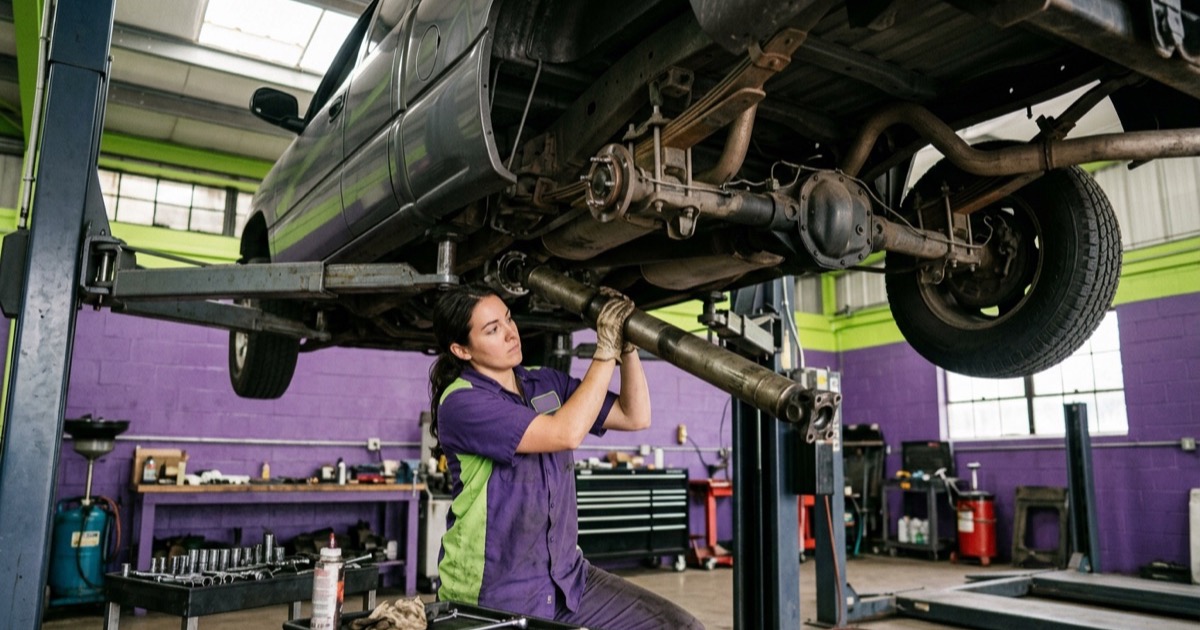
A replacement job means marking how the old shaft sits, unbolting it at the rear differential and the transmission or transfer case, and lowering it out. On two piece shafts the center bearing bracket comes off too. The new shaft goes in, every bolt gets torqued to spec, and the shop test drives to check for vibration.
The price includes the shaft, new bolts or straps where the factory calls for them, and the labor. A rebuilt shaft from a driveline shop is a common choice. It usually comes balanced and with new joints.
If only a joint is bad, the cheaper fix is often a new U-joint or center bearing on your old shaft. A good shop will tell you that.
Why the Price Varies
The type of shaft is the biggest factor. A one piece steel shaft for a common pickup might cost $250 to $450. A two piece shaft with a center bearing and CV joints for an AWD car can cost $600 to $900 aftermarket and much more from the factory.
Whether parts can be serviced matters next. Many truck shafts have U-joints you can replace. Many car shafts have sealed joints, so the whole shaft has to be replaced when one joint fails.
Access changes the labor. On a truck the shaft hangs out in the open. On a sedan or AWD SUV, the shaft runs up a tunnel with heat shields, exhaust and brackets in the way.
Custom work costs more. A lifted truck or a changed wheelbase may need a shaft cut to length and balanced at a driveline shop.
Then there is the shop. A dealer will usually sell a new factory shaft. An independent shop or a driveline specialist can offer rebuilt shafts and joint repairs. A mobile mechanic can handle the easy truck versions in a driveway for less.
What Usually Gets Done at the Same Time
Because the shaft is out, a few nearby parts are easy to check. Some are worth it. Some are not.
The transmission or transfer case output seal is worth checking. If it leaks, replace it while the shaft is off. It is a small part and the labor overlap is huge.
The pinion seal at the differential is worth a look for the same reason.
The center support bearing on a two piece shaft should be new if you are keeping the old shaft. A rebuilt shaft usually comes with one.
Flex discs, sometimes called guibos, on many European cars crack with age. If yours are cracked, do them now.
A full four wheel alignment is not needed for a drive shaft job. The shaft does not touch the steering or suspension settings.
Rebalancing the tires is not needed unless the vibration is also at the wheels. Some shops add it to every vibration job by habit.
- Transmission or transfer case output seal: replace if leaking
- Pinion seal at the differential: replace if leaking
- Center support bearing: new if reusing the old shaft
- Flex discs on European cars: replace if cracked
- Wheel alignment: not needed for this job
- Tire balancing: only if the wheels also test out of balance
Make Sure It Is Really the Drive Shaft
Vibration is the main sign of a bad drive shaft, and lots of things vibrate. A good diagnosis saves you money.
Tires and wheels cause most vibrations. A tire out of balance or with a shifted belt shakes at a set speed, often felt in the steering wheel. A drive shaft vibration is usually felt more in the seat and floor.
A worn U-joint is the most common drive shaft fault, and it is cheap to fix. A shop can grab the shaft and feel for play in the joints in a minute.
A bad center support bearing on a two piece shaft causes a vibration when you start from a stop and a rumble at speed. The rubber around the bearing tears with age.
Engine and transmission mounts that are broken let the drivetrain move and can cause clunks that seem to come from the shaft.
A worn differential or a bad wheel bearing makes noise that can feel like driveline vibration too.
A shop should check the joints, look for a dent or missing weight on the tube, check the mounts, and test drive the car before calling for a whole new shaft.
Questions to Ask Before You Approve the Quote
These questions tell you if you need a full shaft or a cheaper repair.
- What exactly is wrong with my drive shaft, the tube, a joint, or the center bearing?
- Can the U-joints or center bearing be replaced on my shaft instead of the whole thing?
- Is the new shaft new, rebuilt, or used, and is it balanced?
- Does the price include new bolts or straps where the factory calls for them?
- Did you check the output seal and pinion seal while the shaft is out?
- Will you mark and match the phasing so the new shaft does not vibrate?
- What happens if the vibration is still there after the new shaft goes in?
- What is the warranty on parts and labor?
Can a Mobile Mechanic Do It?
Yes, on many trucks and rear drive cars. A one piece truck shaft with bolt on straps is a driveway job for a mobile mechanic with jack stands and hand tools. Many mobile techs can also swap U-joints on the spot.
Two piece shafts on AWD cars are harder. Heat shields, exhaust and a center bearing all have to come off, and a lift makes it much easier.
Custom length shafts and balancing need a driveline shop. A mobile tech can still pull the old shaft and install the new one once it is built.
Tell the mechanic your year, make, model, drive type and whether the shaft is one piece or two. That tells them how long the job will take.
How to Make a Drive Shaft Last
A drive shaft can last the life of a vehicle if its joints stay healthy. Most failures start with a dry or worn joint.
If your U-joints have grease fittings, have them greased at oil changes. Many trucks with grease fittings get skipped, and the joints wear out early.
Keep an eye on the center bearing rubber and flex discs on older cars. Cracks are easy to spot on a lift.
If you lift a truck or change the wheelbase, get the drive shaft angles checked. Bad angles wear joints fast.
Pay attention to new vibrations and clunks. Catching a worn joint early costs a fraction of a whole new shaft.
Signs you need this repair
- Vibration felt in the floor or seat that grows with speed
- Clunk from under the car when shifting into drive or reverse
- Squeak from under the middle of the car at low speed
- Shudder when starting from a stop, often a center bearing
- Knocking or clicking that keeps time with the wheels
- Visible play in a U-joint or a drive shaft hanging lower than normal
- Loss of drive power with the engine still running
Cost by vehicle type
| Vehicle | Typical range | Notes |
|---|---|---|
| Compact / economy car | $310 to $1,115 | Front drive compacts have no drive shaft, only CV axles. AWD compacts have a two or three piece shaft with a center bearing, and many are sold only as a whole assembly. |
| Midsize sedan / small SUV | $345 to $1,250 | Rear drive and AWD midsize cars use a two piece shaft with a center support bearing and often rubber flex discs. Expect the middle of the range, and plan for heat shields and an exhaust section to come down. |
| Full-size truck / large SUV | $415 to $1,510 | Most pickups use a one piece or two piece steel or aluminum shaft with serviceable U-joints. Often the cheaper fix is new U-joints, and a full shaft is only needed if the tube is bent or out of balance. |
| Luxury / European | $525 to $1,895 | German cars often use a two piece shaft with a center bearing, a flex disc at the transmission, and CV joints. Many shafts are only sold whole, and factory parts can run well over $1,000. |
| Hybrid | $380 to $1,375 | AWD hybrids that drive the rear wheels with an electric motor have no drive shaft. Hybrids built on a rear drive or 4WD truck layout use a normal drive shaft. |
| Electric vehicle | Most electric cars put a motor at each driven axle and have only short half shafts, so there is no long drive shaft to replace. | |
| Diesel / heavy duty | $500 to $1,805 | Heavy duty trucks use thick, long shafts sized for towing torque. Parts cost more, and a custom length shaft from a driveline shop is common after a lift or wheelbase change. |
Ranges assume national-average labor rates ($95, $140/hr) and quality aftermarket parts.
Cost by state
State ranges reflect typical independent-shop labor rates for a midsize vehicle.
Common questions
How much does it cost to replace a drive shaft?
Most drivers pay about $350 to $1,250 at an independent shop. A one piece truck shaft sits at the low end. A two piece shaft for an AWD or luxury car sits at the high end, and a factory shaft from a dealer can cost more.
Can I drive with a bad drive shaft?
You should not drive far. A failing joint or center bearing can let the shaft break loose at speed, which can damage the vehicle and cause a crash. Get it checked as soon as you notice a new vibration or clunk.
What are the signs of a bad drive shaft?
The most common signs are vibration that grows with speed, a clunk when you shift into gear, and a squeak or knock from under the middle of the car. A shudder when starting from a stop often points to the center bearing.
Can I replace just the U-joint instead of the whole drive shaft?
Often, yes, on trucks and older rear drive cars with serviceable joints. A U-joint costs far less than a new shaft. Many cars use sealed joints, though, and those need the whole shaft.
How long does it take to replace a drive shaft?
About one to two and a half hours for most vehicles. A one piece truck shaft can take less than an hour. A two piece shaft on an AWD car with heat shields in the way takes longer.
Do front wheel drive cars have a drive shaft?
No, front wheel drive cars do not have a long drive shaft. They use two short CV axles from the transmission to the front wheels. People sometimes call those drive shafts, but the repair is a CV axle job.
Is a drive shaft worth fixing on an old car?
Yes, almost always, because the car cannot move without it. A used or rebuilt shaft keeps the cost down on an older vehicle. A joint or center bearing repair can cost even less.
Related Repair Guides
More Drivetrain Repair Costs
Sources and further reading
Primary sources behind this page. Federal safety, emissions and consumer-protection references, worth reading before you authorize any repair.
- fueleconomy.gov: where the energy goes DOE and EPA explain how power moves through the drivetrain and how some of it is lost on the way to the wheels.
- AFDC: how all electric cars work Department of Energy overview of the EV drivetrain, which is why most EVs have no long drive shaft.
- ASE certified technicians Find shops with ASE certified drivetrain technicians before you approve a quote.
Need Work Done? Get a Free Quote.
Tell us what the car is doing. A local mechanic calls you back, most requests get a call back the same day. No fee, no obligation.