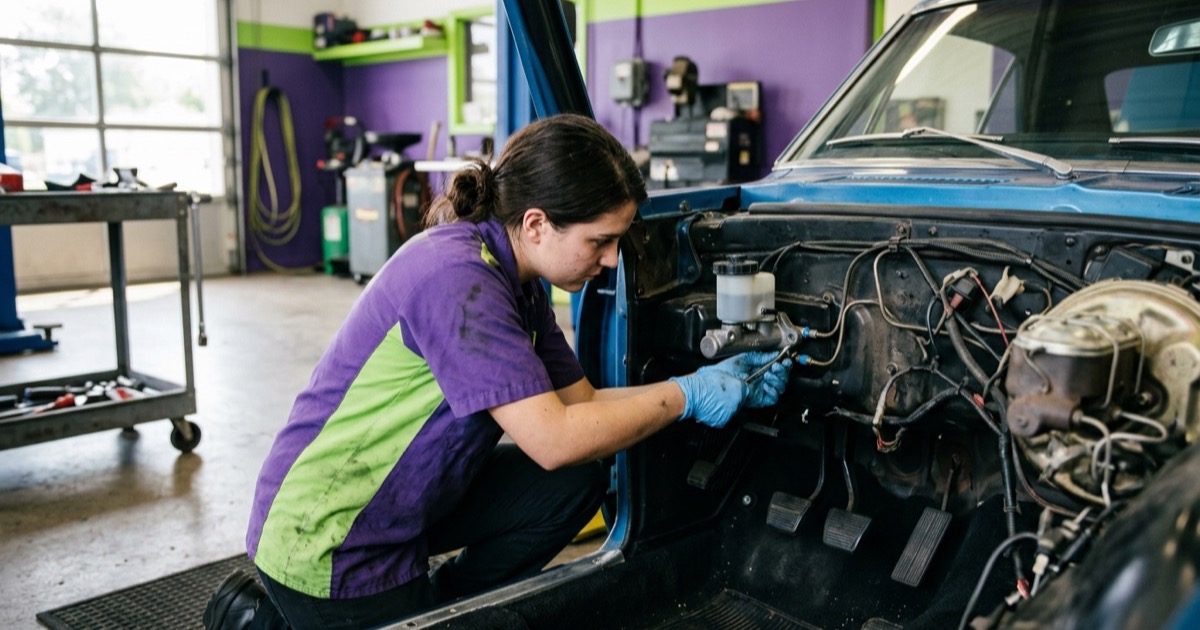
What the Job Is and What You Are Paying For
When you push the clutch pedal, a pushrod presses a piston inside the master cylinder. That pushes fluid down a line to the slave cylinder at the transmission. The slave pushes the clutch fork or a release bearing, which lets the clutch disengage.
The master cylinder has rubber seals inside. When they wear, fluid slips past them instead of building pressure. The pedal feels soft or sinks.
A clutch master cylinder replacement disconnects the fluid line and the pushrod, unbolts the old cylinder from the firewall, and installs the new one. Then the shop fills and bleeds the system so there is no air in the lines.
A proper job includes fresh fluid of the type your car calls for, a full bleed, and a test of pedal feel and clutch release. Most of the cost is labor. The part is usually under $150 for common cars. The national range on this page covers one master cylinder on a common manual car with a bleed.
Most clutch master cylinders fail slowly. The first sign is often a pedal that feels a little lower or softer on hot days, or a clutch that releases close to the floor. Some drivers learn to live with it until the day the pedal drops all the way and stays there.
Some cars share one fluid reservoir with the brakes. On those, a leaking clutch master can drop the level in the brake reservoir too. If your brake fluid is low and you drive a manual, the clutch side may be the leak.
Why the Price Varies So Much
Access is the biggest factor. Some cars have the master right on top of the firewall next to the brake master, a quick job. Others hide it under the dash behind the pedals, or need panels or the brake booster moved.
The second factor is bleeding. Some clutch systems bleed fast. Others trap air and take time, or need a pressure or vacuum bleeder. A few need the slave bled at the transmission from under the car.
The third factor is the part. Some cars sell the master alone. Others only sell it as a kit with the line and slave already filled. Kits cost more but can save labor.
The fourth is the shop. Dealers charge the most. Independent shops are usually cheaper. A mobile mechanic can do many clutch master jobs in a driveway, since the part is on the firewall. If the slave is inside the bell housing, though, that part of the job is not a driveway job.
What Usually Gets Done at the Same Time
The biggest question is whether to replace the slave cylinder too.
Worth it often is the slave cylinder if it is an external one that bolts to the outside of the transmission. The master and slave are the same age, and if one failed the other may soon. Doing both at once means one bleed.
Think twice on an internal slave, also called a concentric slave. It sits inside the bell housing with the clutch. Replacing it means pulling the transmission, which is a clutch job price. If the slave is not leaking, leave it, and plan to replace it with the next clutch.
Worth it every time is a full fluid flush. Old fluid holds water and wears seals.
Worth checking is the clutch line, especially rubber hoses that can swell.
Usually an upsell is a full clutch kit when the clutch does not slip or chatter.
- External slave cylinder: often worth doing together
- Internal slave cylinder: leave it unless leaking or doing a clutch
- Full fluid flush and bleed: always
- Clutch hose or line: replace if swollen or cracked
- Full clutch kit: only if the clutch slips or chatters
Make Sure It Is Really the Master Cylinder
A soft or sinking clutch pedal can come from three places: the master, the slave, or air in the line.
Check the fluid reservoir first. If it is low, there is a leak somewhere. Look under the dash for wet carpet or fluid on the pushrod. That points to the master. Fluid dripping at the bell housing or transmission points to the slave.
If the fluid level stays full but the pedal is soft, the master can be leaking inside past its seals. That leak does not show up on the floor.
Hard shifting with a firm pedal is often not hydraulic at all. It can be a worn clutch, a bad pilot bearing, or worn synchros.
A pedal that stays on the floor can be a broken return spring or a bad pedal assembly. A good shop checks all of these before replacing parts. Ask them to show you the leak or explain the test.
Questions to Ask Before You Approve the Quote
A clutch master quote is usually small. These questions keep it from growing.
- Is the problem the master, the slave, or both, and how did you test it?
- Is my slave cylinder external or inside the bell housing?
- Does the price include fluid and a full bleed?
- Is the part sold alone or only as a kit with the slave and line?
- What fluid type does my car use, and is it shared with the brakes?
- What happens to the price if the bleed takes longer?
- What is the warranty on parts and labor?
Can a Mobile Mechanic Do It?
Yes, on most cars. The master cylinder sits on the firewall, and a mobile mechanic can reach it with hand tools. Bleeding takes a helper or a bleeder tool, which most mobile techs carry.
If the slave cylinder is inside the bell housing and also needs replacing, that part is a shop job, because the transmission has to come out.
Tell the mechanic your year, make, model and whether your car has an internal or external slave when you call. A good mobile tech will tell you if it is a driveway job.
How to Make the New Master Last
Change the clutch fluid every few years. Most clutch systems use brake fluid, which absorbs water and wears seals. Many owners forget the clutch side because there is no service light for it.
Use only the fluid type your car calls for. The wrong fluid can swell seals and cause a new leak.
Do not rest your foot on the clutch pedal while driving. It wears the release bearing and puts stress on the hydraulics.
A new master cylinder with clean fluid can last 100,000 miles or more.
Signs you need this repair
- Clutch pedal feels soft or spongy
- Clutch pedal sinks to the floor and stays there
- Hard to shift or gears grind when the clutch is pushed in
- Low or dropping fluid in the clutch reservoir
- Fluid leaking under the dash near the pedals
- Clutch engages very close to the floor
- Dark or dirty fluid in the clutch reservoir
Cost by vehicle type
| Vehicle | Typical range | Notes |
|---|---|---|
| Compact / economy car | $145 to $535 | Most compact manual cars have the clutch master easy to reach on the driver side firewall. Parts often cost $50 to $120, and labor is about an hour plus bleeding. |
| Midsize sedan / small SUV | $155 to $570 | Midsize manual cars are similar to compacts. Some share a fluid reservoir with the brakes, which affects how the system is bled. |
| Full-size truck / large SUV | $180 to $660 | Manual trucks often have a master cylinder with a hard to reach top nut, and some come as a pre filled kit with the slave cylinder. Those kits cost more but save bleeding time. |
| Luxury / European | $220 to $805 | Many European manuals put the master behind pedals or panels, adding labor. Some need special bleeding steps or a pressure bleeder. |
| Hybrid | $170 to $625 | Very few hybrids have a manual transmission, so this job rarely applies. If yours does, the job is the same as a regular manual. |
| Electric vehicle | Electric cars have no clutch pedal and no clutch master cylinder, so this repair does not apply. | |
| Diesel / heavy duty | $215 to $785 | Manual diesel trucks use a heavier clutch and often a larger master cylinder. Parts cost more, and some trucks need the master and slave replaced together as a sealed kit. |
Ranges assume national-average labor rates ($95, $140/hr) and quality aftermarket parts.
Cost by state
State ranges reflect typical independent-shop labor rates for a midsize vehicle.
Common questions
How much does it cost to replace a clutch master cylinder?
Most manual cars land around $160 to $570 at an independent shop or mobile mechanic. Easy firewall mounted parts sit at the low end. Hard to reach masters, kits with the slave, or luxury cars cost more.
Can I drive with a bad clutch master cylinder?
You can for a short time if the pedal is only a little soft. If the pedal sinks or the car will not go into gear, stop driving. Forcing gears without a full clutch release damages the transmission.
Should I replace the clutch master and slave at the same time?
Often yes, if the slave is external and easy to reach. They are the same age and doing both means one bleed. If the slave is inside the bell housing, it is usually replaced with the next clutch job instead.
How long does a clutch master cylinder replacement take?
About one to two and a half hours on most cars. Easy firewall mounted parts take about an hour. Hard to reach parts or stubborn bleeding take longer.
What fluid goes in a clutch master cylinder?
Most cars use DOT 3 or DOT 4 brake fluid. Some European cars use a special fluid. Always check the cap on the reservoir or your owner manual before adding fluid.
Why does my clutch pedal stay on the floor?
A pedal that stays down is often a failed master or slave cylinder, or a big leak that let air into the system. It can also be a broken pedal return spring. Have the hydraulics checked first.
Is a clutch master cylinder worth fixing on an old car?
Almost always, yes. It is one of the cheaper drivetrain repairs and without it the car cannot be shifted. Even on a car worth $2,000, a $300 repair keeps it driving.
How much does a clutch master cylinder cost at a dealer?
Dealers usually charge more than an independent shop because of factory parts and a higher hourly rate. On a common manual car, expect a dealer to land toward the top of the range or above it, so get a second quote.
Related Repair Guides
More Drivetrain Repair Costs
Sources and further reading
Primary sources behind this page. Federal safety, emissions and consumer-protection references, worth reading before you authorize any repair.
- FMVSS 116 motor vehicle brake fluids The federal standard for DOT 3 and DOT 4 brake fluid, which most clutch hydraulics use.
- fueleconomy.gov maintenance guide DOE and EPA guidance on routine vehicle maintenance.
- ASE certified technicians Find shops with ASE certified manual drivetrain technicians before you approve a quote.
Need Work Done? Get a Free Quote.
Tell us what the car is doing. A local mechanic calls you back, most requests get a call back the same day. No fee, no obligation.