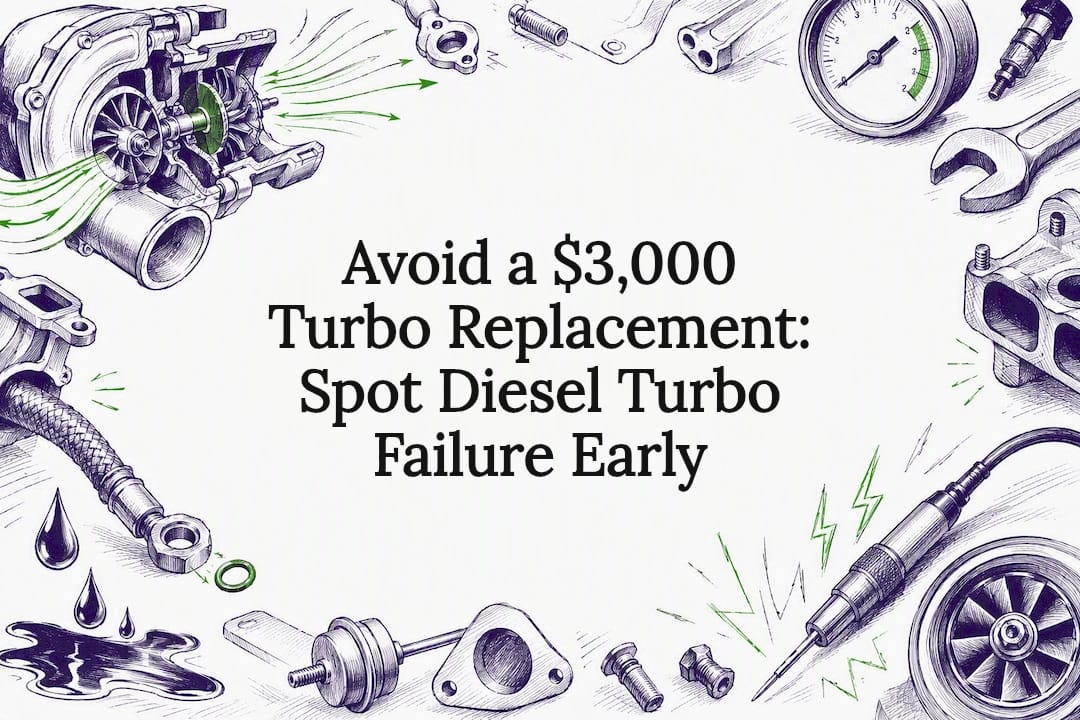
Avoid a $3,000 Turbo Replacement. Spot Diesel Turbo Failure Early
If your diesel is losing power, blowing blue or white smoke, or making a high pitched whine, the turbo is likely involved and you should stop hard driving and run a quick diagnostic check now. The most reliable diesel turbo failure symptoms are sustained power loss or turbo lag, unusual smoke color, whining or grinding noises, and rising oil use or oil showing up in the intake. Similar symptoms can also come from boost leaks, a clogged DPF, or a bad sensor, so a real diagnosis matters before anyone tells you to buy a new turbo.
The short version.
- Most diesel turbo failures are preventable and caused by oil starvation, contamination, debris, or DPF restrictions, not defective parts.
- Early signs such as increased oil use or decreased boost occur weeks before smoke or total failure, highlighting the importance of timely diagnosis.
- Diagnostic checks, spinning the compressor wheel, boost comparison, pressure testing, and oil line inspection, can identify real turbo issues without removal.
- Rapid, heavy blue smoke, metallic grinding noises, or sudden boost loss require immediate stopping and professional inspection to prevent engine damage.
- Correct diagnosis relies on systematic testing to rule out leaks, sensor faults, and feed line issues before considering turbo replacement.
Diesel Turbo Failure Symptoms Checklist. What Each One Means
Not every symptom points to the same problem, and knowing which one you have changes how urgently you need to act. Early signs like mild oil consumption or a slight dip in power often show up four to eight weeks before smoke or a full failure hits, according to early detection research from VFI Diesel. That window is your best chance to fix something cheap before it turns expensive.
Loss of power and turbo lag. A healthy turbo spools quickly and gives you a noticeable push once boost builds. When that push feels delayed or weak, especially under load or towing, the turbo may be struggling to build pressure. A gradual drop over weeks points to wear. A sudden drop points to something acute such as a boost leak or a stuck vane.
Exhaust smoke color. Smoke color tells you almost as much as a scan tool.
Unusual noises. A rising whine that changes pitch with engine speed usually means the compressor or turbine wheel has bearing wear or shaft play. A whistling sound often signals a boost leak somewhere in the intake tubing. Grinding or a metallic rattle almost always means physical contact between the wheel and its housing, which is a stop driving situation.
Oil consumption and oil in the intake. Check your intercooler piping and compressor inlet for oil residue. For fleet trucks, oil use above one quart per 1,000 highway miles is enough to justify an immediate seal inspection.
Boost related fault codes. Underboost codes are common but rarely mean "replace the turbo." They mean "go find out why boost is low," which could be a leak, a stuck VGT vane, or a bad sensor.
Secondary signs. Watch for climbing exhaust gas temperatures, a drop in fuel economy, or intermittent stalling under load. These rarely happen alone and usually confirm what the primary symptoms already told you.
- Blue smoke usually means oil is burning in the combustion chamber, often from worn turbo seals letting oil past the shaft.
- White smoke at startup that clears fast can be normal condensation, but persistent white smoke can mean oil or coolant is getting where it should not.
- Black smoke points to excess fuel or restricted airflow, which can mean the turbo is not producing enough boost to match fuel delivery.
How Do You Check a Turbo Without Removing It?
You do not need to pull the turbo to get real answers. A handful of checks, done in order, will tell you whether the problem is the turbo itself or something feeding it bad air, oil, or exhaust flow.
Pro Tip. Check the compressor inlet for oil pooling before you touch anything else. Oil sitting right at the inlet strongly suggests a seal problem or oil migration, and it takes thirty seconds to look.
- Spin the compressor wheel by hand. Pull the intake tube off the compressor inlet and spin the wheel. It should turn smoothly with no grinding, and shaft play should be minimal. Noticeable side to side movement or a scraping sound means bearing or shaft damage.
- Compare actual boost to desired boost. Hook up a boost gauge or use a scan tool to watch commanded versus actual boost. If actual boost reads more than 2 PSI below target, check for induction leaks before you even think about swapping the turbo. That single threshold saves a lot of people from an unneeded repair bill.
- Pressure test the charge air system. Pressurize the system between the compressor outlet and the intake manifold to 20 to 30 PSI and check for leaks with a soap solution or by listening closely. Heavy duty diagnostic procedures confirm that if the system holds pressure, the underboost problem is inside the turbo itself rather than a leak downstream, per heavy duty turbocharger diagnostic guidance.
- Check oil level and inspect the feed and return lines. Look for kinks, coking, or seepage. A restricted feed line starves the turbo of lubrication fast, and a partially blocked return line can push oil past the seals and into the intake, mimicking a worn turbo.
- Use a scan tool to command the VGT actuator. Watch commanded position against actual position while boost responds. This separates an actuator or wiring fault, which is a cheap fix, from actual mechanical wear on the turbine wheel, according to diesel truck diagnostic guidance. Mechanicrank's OBD II study guide covers how to read live data like this if you want to get comfortable with it yourself.
- Know when to stop and call a technician. If you hear metallic grinding, see heavy blue smoke, or lose boost suddenly, do not keep driving to "get a second opinion." Get the vehicle towed or inspected on site.
What Actually Causes Diesel Turbo Failure?
More than 90 percent of turbo failures trace back to preventable causes rather than a defective part, according to Garrett Motion's failure analysis. That statistic matters because it means most failures were avoidable with earlier attention.
Fixing the actual cause matters more than swapping parts. A shop that replaces a turbo without resolving a clogged DPF will likely see the new unit fail again shortly, based on independent technician analysis.
- Oil starvation. Caused by a blocked feed line, poor priming after an oil change, or simply running low on oil. Bearings can score within seconds of losing lubrication, which is why this cause produces the fastest, most catastrophic damage.
- Oil contamination. Dirty oil with metal or soot particles abrades bearing surfaces gradually. It tends to produce a sharp increase in noise before smoke or power loss ever shows up, which is why oil quality is such an early warning sign, per Garrett's findings.
- Foreign object damage. A cracked air filter or loose intake clamp lets debris reach the compressor wheel, chipping blades and throwing the assembly out of balance.
- DPF restriction and exhaust backpressure. A clogged diesel particulate filter forces backpressure on the turbine side. Backpressure above roughly 40 inches of water at rated power signals serious restriction and can degrade turbine seals over time, based on heavy duty diagnostic thresholds.
- VGT carbon fouling and actuator faults. Carbon buildup on variable geometry vanes can stick them in place, and a failing actuator can produce symptoms that look exactly like mechanical wear even when the turbine itself is fine.
What Should You Do Right Now?
Stop driving immediately if you hear metallic grinding, see heavy blue smoke, or notice a sudden total loss of boost. Continuing to drive on a shafting turbo can send metal debris downstream into the intercooler and engine, turning a turbo repair into an engine repair.
Mechanicrank's oil check guide walks through what to look for on the dipstick before you even call anyone.
- Record everything before you call a shop. Note any fault codes, actual versus desired boost readings, take photos of oil residue or smoke, and record the noise on your phone if you can.
- Follow a logical diagnostic order. Pressure test the charge air system first, inspect oil feed and return lines second, scan for codes third, then check DPF backpressure and VGT operation. This order rules out cheap causes before anyone commits to turbo replacement, consistent with systematic diagnostic guidance.
- Address the cause before or during the repair. That means correcting oil spec and change intervals, priming a new turbo properly before startup, fixing kinked return lines, and resolving DPF restriction so the fix actually holds.
What Should a Real Turbo Diagnosis Look Like?
A qualified diesel shop should pressure test your boost lines, check shaft play against a set limit, and pull codes with freeze frame data rather than guessing based on mileage alone. They should rule out oil feed problems, boost leaks, sensor faults, and DPF restriction before ever quoting turbo replacement, matching the diagnostic order heavy duty industry guides recommend.
Bring your recorded codes, boost readings, and photos. That documentation alone prevents a lot of unneeded turbo swaps.
Why Owners Get This Wrong
Most owners treat turbo symptoms like a coin flip, either it is fine or it needs a full replacement. That is backwards. The data on preventable failure causes tells a different story. The real skill is separating a five minute boost leak fix from a genuine mechanical failure, and most people never learn to do that because shops rarely walk them through it.
The conventional advice to "just replace the turbo" when boost drops ignores the 2 PSI rule entirely. A soapy hose clamp or a cracked intercooler pipe produces identical symptoms to a dying turbo, and one costs $40 to fix while the other costs $3,000. My take is that the pressure test and the boost comparison are the two checks every diesel owner should learn, because they take twenty minutes and they settle the argument before a shop ever touches a wrench. Do those first. Everything else follows from what they tell you.
Find a Diesel Turbo Specialist Near You
Mechanicrank connects you with diesel mechanics and mobile repair specialists who run these checks properly. You can get a real diagnosis faster than cold calling shops out of a phone book, and it costs you nothing to search. You get listings, ratings, and a map interface that shows which diesel and mobile mechanics work near you, without the guesswork of picking a name off a search results page.
Before you request service, gather your boost readings, any fault codes, and photos or a short video of the noise. That documentation helps a technician skip the guessing stage and go straight to testing. If you want to understand your engine systems better before that call, Mechanicrank's diesel and heavy duty study guide breaks down maintenance and diagnostics in plain language, and the oil change cost guide gives you a realistic price range so you know what a fair service quote looks like. When you are ready, search Mechanicrank for a diesel mechanic or mobile repair specialist and get a quote based on what your truck actually needs, not a guess.
Sources
The diagnostic thresholds and failure data cited here come from Garrett Motion's turbo failure analysis, the Heavy Duty Journal's turbocharger diagnosis guide, Diesel Power Products' no removal testing guide, and VFI Diesel's early detection guide. Actuator diagnosis concepts draw on general guidance from Haldex's solenoid valve diagnostic resources.
- Why do turbochargers fail? Garrett Motion
- Turbocharger Failure Diagnosis. Complete Heavy Duty Guide
- Can a clogged DPF damage a turbocharger?
- How to Tell If Your Turbo Is Starting to Fail. Diesel Truck Guide
- Diesel Turbocharger Failure Signs. Early Detection Guide
Can You Drive a Diesel With a Bad Turbo?
You can drive short distances with mild symptoms like slight power loss, but you should stop immediately if you hear grinding, see heavy blue smoke, or lose boost suddenly, since continued driving can send debris into the engine.
Can Turbo Failure Be Fixed, or Does It Always Need Replacement?
Many turbo symptoms trace back to fixable causes like boost leaks, sensor faults, or a clogged DPF rather than internal turbo damage, so a proper diagnosis often finds a repair cheaper than full replacement.
What Is the Average Lifespan of a Diesel Turbocharger?
Lifespan varies widely by maintenance habits and driving conditions, but turbos that receive regular oil changes and clean air filters routinely outlast those that do not, since most failures come from preventable causes rather than normal wear.
How Do You Test a Turbo Without Removing It?
Spin the compressor wheel to check for rubbing or shaft play, compare actual to desired boost with a scan tool, and pressure test the charge air system at 20 to 30 PSI to isolate leaks from true mechanical wear.
What Does a Whining Noise From the Turbo Mean?
A whine that changes pitch with engine speed usually points to bearing or shaft wear inside the turbo, while a whistling sound more often means a boost leak in the intake tubing rather than the turbo itself.
Keep reading
Own a shop or a mobile operation?
Your free Mechanicrank listing is one of the citations this article talks about. Claimed listings get an owner badge, a photo gallery, and a green star on the map.
Claim Your Free Listing →