What a Tire Rotation Includes
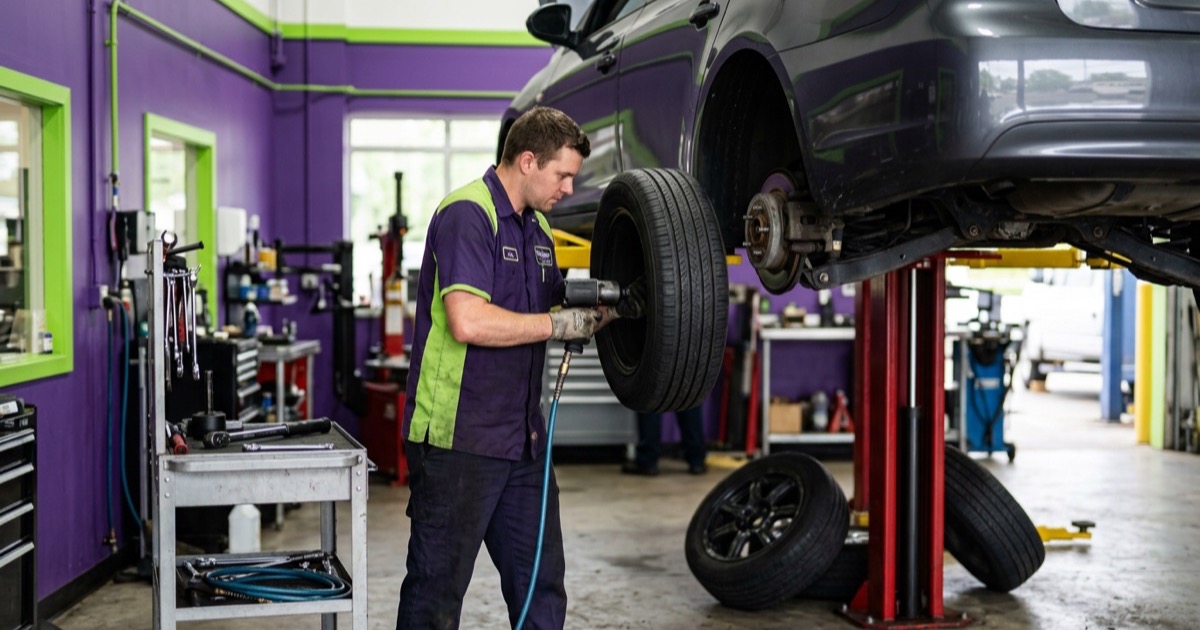
The job is simple. The car goes up on a lift or jack stands. All four wheels come off. Each one moves to a new corner based on a set pattern, then the lug nuts get torqued back to the factory number.
A good shop does a few more things while the wheels are off, and they should be part of the price. They set every tire to the pressure on the door jamb sticker. They look at the tread for odd wear. They glance at the brakes, since the pads and rotors are in plain view with the wheel off.
Some shops also balance the tires during a rotation, but that is a separate service with its own charge. Balancing is only needed if you feel a shake at highway speed. A rotation alone does not need it.
On cars with tire pressure sensors in the wheels, moving the tires can confuse the system about which sensor is where. Some cars sort it out on their own after a short drive. Others need a scan tool to relearn the sensor spots. Ask if that step is included.
- Lift the car and remove all wheels
- Move each tire to its new corner using the right pattern for your drivetrain and tire type
- Torque the lug nuts to spec in a star pattern with a torque wrench
- Set tire pressures to the door jamb sticker
- Check tread depth and note any uneven wear
- Quick look at brake pads, rotors and suspension parts with the wheels off
- Relearn the tire pressure sensors if your car needs it
Why Rotation Matters More Than People Think
Each corner of a car wears its tire in a different way. On a front-wheel-drive car, the front tires steer, brake hardest and put down all the power. They can wear twice as fast as the rears. Leave them there and the fronts are bald while the rears look almost new.
Rotation spreads that work around. All four tires reach the end of their life at about the same time, and you buy a full set once instead of pairs over and over. That also keeps the grip the same front to rear, which helps the car stay stable in a hard stop or on a wet road.
There is a warranty angle, too. Many tire tread life warranties require proof of regular rotation. If you skip it and the tires wear out early, the maker can deny the claim. Keep the receipts.
On all-wheel-drive cars, it goes further. Many AWD systems are built for four tires of nearly the same size. A worn pair spins at a slightly different speed than a fresh pair, and the center coupling or differential has to make up the gap all day. Your owner's manual will say how much tread difference your car allows.
Why the Price Varies
Most shops charge somewhere between $25 and $60 for a plain rotation. Quick lube chains and tire stores sit at the low end. Dealers often charge more but may bundle it with an oil change.
The biggest price cut is buying tires from a store that rotates them free. Many national tire chains do this for the life of the tires. Some warehouse clubs do the same. If you paid for that, use it.
Trucks cost a bit more. The wheels are heavy, the lug nuts are torqued high, and a five-tire rotation with the spare takes longer. Dually trucks with six tires take the longest.
Cars with locking lug nuts can add time if the key is missing or worn. Keep the key in the glovebox where the shop can find it. A missing key can turn a 20 minute job into a much longer one.
A mobile mechanic can rotate tires in your driveway with a floor jack and stands. It usually makes the most sense when they are already there for an oil change or brake job. A stand-alone mobile visit for just a rotation may cost more than a shop because of the trip charge.
Rotation Patterns and When Each One Fits
There is no single right pattern. The right one depends on which wheels drive the car and what kind of tires you have. A shop that uses the same pattern on every car is not doing the job right.
Front-wheel-drive cars usually get the rearward cross. The front tires move straight back. The rear tires cross to the opposite side as they move up front.
Rear-wheel-drive and four-wheel-drive vehicles usually get the forward cross. The rear tires move straight up to the front. The front tires cross over as they go to the back.
Directional tires have an arrow on the sidewall and are built to roll one way only. They stay on the same side and just swap front and back. Staggered setups with different sizes front and rear can only swap side to side, and only if the tires are not directional. Some cars with both cannot be rotated at all.
- Front-wheel drive: rearward cross
- Rear-wheel drive or 4x4: forward cross
- All-wheel drive: X pattern or forward cross, per the owner's manual
- Directional tires: front to back on the same side only
- Staggered sizes: side to side only, if not directional
- Full-size spare: five-tire pattern that includes the spare
What Usually Gets Done at the Same Time
A rotation lines up well with an oil change. Most people do both every 5,000 to 7,500 miles, and the car is already in the air. That is why many shops sell them together.
A brake check is the smart add-on, and it should be free. With the wheels off, the tech can see pad thickness and rotor condition in seconds. Ask for the numbers in millimeters, not just a thumbs-up.
Tire balancing is worth it only if you feel a steering wheel shake between about 55 and 70 mph, or if you just had new tires mounted. Otherwise it is often an upsell.
A wheel alignment is worth it if the tires show feathered edges, wear on one shoulder, or the car pulls. It is not needed just because you rotated. If the shop says every rotation needs an alignment, ask them to show you the wear that proves it.
Nitrogen fill is the classic upsell. Plain air is already about 78 percent nitrogen. Keeping your tires at the right pressure matters far more than what gas is inside.
Reading Your Tire Wear Before You Rotate
Look at your tires before the rotation, because the wear tells a story. Rotation evens out normal wear. It does not fix a problem that is causing bad wear.
Wear in the middle of the tread means too much air pressure. Wear on both outer edges means too little. Wear on just one edge usually points to an alignment problem, often toe or camber.
Cupping, which looks like scalloped dips around the tire, often points to worn shocks or struts or a wheel out of balance. Moving a cupped tire to a new corner will not fix it. It will just make noise somewhere else.
If the shop finds any of these, ask them to fix the cause or tell you the cause before they rotate. Otherwise, you are just spreading the damage to all four tires.
Use the penny test to check tread depth. Put a penny upside down in the tread. If you can see the top of Lincoln's head, you are at or near 2/32 of an inch, which is the legal minimum in most states. Many drivers replace tires closer to 4/32, since wet grip drops a lot as tread gets thin.
How to Avoid a Comeback
The biggest risk on a rotation is the lug nuts. Too loose and a wheel can work its way off. Too tight with an impact gun and you can warp a brake rotor, stretch a wheel stud or make the nuts almost impossible to get off on the side of the road.
A good shop runs the nuts down by hand or with a light setting, then finishes with a torque wrench to the number for your car. Most cars land between about 76 and 100 foot-pounds. Trucks run higher. Ask the shop if they used a torque wrench.
Re-check the lug nuts after the first 50 to 100 miles if the wheels are alloy or if the shop used an impact. It takes two minutes with a torque wrench.
Also check that the tire pressure light is off after a short drive. If it stays on, the sensors may need a relearn, or a sensor may have been damaged. Bring it back right away instead of ignoring the light.
Signs you need this repair
- Front tires worn much more than the rears on a front-wheel-drive car
- It has been more than 7,500 miles since the last rotation
- More road noise or a hum that grows with speed
- Car feels less sure on wet roads even though the tires are not that old
- Tread depth that differs by more than a few 32nds of an inch between front and rear
- Tire tread warranty paperwork asks for rotation records you do not have
- Uneven wear on all-wheel-drive tires
Cost by vehicle type
| Vehicle | Typical range | Notes |
|---|---|---|
| Compact / economy car | $30 to $60 | Front-wheel-drive compacts wear the front tires much faster than the rears, so rotation pays off well here. Most shops charge the low end of the range. |
| Midsize sedan / small SUV | $30 to $60 | A standard rotation on a lift takes about 20 minutes. Some sedans need a tire pressure sensor relearn afterward, which a good shop does without being asked. |
| Full-size truck / large SUV | $30 to $70 | Big wheels and high lug nut torque add a few minutes, and some shops charge a bit more for trucks. Many four-wheel-drive trucks also call for a five-tire rotation that brings in the full-size spare. |
| Luxury / European | $35 to $80 | Many performance models run wider tires on the rear than the front, so the tires cannot swap ends. Some also use directional tires that only move front to back on the same side. |
| Hybrid | $30 to $65 | Hybrids rotate the same way as the gas version of the car. Low-rolling-resistance tires on many hybrids wear evenly when rotated on time and badly when they are not. |
| Electric vehicle | $35 to $70 | EVs are heavy and put full torque to the pavement from a stop, so tires often wear faster than on a gas car. Many EV makers suggest a rotation every 5,000 to 7,500 miles. |
| Diesel / heavy duty | $35 to $80 | Heavy-duty trucks with single rear wheels rotate like a normal truck. Dually trucks with six tires need a different pattern and more time, so expect the top of the range or a little above. |
Ranges assume national-average labor rates ($95, $140/hr) and quality aftermarket parts.
Cost by state
State ranges reflect typical independent-shop labor rates for a midsize vehicle.
Common questions
How much does a tire rotation cost?
Most shops charge about $25 to $60 for a tire rotation. Many tire stores do it free for the life of tires you bought from them. Dealers often charge more but may bundle it with an oil change for a lower combined price.
How often should I rotate my tires?
Every 5,000 to 7,500 miles is the common rule, which lines up with most oil changes. Your owner's manual has the exact number for your car. EVs, AWD vehicles and performance cars may call for shorter intervals because they wear tires faster.
Is tire rotation really necessary?
Yes, if you want your tires to last as long as they should. Without it, the drive tires wear out far ahead of the others and you end up buying pairs more often. Many tire tread warranties also require proof of regular rotation.
Do I need an alignment after a tire rotation?
No, a rotation does not change your alignment. You only need an alignment if the car pulls, the steering wheel is off center, or the tires show wear on one edge. A shop that says every rotation needs an alignment should show you the wear that proves it.
Can I rotate my tires myself?
Yes, if you have a floor jack, jack stands and a torque wrench. Lift on the factory jack points, follow the right pattern for your drivetrain, and torque the lug nuts to spec in a star pattern. Never work under a car held up only by a jack.
Why is my tire pressure light on after a rotation?
Your car may need its tire pressure sensors relearned so it knows where each one moved. Some cars do this after a short drive. Others need a scan tool. A sensor can also get damaged during the job, so bring it back if the light stays on.
Does a tire rotation include balancing?
No, balancing is a separate service with its own price. You only need it if you feel a shake at highway speed or just had new tires mounted. Some shops bundle the two, so read the quote.
Related Repair Guides
More Maintenance Repair Costs
Sources and further reading
Primary sources behind this page. Federal safety, emissions and consumer-protection references, worth reading before you authorize any repair.
- 49 CFR 571.138: Tire Pressure Monitoring Systems The federal safety standard behind the tire pressure warning light that may need a relearn after a rotation.
- 49 CFR 571.139: New Pneumatic Radial Tires for Light Vehicles Federal standard for passenger car and light truck tires, including the treadwear indicators.
- fueleconomy.gov maintenance tips DOE and EPA guidance on tire pressure and maintenance that affects fuel economy.
- DOE Alternative Fuels Data Center: EV maintenance Federal overview of what maintenance electric vehicles still need, including tires.
Need Work Done? Get a Free Quote.
Tell us what the car is doing. A local mechanic calls you back, most requests get a call back the same day. No fee, no obligation.